Thursday, 10 January 2019

Blue Jays memories: 1983, Getting into the race, part two

It was the shot heard round the world for the Toronto Blue Jays. A home run that, as it turned out, signalled the beginning of a collapse that showed the Toronto Blue Jays were just not ready to win the American League East title.

Designated hitter Cliff Johnson of the
1983 Toronto Blue Jays provided
veteran leadership throughout the season.
Source: www.torontopubliclibrary.ca
(may be subject to copyright)
The saga of Lenn Sakata
The Jays hung around in the race for the American League East title, although as the season wore on, their weaknesses became more evident, especially the lack of relief pitching. The starters would give them good outings, and the offence would provide a lead, but the bullpen could not hold it.

Toronto started the month of August at 12-12, but were presented with a golden opportunity. They were going into Baltimore for a three-game set. The Orioles were tied for the division lead, 2.5 games up on the Jays. Oddly the two teams had the same number of wins, but the Orioles had three fewer losses. If the Jays won all three, they would move past Baltimore and likely into the lead.

What transpired was one of the weirdest series I have ever seen, filled with drama and its fair share of karma.

The series opened on Aug. 23 with the Jays sending Luis Leal, their third starter behind ace Dave Stieb and Jim Clancy, to face Mike Flanagan, the Orioles’ ace. That game was highlighted by Blue Jay Shortstop Alfredo Griffin making several great defensive plays. The game was nationally televised in the States, so the whole country got to see Griffin at his best for really the first time.

Leal would go the distance, pitching nine complete innings, allowing three runs, seven hits and striking out four as the Blue Jays won 9-3. The Jays chased Flanagan in the fourth, after scoring seven runs. To make matters worse for Baltimore they shot themselves in the foot, making five errors, including two each by second baseman Lenn Sakata and Flanagan.

Lenn Sakata of the 1983 Baltimore Orioles went
from goat to hero, and became the first in
a long line of Toronto Blue Jay killers.
Source: https://alchetron.com/Lenn-Sakata#-
(may be subject to copyright)
Everything would turn in the next game. It was on CTV’s Wednesday night Blue Jays Baseball, and I will never forget that night or that game. All the talk had been about how great Griffin had played, and what a goat Sakata had been.

Jim Clancy got the start in Game 2, on Aug. 24, and pitched a gem. There was no scoring until the third inning when the Jays got a run off Scott McGregor, only to have the Orioles tie it in the bottom half of the inning. Toronto went up 2-1 in the fifth then tacked on another run in the eighth to lead 3-1 with Baltimore having one last chance in the bottom of the ninth inning.

But the Jays could not hold the lead. The Orioles cashed in two runs to tie the game 3-3 and send it into extra innings.

Things still did not seem dire though. Designated hitter Cliff Johnson promptly it a solo home run to give the Jays a 4-3 lead. Things looked even better when the Jays got another base runner. The Orioles had brought in reliever Tippy Martinez who picked him off. Undeterred, the Jays got another base runner. Martinez picked him off too. Then, incredibly, Toronto put another man on base and Martinez picked him off too!

Years later my best friend of the time Chris Vining said that Martinez’s move was obviously a balk.

Still, the Jays had a one-run lead, three outs away from moving a step closer to first place.

Cal Ripken Junior stepped in and hit a solo homer to again tie the score. The fans were going crazy in Baltimore.

The Jays managed to get two outs and the Orioles put two men on.

So, who steps to the plate? Lenn Sakata, goat from the day before. Baltimore manager Joe Altobelli had had to make so many changes in his line up in his effort to tie the game, that he ran out of catchers. Sakata, had not caught since little league, and was pressed into action behind the plate in extra innings.

There is another theory about Martinez picking off all those base runners. Because the Jays were trying to take advantage of Sakata’s inexperience, they were leading too far off first base, making it easier for Martinez to pick them off. So, Sakata survived that inning behind the plate, and now had a chance to win the game with a base hit.

The Jays brought in Randy Moffitt, after their avowed closer Joey McLaughlin surrendered that home run to Ripken.

Sakata, who was not the best hitter, turned from goat to hero by hitting a three-run, walk-off home run.

Game over.

Roy Lee Jackson was a reliever
with the 1983 Toronto Blue Jays.
Source: www.baseball-reference.com
(may be subject to copyright)
The next night, the Jays concluded that series with a virtual repeat performance. Dave Stieb dueled Storm Davis to a scoreless draw after nine innings. In the top of the tenth, Barry Bonnell hit a solo home run to give Toronto a one-run lead. However, the bull pen blew it again. This time their other ace reliever, Roy Lee Jackson, surrendered two runs in the bottom of the inning, to give Baltimore a 2-1 victory.

The Jays had gone from the possibility of leading the division by half a game, had they won those two extra-inning games, to trailing Baltimore by 3.5 games.

The pattern repeated itself in their next series in Detroit. The Jays lost Game 1 in extra innings then won Game 2. The pivotal third game, if the Jays won, would move them closer to first place. They scored two in third and Detroit got one back in the fourth, to provide all the scoring going into the ninth, and Detroit’s last at-bat. Starter Luis Leal had turned in another quality start for Toronto, turning the lead over to the bull pen. McLaughlin was called in the ninth to nail down the victory.

Joey McLaughlin was a reliever
with the 1983 Toronto Blue Jays.
Source: www.baseball-reference.com
(may be subject to copyright)
This time, it was Chet Lemon who launched a three-run, walk-off home run into the seats to give the Tigers the win in the game and the series.

The Jays were now five games back, and in a bit of a tailspin.

End of the line
The Jays finished August with a 15-19 record, and with faint hopes of winning the division. They rebounded somewhat in September, going 16-10, but only made up one game in the standings. They closed out the season with two games to start October, winning one and losing one against Minnesota.

They finished the year 89-73. They had led the American League East at the all-star break. Although they faded and finished fourth behind the Orioles, it was by far the best record in their history.

Parting thoughts
That collapse in August had exposed the Jays’ biggest weakness – they needed relief pitching. It would be something they would try and address for the next few seasons, ultimately finding just the right combination.

Still, 1983 was a watershed year. The Blue Jays had gone from perennial doormat to contender, almost over night. This season would be the first of 11 straight winning seasons for the Blue Jays. The streak may have been longer, but was ended by a strike in 1994.

The late-season collapse also started a string of heartbreaks and disasters that would haunt the Jays until they finally exorcised their demons by winning the World Series in 1992.

The year also produced its share of moments. Centrefielder Lloyd Moseby was the player of the month for August, and would win a Silver Slugger Award at the end of the season. Dave Stieb had started and won the all-star game.

More than anything, the season created an energy and electricity around the team that would propel it for the next 11 years. The song “Let’s Play Ball” became a mantra for the team. Oddly, it alludes to a seagull, which was a strange coincidence. That year Dave Winfield, then playing for the New York Yankees, killed a seagull accidentally by a throw from the outfield. He was even charged, although the charges were dropped.

It just demonstrated there was a new interest and buzz about the team.

One other odd memory also illustrated the new found excitement around the team. I was watching the Canadian Open tennis tournament on CTV.

Billie-Jean King was doing the colour commentary. I think it was Fergie Olver who was the announcer, and he kept bringing updates from a Jays game going on in Boston. The Jays had trailed badly, but as the match wore on, they mounted a comeback. Olver said Billie-Jean King was going crazy in the booth, jumping up and down with excitement when the Jays took the lead and eventually won the game. Why? Because her brother Randy Moffitt played for the Jays as a relief pitcher.

It was a magical time, because the Jays were the ultimate underdog.


Even though they did not win in the end, they had come so far – and they had set the stage for things to come.

*This is from the vault

Wednesday, 9 January 2019

Blue Jays memories: 1983, Getting into the race, part one

The 1983 season was a wild ride for the Toronto Blue Jays, and the moment they turned the corner from league doormat, to contender. And it was so much fun to watch.
  
Bobby Cox was the manager of the 1983 Toronto Blue Jays.
Source: www.torontopubliclibrary.ca
(may be subject to copyright)
Low expectations
The Blue Jays really began to turn their franchise around in the last part of the 1982 season, winning 17 out their last 26 games. The arrival of manager Bobby Cox, coupled with general manager Pat Gillick’s shrewd acquisition of key players, as well as good prospects, allowed the team to blossom in 1983.

They seemed to do it with mirrors at times. Cox employed a strategy where he platooned players at several positions, starting a right-handed batter or left-handed batter depending on the pitcher they faced. Individually, their stats were not impressive, but added together they made a major contribution at the plate. So, Garth Iorg and Rance Mulliniks alternated at third base, while Ernie Whitt and Buck Martinez alternated behind the plate at catcher. They also platooned a number of outfielders depending on game situation.

Garth Iorg platooned at third base
with the 1983 Toronto Blue Jays.
Source: www.torontopubliclibrary.ca
(may be subject to copyright)
Rance Mulliniks platooned at third base
with the 1983 Toronto Blue Jays.
Source: www.bluebirdbanter.com
(may be subject to copyright)

They had no super stars in the field, aside from outfielder Dave Collins who had been a solid player for the Seattle Mariners, Cincinnati Reds, and New York Yankees before the Jays traded for him in 1983. He was largely regarded as their best player going into the season. They also had two young outfielders, Lloyd Moseby in centre and Jesse Barfield in right, who were solid. The infield was anchored by shortstop Alfredo Griffin, who had been American League rookie of the year in 1979, an award he shared with John Castino of the Minnesota Twins. Complementing Griffin up the middle was second baseman Damaso
Garcia who was a great hitter, and formed a potent double-play combination with Griffin. Willie Upshaw had cemented his position at first base, playing well with his bat and glove.
Ernie Whitt platooned at catcher with the
1983 Toronto Blue Jays.
Source: http://www.sportslogos.net/
(may be subject to copyright)
Buck Martinez platooned at catcher with the
1983 Toronto Blue Jays.
Source: www.torontopubliclibrary.ca
(may be subject to copyright)

The pitching staff was also a mixed bag, that became a microcosm of the team itself. Dave Stieb was the ace of the staff, having pitched five shut outs and 19 complete games the previous season to lead the American League. They had two other solid starters in Jim Clancy and Luis Leal, with Jim Gott, who had played some rookie league ball for the Calgary Cardinals of the Pioneer League, as a credible fourth starter. However, their bullpen was suspect. Closers Joey McLaughlin and Roy Lee Jackson could do the job, but they were by no means like the stoppers who
could be counted on to close a game every time they came out of the pen.
Alfredo Griffin was the shortstop for
the 1983 Toronto Blue Jays.
Source: www.torontopubliclibrary.ca
(may be subject to copyright)
Damaso Garcia played second base for
the 1983 Toronto Blue Jays.
Source: www.torontopubliclibrary.ca
(may be subject to copyright)

So, at the time, no one heard of most of these people and give them little chance of winning the American League East.

Surprise, surprise
Lloyd Moseby played centrefield for
the 1983 Toronto Blue Jays.
Source: www.pinterest.ca/pin/541276448960878675
(may be subject to copyright)
Jesse Barfield played rightfield for
the 1983 Toronto Blue Jays.
Source: www.torontopubliclibrary.ca
(may be subject to copyright)
The season started the same way so many others had before them. Although Stieb beat Red Sox ace Dennis Eckersley in Fenway Park in Boston on opening day, the Jays could not really put together any sort of winning streak, trading wins and losses, closing out the first month of the season with an 8-10 record. They were sixth in the American League East and 2.5 games out of first. Nothing special, or surprising.

Dave Stieb was the ace of the pitching
staff for the 1983 Toronto Blue Jays.
Source: sabr.org
(may be subject to copyright)
Jim Clancy was another one of the aces of
the 1983 Toronto Blue Jays' pitching staff.
Source: www.torontopubliclibrary.ca
(may be subject to copyright)
It all changed in May, as the Jays caught fire. They went 15-6 to start the month, moving into a tie for first on May 23 when Luis Leal beat Milt Wilcox and the Tigers at Exhibition Stadium in Toronto. It was the latest point in a season in franchise history that the Jays were in first place.

By the time the smoke had cleared, the Jays had gone 18-9 in May, to up their record to 26-19, and a one-game lead in the division. Moreover, Dave Stieb had been named pitcher of the month for May.

It was more of the same in June, as the Jays went 16-12, and doubled their division lead to two games with a 42-31 record.

They lost two of three to Seattle to start July, but had achieved something never before done in Blue Jays history. They led the American League East at the all-star break, with a one-game lead.

Adding to the excitement, Dave Stieb was named starter of the American League team at the all-star game at Comiskey Field in Chicago on July 6. He earned the win as the American League won 13-3, on the strength of a grand slam by Fred Lynn, the first and only grand slam in all-star history. Stieb struck out the side in the first inning too, fanning Andre Dawson, Dale Murphy and Mike Schmidt. It was also the first first of two straight years Stieb started the all-star game. Even though they were in first place, the Jays had no other players named to the all-star team. They were still a well-kept secret.


The Blue Jays would remain in first alone, or tied for first until July 25. They fell out of first on July 26, and were 2.5 games back by the end of July. Their record for the month was 15-12, and overall they were 57-43, still way further ahead than anyone predicted. Better yet, they were still in striking distance of first place.

*This is from the vault
Tuesday, 8 January 2019

Party like it's 1985: Remembering the 1985 Kansas City Royals, part two

Bret Saberhaen was one of the aces of the
Kansas City Royals pitching staff,
and the most valuable player of the 1985 World Series.
Source: sportsposterwarehouse.com/products
(may be subject to copyright)
When the Kansas City Royals made their improbable run to the 2014 World Series, then actually won it a year later in 2015, it brought back memories of 1985.

That was the last, and only time, the Royals had ever won the World Series, and it was a thriller.

Cross-state rivalry
After defeating the Toronto Blue Jays in the American League Championship Series, awaiting the Royals in only their second ever World Series was the St. Louis Cardinals, managed by Whitey Herzog. He had led the Royals to three straight division titles from 1976 to 1978. He was then hired by the Cardinals in 1980, and led them to a World Series championship in 1982. Both teams were from Missouri, also making this a cross-state rivalry.

The Cardinals seemingly took control early, winning the first two games, held at Royals Stadium. St. Louis took Game 1 on Oct. 19 by a 3-1 score, then beat the Royals 4-2 the next day to take a 2-0 series lead.

Kansas City won the first of three straight in St. Louis, by a score of 6-1 on Oct. 22. The Cardinals won the pivotal Game 4 by a score of 3-0, putting a stranglehold on the series on Oct. 23.

Kansas City rebounded in Game 5 on Oct. 24, winning 6-1, sending the series back to Kansas City for the last two games, if necessary.

The series would turn on Game 6. The Cardinals led 1-0 going into the bottom of the ninth. Jorge Orta was involved in a close play at first where he was called safe by First Base Umpire Don Denkinger. Replays showed Orta was clearly out. That base runner would eventually come around to score the tying run, then ALCS hero Jim Sundberg came around later to score the winning run. The Royals again had come from behind to force Game 7 the next night.

That win in Game 6 demoralized the Cardinals. Game 7 was held in Kansas City on the night of Oct. 27. The Cardinals did not even seem to show up, surrendering two runs in the second inning, three in the third and five in the sixth, as the Royals cruised to an 11-0 win in the game and 4-3 in the series.

Pitcher Bret Saberhagen was named World Series most valuable player for allowing one run in Game 3 and zero runs in Game 7, both wins for the Royals.

It had become cliché to say, but improbably the Kansas City Royals had come back from a 3-1 deficit to win the World Series.

Parting thoughts
When the Royals put the finishing touches on their 11-0 win in Game 7 of the World Series, it was the culmination of years of success for the Kansas City Royals.

They had come close in the 1970s, making it to three straight League Championship Series, then even closer in 1980 when they advanced to their first ever World Series. Yet that final victory kept eluding them.

They remained competitive. By 1985, they had already won another division title in 1984, and were back in the playoffs.

This time around though, something was different. In all those other years, they ran into superior teams who all but once went on to win the World Series. Now, they had re-tooled their pitching staff with young arms, and still got veteran leadership and strong play from veterans such as George Brett and Frank White.

It would be manager Dick Howser’s last year with the club, after four years, and they went out with a bang.

What made this team different was they never gave up. They faced six elimination games, the maximum a team could play in that era. They fought them all off, and won the championship.

It was an amazing October, and one to remember.

It would take the Royals exactly 30 years to win their next World Series. It really was time to party like it was 1985, not only to celebrate the 2015 championship, but to remember one of the best teams, and greatest playoff performances, of the 1980s.

*This is from the vault

Monday, 7 January 2019

Party like it's 1985: Remembering the 1985 Kansas City Royals, part one

George Brett was the leader of the Kansas City Royals,
and the most valuable player of the
1985 American League Championship season.
Source: http://ultimatebaseballlook.blogspot.com/2013/12/kansas-city-royals.html
(may be subject to copyright)
Party like it’s 1985. That was one of the themes as the Kansas City Royals made their improbable run to the 2014 World Series.

That’s because that was the last, and only time, the Royals had ever won the World Series, with two improbable playoff series comebacks.

It was a party in 1985, one that would not be repeated until 30 years later when, in 2015, the Royals finally won their second World Series.

Playoff consistency
From the 1970s right through to 1985, the Kansas City Royals had become the class of the American League West Division, winning six times in 10 years.

However, they had consistently run into strong teams from the American League East Division, and were only able to make it to one World Series, in 1980, when they lost in six games to Pete Rose and the Philadelphia Phillies.

Their most recent playoff appearance was in 1984, when they won the American League West with a record of 84 wins and 78 losses, but ran into the Detroit Tigers, who not only would win the World Series, but may have been one of the best teams in history. The Tigers swept the Royals in the best-of-five American League Championship Series, in the last year before it was expanded to a best-of-seven affair.

As 1985 dawned, the Royals had fortified their pitching rotation with several young prospects with lively arms. I recall watching the Royals play my beloved Toronto Blue Jays. Announcer Tony Kubek told us all to watch out for these guys, some with strange names, like Bret Saberhagen, Mark Gubicza, and Danny Jackson.

He would turn out to be a baseball prophet.

The Royals were still led by all-star third baseman George Brett, second baseman Frank White, outfielder and speedy lead-off man Willie Wilson and a strong pitching staff led by Saberhagen, who would go on to win the Cy Young Award, Charlie Leibrandt, and ace reliever, sidearmer Dan Quisenberry.

They would better their record to 91-71 on their way to the American League West crown and a date with the Toronto Blue Jays in the American League Championship Series, newly expanded to a best-of-seven.

Championship series comeback
The series opened at Exhibition Stadium in Toronto for the first two games. The Blue Jays won Game 1 by a score by 6-1 on Oct. 8, then outlasted the Royals in 10 innings on Oct. 9 by a score of 6-5. The Jays seemingly had control with a 2-0 lead going to Kansas City.

The Royals rebounded to win Game 3 two days later by that same 6-5 score, but Toronto responded on Oct. 12 with a 3-1 win and a 3-1 stranglehold on the series.

The series was a 2-3-2, so Game 4 was in Kansas City then the final two games, if necessary, would be back in Toronto.

Well, the Royals kept their season alive, winning Game 5 by a score of 2-0, at the very least saving face in front of their home fans. Lefty Danny Jackson got the win, beating Toronto’s ace lefty Jimmy Key.

The series returned to Toronto two days later, on Oct. 15, for Game 6. This time Gubicza beat another Toronto ace, Doyle Alexander, by a score of 5-3.

The noose was tightening now, as the teams would play one game to decide everything.

The pivotal Game 7 was held Oct. 16 and it would be the next in a series of Blue Jay heartbreaks that would not end until 1992.

The Royals scored once in the second and once in the fourth before the Jays got a run back in the bottom of the fifth to trail 2-1 after five complete.

Then disaster struck for the Blue Jays. The Royals loaded the bases, bringing up catcher Jim Sundberg. Jay Manager Bobby Cox left starter Dave Stieb in one batter too many, as Sundberg hit a long fly ball that bounced off the top of the fence. By the time the Jays got the ball back into the infield, Sundberg had a three-run triple, and a 5-1 lead. He would eventually score, giving the Royals a  6-1 lead.

The Royal pitchers took over, shutting out the Jays’ batters in the sixth, seventh and eighth innings. With their last at bat in the bottom of the ninth inning, Toronto put two runners on, managing to get one run back, but that was it.

Improbably, the Royals had come back in the series from 3-1 down, to win in seven games with the 6-2 victory.

Wikipedia says it was the first time a team had come back from down 3-1 in a League Championship Series, which is true but misleading. This was the first year the series was expanded to seven games. Had it still been a best-of-five, the Jays would have won.

George Brett was named the series most valuable player, who went eight-for-23 with two doubles, three home runs, five runs batted in, seven walks and a .348 batting average. He also scored six runs.

Parting thoughts
Would the Royals be able to sustain that momentum in the World Series? Stay tuned.


*This is from the vault

Sunday, 6 January 2019

Requiem for Sears

A photo of the Simpson-Sears store located in Park Place Mall in Lethbridge in
October of 2017,  just after the announcement the Sears stores would be closing.
Source: Photo taken by Rob Vogt
I happened to be at my Mom’s when I heard the news Simpson Sears was closing for good.

It made me think about how much a part of life, and how many memories, are tied up in Sears and stores like it.

Hanging on my Mom’s living room wall is a picture of a young, blonde blue-eyed boy with a mushroom-shaped head – taken at Sears when I was four.

I went into my garage and saw my very first ghetto blaster sitting on a pile of old junk. It was a Christmas present from my parents – purchased at Sears.

That reminded me of all those Christmases we anxiously waited for the Sears Christmas catalogue to see what the latest toys and games were, and got our requests in early.

I remember sitting on Santa’s lap at Sears every Christmas and telling him exactly what I wanted. He always seemed to come through too.

There was the Sears coffee shop, where my mom and I would talk for hours.

Even the last few years, I bought a wedding gift for some dear friends here in Claresholm. Why? They were registered at Sears.

Wasn’t everybody?

Not anymore, and Sears’ inability to change with times, along with poor business leadership, led to its demise.

Parting thoughts
We are all poorer for the loss of Sears, because it is more than a store, it is an institution. Anyone of a certain age has memories of Sears. Shared memories are what bind us together as a community and a society.

When we lose that, and there is nothing to replace it, we lose a bit of ourselves. Still, I do have fond memories of Sears, and for that I am grateful.

*This is from the vault, and was first published in the Claresholm Local Press

Saturday, 5 January 2019

Achieving greatness: Villanova’s first championship, part two

It was a magical March in 1985 when Villanova became the lowest-ranked team to win the national championship – and they engineered one of the greatest upsets in history to do it.

After upsetting the first and second seeds to win their regional tournament, the Wildcats were peaking at the right time.

National semi-final
The Wildcats went to Lexington with some familiar faces. Both Georgetown and St. John’s, who finished ahead of Villanova in the regular season, had won the East and West Regions respectively. It was the first, and only, time in history three teams from the same conference were in the Final Four.

The only outsider was number-two ranked Memphis State, who upset the top-seeded Oklahoma Sooners by two in the Midwest Regional Final. They would be Villanova’s opponent in the national semi-final. If the Wildcats won, they would have intimate knowledge of their opponent, whoever it was.

The teams met on March 30, going back and forth, and were tied 23-23 at halftime, before Villanova took control in the second half, going on to a 52-45 victory. Dwayne McClain led the Wildcats with 19 points; Ed Pinckney had 12 points; Gary Mclain had nine points; Harold Jensen had six points; and Harold Pressley and Mark Plansky had three points each.

Meanwhile, Georgetown and St. John’s locked horns, for the fourth time that season, in the other national semi-final. The Hoyas had a 32-28 lead at halftime, but they broke the game open in the second half, outscoring the Redmen by 14 to win the game by a comfortable score of 77-59.

The Wildcats would meet the Hoyas for the national championship in two days time.

Dwayne McClain of the 1985 Villanova Wildcats
jumps on the ball as time runs out and his team wins
the national championship of college basketball.

Source: Associated Press
(may be subject to copyright)
Massimino’s Masterpiece
Villanova Coach Rollie Massimino told his players two things before they took the court at Rupp Arena, according to the Christian Science Monitor. They should play to win, not play to lose. And, in a one-game showdown, anything is possible. They were as good as any team in America.

It did not matter that they had lost twice to the Hoyas already, nor that Georgetown was 32-2 while Villanova had lost 10 games and was never ranked higher than 14th all year. Or that Georgetown held their opponents to 39 per cent shooting.

He had them believing.

Georgetown was a team not just built on skill and execution. They intimidated their opponents, and set out to to do just that against Villanova. According to the Philadelphia Inquirer, Reggie Williams gave Wildcat Chuck Everson a forearm shiver, then Hoya Horace Broadnax walloped Pressley where the sun don’t shine. Meanwhile, Pinckney was battling a virus, and threw up just before halftime.

Intimidation looked as if it was working when Reggie Williams got the Hoyas out to a 20-14 lead. Massimino challenged Pressley, the Wildcats’ best defender to get to work. He in turn shut down Williams. Then, Patrick Ewing who may still be the greatest centre in college basketball history, had three straight dunks, which often triggered runs that buried opponents.

Not Villanova.

Instead, Pinckney went straight at Ewing, drawing a foul and completing a vital three-point play to give the ‘cats a 34-30 lead.

Perhaps the most inspiring performance, beyond Pinckney who would be named the most outstanding player, was that of Harold Jensen. He had been a reserve much of the year, playing a large part of it with a broken thumb, and battling his own self-image.

He told Massimino that he felt like he was letting him down. The coach disagreed, and told him to shoot more. Jensen took that to heart. With just under three minutes to play in the game, Jensen tried to get the ball inside to Pinckney.

But instead, with his coach's words ringing in his ears, Jensen found himself open on the right wing and put up a shot. It went in, his fifth straight shot, with 2:36 to play, giving Villanova the lead they would not relinquish. Jensen shot 100 per cent that game, as did Gary Mclain.

The Hoyas fouled to stop the clock, sending Jensen and Dwayne McClain to the foul line for a succession of one-and-one foul shots. They had to make the first one to attempt the second – and they did.

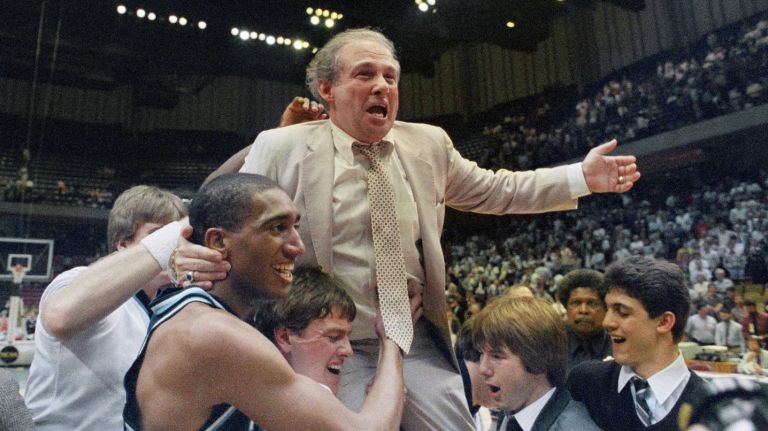
Rollie Massimino, coach of the 1985 Villanova Wildcats celebrates after
his team wins the national championship of college basketball.

Source: Associated Press
(may be subject to copyright)
With time waning, Jensen threw the ball in to McClain who fell to the floor, smothering the ball as time expired, in one of the most iconic moments of that game.

The Wildcats had felled the giant, with a 66-64 win.

Villanova had engineered the upset by playing smart, being patient, and defending very well. They attempted less than 30 shots, shooting 72.2 per cent in the first half, and 90 per cent in the second half, hitting nine of 10 field goals. They went a game total of 22 of 28 from the field and 22 of 27 from the free-throw line. Meanwhile, Georgetown had shot 54.7 per cent.

Moreover, the Villanova starting five came to play, relied on heavily by Massimino. In fact, they had scoring from all five starters and no one else, with four hitting double digits. Dwayne McClain had 17 points; Pinckney had 16 points; Jensen had 14 points; Pressley had 11 points; and Gary Mclain had eight points. McClain, Mclain, and Pressley each played all 40 minutes of the game, while Pinckney played 37 minutes and Jensen played 34. They had truly left everything out on the floor.

It quite literally, was a masterpiece.

Interestingly, according to the Christian Science Monitor, Mclain, McClain, and Pinckney had all met in high school at a summer basketball camp. Pinckney said the others kept saying they would all do something special together.

“I believed them,” he said.

No truer words were spoken.

Parting thoughts
When Villanova won their 2016 championship, one thing I kept noticing, was how the announcers kept flashing to Rollie Massimino in the stands. It was amazing to see his reaction when the Wildcats sank the winning shot.

After all, he was the coach who engineered what many consider the greatest upset in college basketball history. In what has been called “The Perfect Game”, Massimino’s Villanova Wildcats shocked the world, and the defending national champion Georgetown Hoyas, to win the title.

It turned out Massimino was dying of cancer in that 2016 championship game. It was awesome that he was able to celebrate with current coach Jay Wright, who had apprenticed under Massimino.

After he died in 2017, his players from that 1985 team shared their experiences. According to ESPN, Pinckney said Massimino was a, “life coach not just a basketball coach.”

Three other players from that team – Everson, Pressley and Brian Harrington – went to see Massimino in the hospital right before his passing. They told him they loved him, and he told them he loved them.

It just illustrated what Massimino had tried to foster throughout his time at Villanova – a sense of family. They were more than just players, they were students and people. He would wake them up before dawn for study hall. He was also proud of the 100 per cent graduation rate his players had.

Dwayne McClain told the Christian Science Monitor the players were family. He described Massimino as a brother, friend, a father, a boss, and a coach.

That was Massimino’s actual masterpiece – making better people, not just better basketball players.


That was the real championship.

*This is from the vault

Friday, 4 January 2019

Achieving greatness: Villanova’s first championship, part one

The 1985 Villanova Wildcats
Source: http://www.phillyhall.org/champions_basketball.html
(may be subject to copyright)
It was a different game and a different time, but it was another amazing run for Villanova to the national collegiate basketball championship three years ago in 2016, and again to this past year’s championship in 2018.

It reminded me of that magical March of 1985 when Villanova became the lowest-ranked team to win the national championship – and they engineered one of the greatest upsets in history to do it.

Fast start
The Wildcats started fast in the fall of 1984 with eight straight wins over non-conference opponents before suffering their first defeat, at the hands of the Georgia Bulldogs.

Then their conference scheduled started, and the big boys of the Big East loomed on the horizon.

Conference chaos
The Big East of the 1980s was just loaded with great teams. Villanova won their first two games, against Syracuse and Connecticut, to push their record to 10-1.

That streak ended at Madison Square Garden in New York, where they lost to the St. John’s Redmen on Jan. 7. Five days later, they hosted the Georgetown Hoyas at the Spectrum in Philadelphia, but Georgetown won that game 52-50.

The Wildcats would rebound to win their next three, over Boston College, Seton Hall, and Providence, to up their record to 13-3, before dropping an out-of-conference game at Maryland on Jan. 27.

They returned to the Big East, where they beat Pittsburgh, lost at Syracuse, and beat Connecticut before dropping three straight to St. John’s, at Georgetown and at Boston College.

They re-grouped again, beating non-conference St. Joseph’s at the Spectrum on Feb. 19, then winning at Providence and beating Seton Hall at the Villanova Field House.

The Wildcats rounded out their regular season with an 85-62 blowout loss at Pittsburgh, to finish the season unranked, with an 18-9 record, and 9-7 in the Big East Conference.

Conference tournament
Villanova finished fourth in the Big East, behind St. John’s who was 15-1, Georgetown who was 14-2, and Syracuse who was also 9-7 but owned the tiebreaker.

The Wildcats opened the tournament in Madison Square Garden on March 7 against Pittsburgh, who the Wildcats beat by a score of 69-61. That set up a semi-final with the number-one ranked St. John’s Redmen the next day. Playing in front of a home crowd, the Redmen defeated Villanova soundly by a score of  89-74, before losing the tournament championship 92-82 to Georgetown.

That set the stage for one of the most memorable runs in NCAA championship tournament history.

Road to the Final Four
The tournament was expanded to 64 teams in 1985, and Villanova was seeded eighth in the Southeast Regional.

Their first opponent was the Dayton Flyers who were playing in front of their home crowd at the University of Dayton Arena. The teams went back and forth, with Dayton leading 23-21 at halftime, before Villanova escaped with a 51-49 victory. Scoring for the Wildcats were Ed Pinckney with 20 points; Dwayne McClain with 11 points; Harold Jensen and Harold Pressley with eight points each; and Gary Mclain and Dwight Wilbur with two points each.

Awaiting the Wildcats in their regional second round game was the number-one seeded Michigan Wolverines. Villanova jumped out to a 30-26 halftime lead, and held Michigan at bay to win by a final score of 59-55. Dwayne McClain led the way with 20 points; Pinckney had 14 points; Gary Mclain and Pressley each had nine points; reserve Mark Plansky had four points off the bench; and Jensen had three points. Roy Tarpley, who was one of my favourite players of the ‘80s, even through drug suspensions, led the Wolverines with 14 points.

With that win, the Wildcats advanced to the Sweet Sixteen in Birmingham, Alabama where they had a date with the fifth-ranked Maryland Terrapins, who Villanova had lost 77-74 to on Jan. 27. This time the Wildcats won by three, 46-43, after falling behind 20-19 at halftime. Pinckney led the way with 16 points; Dwayne McClain had 12 points; Pressley had seven points; Wilbur had four points; Plansky added four off the bench; and Gary Mclain had three points.

Now, they were on their way to the Elite Eight, just one step from the Final Four in Lexington, Kentucky. Standing in their way in the Southeast Regional Finals, were the second-ranked North Carolina Tar Heels.

The teams met on March 24 , where the Wildcats fell behind 22-17 at halftime. They rallied in the second half, outscoring Carolina 39-22 to continue their meteoric rise, defeating the Heels by a score of 56-44. Pressley led the way with 15 points, Gary Mclain and Dwayne McClain had 11 points each, Pinckney had nine points, and Jensen had 10 points off the bench.


Having now dispatched the first and second seeds, the Wildcats were peaking at the right time.

*This is from the vault