It’s the end of Mork and Mindy as we know it…I feel fine.
The recent death of Jonathan Winters reminded me of an old lesson in life: don’t mess with a good thing, especially good comedy television.
Back in 1978 Robin Williams guest starred on Happy Days as an alien named Mork from the planet Ork. It was a dream episode, but proved so popular they gave the up-and-coming comedian his own series featuring an alien trying to find his way on Earth.
The creators set “Mork and Mindy” in Boulder, Colorado where twenty-something and single Mindy McConnell, played by Pam Dawber, discovers this lost alien named Mork. As can only happen in sitcom fashion, she takes him home to live in her attic. He moves through his days exploring, and ends each episode by sending reports to his superior named Orson, who we never see but who Mork is constantly making fat jokes about.
Robin William, Pam Dawber, and Jonathan Winters as Mork, Mindy, and Mearth.
The first season of “Mork and Mindy” aired on CBC on Saturdays in the late afternoon, at 5:30 p.m. It was one of the many odd scheduling choices that only occurred on peasant vision. It was pre-empted by playoff hockey and, at times, difficult to find. In subsequent seasons it moved to a more standard weeknight slot, Thursdays I believe.
The first season was excellent. There were not that many episodes, as it was a midseason replacement, but they all made me laugh. The next season saw some changes, including the departure of characters such as Mindy’s dad. New characters were added, including a brother and sister who owned a nearby sandwich shop or deli that Mork and Mindy visited. The third season saw more tinkering with the return of Mindy’s dad.
Disaster struck in the fourth and, thankfully, final season (1981-1982) where the sublime became the ridiculous. Mork and Mindy married and, get ready for this, Mork got pregnant. We discover the natives of Ork, unlike humans, start old and get younger as they age. Mork lays an egg, which is fitting, because so did the show. And he arrived on Earth in an egg-shaped spacecraft. Who should come out as the love child of Mork and Mindy? Who else but Jonathan Winters. I cannot make this stuff up. It gets better. They name the “child” Mearth, a tribute to his new world and his parents.
Robin Williams had already begun making movies and was growing too big for the show. It was living on fumes anyway. Adding Winters was a last gasp attempt to give oxygen to a dying show. It didn’t work.
The show, as I recall, ended with Mork, Mindy, and Mearth being pursued through time by a killer from an enemy planet of Ork’s, played by Joe Regalbuto. They escaped to live on in one more episode to end the season. Mercifully, the show was cancelled in 1982 after four seasons and 95 episodes.
In the end, Mork and Mindy was a show that started off as a hit and really was spoiled by too many cooks in the kitchen. It is unfortunate that I was too young to have seen the comic genius of Jonathan Winters before that. Instead, I am left with an impression of an old man playing a child on a spent sitcom. An actor brought in to save a show beyond repair.
Jonathan Winters would re-surface in the early 1990s as the elder Gunny Davis in the sitcom Davis Rules, co-starring with Randy Quaid. Winters would go on to win an Emmy award for the role in 1991 as best supporting actor. A bit of redemption in the world of the situation comedy.
I'm not sure what it was. The name, the hair, the electrifying play on the field. Whatever it was, there was no football player in the 1980s I liked more than the one and only Julius Caesar "J.C." Watts. Not only would he wow and thrill fans in college, but he came to the Canadian Football League and almost engineered one of the greatest upsets in Grey Cup history. To top it off, he returned home and became the first African-American Congressmen in the Republican party elected in Oklahoma. Athlete, leader, role model. There was only one J.C. Watts.
Quarterback to leader
J.C. Watts came to my attention in the 1980 Orange Bowl. The team was led by Billy Sims, one of the greatest runningbacks in college history. He had won the Heisman Trophy the year before as a junior, and could have won it again that year, but Charles White of the USC Trojans had an even better year. Still, Sims rushed for 1,506 yards and was the runner-up for the Heisman. The 1980 Orange Bowl would be Sims' last game in college, as he was in his fourth year. He made it a memorable one as he rushed for 164 yards, shredding the Florida State defence, en route to a 24-7 victory. It was the first Orange Bowl I ever watched. My outstanding memory of J.C. Watts, beyond wearing number one and J.C. actually standing for Julius Caesar, was he basically transferred the ball from the centre to Sims. Yet in reality, he too rushed for more than 100 yards as the number five Sooners upset the unbeaten, fourth-ranked Seminoles and Watts was named offensive MVP.
Watts would have to carry an even bigger load as the 1980 season opened. Sims went on to be taken first overall by the Detroit Lions in the 1980 NFL draft. Watts returned for his senior year, and would be the team's leader. He was an option quarterback in a wishbone offence. The team got off to a rocky 2-2 start in the first month of the season with a win over Kentucky, loss to Stanford, win over Colorado, and a loss to Texas, dropping them all the way to number 17 in the rankings. With two losses, a national championship was out of the question, but the Sooners did not give up. They reeled off seven straight wins to end the regular season at 9-2 and ranked fourth. They finished unbeaten at 7-0 in the Big 8, securing the conference championship and a trip to the Orange Bowl. Watts led the way with 18 touchdowns, and 615 yards rushing in that run-oriented offence.
Awaiting them in Miami were the 10-1 and number two ranked Florida State Seminoles, looking for their first national championship with a win, and revenge for their loss the year before.
Rough start
Statistically, the 1981 Orange Bowl would not be J.C.'s greatest hour. He fumbled four times and lost three of them, but it was the way he finished that made him a leader.
J.C. Watts in his favourite spot – on the run.
The first quarter was scoreless, then Florida State went on a 70-yard drive, jumping out to a 7-0 lead. The Seminoles had a tough defence and they stymied the Sooners. Late in the second quarter, Oklahoma finally got on the board with a field goal by Michael Keeling right before halftime. The teams went into the break with Florida State leading 7-3, setting up a wild second half.
Halftime adjustments can be so important. Oklahoma took the second half kick-off 78 yards, capping it off with a touchdown by David Overstreet and a 10-7 lead. (Overstreet would play two seasons for Montreal in the CFL before moving on to the Miami Dolphins. Not much after that, he died tragically in a car accident at the age of 25). The Seminoles tied it 10-10 at the end of the third quarter on a field goal by Bill Capece, who was one of the nation's best kickers, and an All-American.
Tragedy struck for the Sooners four minutes into the fourth quarter. Backed up deep, they were forced to punt out of their own end zone. There was a bad snap and Florida State fell on it for a gimme touchdown and a 17-10 lead. Nothing was going right for the Sooners.
That lead held up. Time was running out on the Sooners. They took over with 3:19 remaining, and 78 yards to tie the game. It would likely be their last chance. To make matters worse, that run offence made it difficult to come from behind, and score quickly. J.C. the runner would have to go to the air.
Epic finish
As he trotted out, I did not have much hope. It was late, I had the TV low so I wouldn't keep my parents up, and I huddled in a blanket with my 10-year-old face right next to the screen. J.C. rolled out and found a streaking Steve Rhodes down field for 42 yards. Rhodes was playing on an injured hamstring, limiting his speed. He would have scored with a healthy leg. Instead, he left the game.
Watts went for the end zone the next play, but threw it just a bit long for Jim Rockford (who would block a punt in the end zone for the Hamilton Tiger Cats in the 1986 Grey Cup). The incompletion stopped the clock. J.C. took the next snap and hit Chet Winters out of the backfield for 14 yards and out of bounds to stop the clock.
Then tragedy almost struck again. The rush came, J.C. panicked, and threw it right to a Seminole defender. He bobbled it and dropped it. New life for the Sooners. Watts had to avoid the rush again on the next play, this time rolling to his left and running 11 yards down the sideline before getting out of bounds to stop the clock again. He tried Rockford in the end zone again, but this time Jarvis Coursey almost intercepted it, knocking the ball down instead. (Coursey went on to be the co-MVP of the Orange Bowl, playing one of the best games of his life. Just one play short as it turned out).
New life again for the Sooners. J.C. dropped back and found Rhodes in the end zone. Touchdown! I let out a mighty scream, hoping I didn't wake up my parents. The Sooners still trailed 17-16. It was Rhodes first play back on that bad leg since that 42-yarder. He beat Bobby Butler, who moments earlier had recovered that botched snap for the go-ahead touchdown.
What would Coach Barry Switzer do? No overtime in college football back then. No chance at a national championship. Why not go for two points and the win? If they failed, they were likely giving the Seminoles the national championship, or a very good case in any event.
Oklahoma went for two.
The defence expected a run. J.C. dropped back and found Forrest Valora in the end zone. It was good enough for two points and an 18-17 lead.
Still, there was 1:27 to play, and Florida State had the best kicker around. Quarterback Rick Stockstill moved the Seminoles into position for a last-play field goal. The problem was it was 62 yards and Capece was short.
The Sooners had come all the way back to stun the Seminoles in one of the best games in Orange Bowl history. J.C had been playing hurt much of the game, but he gutted it out when he needed to. He finished the game completing 7 of 12 passes for 128 yards, including 67 on that last drive, and rushed for 48 yards. He was named the Orange Bowl MVP for the second straight year. Oklahoma finished the season ranked third overall, while Florida State plummeted to fifth.
Never leave early
About a week later I was visiting some relatives. I asked my cousin if he saw the Orange Bowl. Now this cousin could never admit he was wrong. Ever. He said he loved the Seminoles and was glad they won. Wait a second, I said, the Sooners won.
"No, they didn't," he said.
"Ya, they did."
"No, they didn't," he insisted. No i-Phone or Internet to settle the argument.
I then recounted the entire final drive for him (although I needed this YouTube video to remind me again).
He still insisted.
"You went to bed before the game was over, didn't you?" I asked.
He nodded yes.
"Never leave early."
(I should send him this link, because he probably still doesn't believe me)
What comes next?
The Orange Bowl was J.C. Watts final game with the Sooners. He completed 89 of 201 passes in his career for 1,953 in three years. He carried the ball 343 times for 1,444 yards and 35 touchdowns.
So what was next? It would be so cool if he came to the CFL…
Passing time on the bus
Every day like clockwork, I rode the bus to school in the morning, and back from school in the afternoon. I was the first one on, the last one off. For almost 12 years.
One of the best things to happen was when we finally got a bus with a radio. Maybe we just finally got a bus driver who turned it on. At first it was all country music, all the time, making it marginally better than no sound at all. Finally, Lorne Kruszewski, one of the older students on the bus, changed it to 1090 CHEC on his way off the bus one afternoon. CHEC was a top 40 station broadcasting out of Lethbridge that played rock and pop.
Then one day it happened. It was the fall of 1984 and I was in Grade 10. I was just beginning to discover music. This song came on the radio that sounded familiar, but I just couldn't figure out where I had heard it before. It was a ballad that really touched me deeply. No one on the bus was even really paying attention to ask.
That night I waited anxiously for CHEC's top ten show at 7 p.m. It was a countdown of the days most requested songs. I had taken to listening to it in a spare bedroom that had been my sister's before she went off to college. At 7 p.m., they began to count down the songs. I had heard them all before.
Then it finally came. I'm not sure if it was number one or two, or even three, but there it was. The deejay said they had been getting calls all day requesting the song. He hadn't heard of the singer or the song before. It was a fellow named Jack Wagner and the song was "All I Need".
Jack Wagner's debut album. I ordered it through Columbia House
The sounds of General Hospital
Sure enough, it was the song I'd heard. Now I had a title and artist, but where had I heard that song before? Back then, with three channels on peasant vision, no magazines, and not much entertainment news, it took a couple weeks until I finally found out.
It was on the bus. The song came on again, and I asked Mat (that's with one "t") my friend and neighbour if he knew who this was. He shrugged. Then Katie, another neighbour who was a grade ahead of us, and much more in the know about such things leaned back.
"He's Frisco…from General Hospital."
That was it. Frisco Jones.
At that time, the teen heartthrob on General Hospital wasn't Jack Wagner, it was John Stamos. He played Blackie, a rebellious musician who led his own band. Frisco was the lead singer. I recall being home from school one day, and tuning in General Hospital. Blackie was trying to impress an agent or promoter of some kind, so they played a song. It was called "Sneak Attack", and I had never heard it before. I was taken aback slightly because I thought, for whatever reason, Blackie was lead singer. Instead it was this guy named Frisco I'd never seen before. I definitely didn't know his name.
Well, everyone seemed to have the same reaction I did to "All I need", because it flew up the Billboard charts. It was Entertainment Tonight that kept me updated on the music charts. Anyway, it made it all the way to number two on the Hot 100, but could not displace Madonna's "Like a Virgin". However, the single did top the adult contemporary chart for a couple weeks.
A few months later, I joined Columbia House and "All I need" the album, was in the first dozen I ordered. When the box arrived, I made another interesting discovery. Not only was "All I need" there, but so was "Sneak Attack", and "Lady of my Heart", another song that pulled at the heartstrings.
Because he did his best work while I was at school, I kind of lost track of him.
Jack Wagner in a recent episode of Castle, where he played a drunken, washed up professional golfer suspected of murder
All I need through the decades
Jack Wagner became synonymous with soap operas. Beyond General Hospital, there was Santa Barbara, and The Bold and the Beautiful, then he migrated to the nighttime drama where he was Heather Locklear's love interest on Melrose Place. Just recently, General Hospital celebrated its 50th anniversary, and Jack Wagner resumed his role as Frisco Jones. He even sang "All I need" on the show.
Wagner has also had guest spots on various shows, including Castle, where I last saw him. He was playing a drunken, washed up professional golf player.
I have always had a soft spot for Jack Wagner. So many different memories are tied up in "All I need", whether it's riding the bus, Columbia House, or soap operas. He can be described as a one-hit wonder, but boy what a hit it was.
Long before Steve Nash, and Jamal Magloire, and all those other Canadians who played in the NBA, and long before the NBA returned to Canada in 1995 with the Toronto Raptors and the Vancouver Grizzlies, there was a group of relatively unknown Canadians who shocked the basketball world.
Shocking the world
The year was 1983, and the setting was the World University Games in Edmonton, Alberta. The Canadian men's basketball team was assembled from a group of college players, mostly from Canadian schools, but also a few American NCAA schools. At the time, the University of Victoria Vikings ruled men's basketball, and they were well-represented at the Universiade.
The team was coached by Jack Donohue, who had more success with the Canadian national team in international play than any other coach. He took them to fourth place finishes in the 1976 and 1984 Olympic Games. No one knows what could have happened in 1980, but Canada chose to boycott the games that year, held in Moscow, over the Soviet Union's aggression in Afghanistan. He also coached Lew Alcindor in high school. Alcindor would go on to become Kareem Abdul-Jabbar, one of the greatest college and professional players in history.
The heavily-favoured team from the USA, loaded with talent
There is not a lot of information readily available on the 1983 World University Games tournament. We pick up the story after Canada managed to make it all the way to the semi-finals.
Awaiting them were the heavily-favoured and star-studded team from the United States. According to USA Basketball, the Americans had captured four straight gold medals and were loaded with talent. The team featured Charles Barkley, Karl Malone, Johnny Dawkins, Ed Pinckney, and Kevin Willis. They cruised to the semi-finals with five straight wins, including a 156-75 win over Lebanon. In fact, the Americans hit or surpassed 100 points in each of their first four games. Their first test came against Cuba, but the U.S. still won by 15. This team averaged 112.7 points and had six players average in double figures.
Back in those days, unfortunately, it was before TSN or Sportsnet, so there was no wall-to-wall sports coverage. We missed the game that shocked the world. In front of 10,000 fans at the Butterdome in Edmonton, Canada defeated that world powerhouse the United States of America. It was not even that close, as Canada won by a score of 85-77, connecting on 29 of 40 free throws.
The win put them in the gold medal game against Yugoslavia, who was led by future NBA star Drazen Petrovic. By then, the Canadian team had drawn some attention. The game was broadcast on CBC, and I stayed up relatively late to watch it. So, on the campus of the University of Alberta, on a warm Saturday night, a group led by players with names such as Pasquale, Triano, Wiltjer, Kazanowski, and Tilleman, Team Canada claimed gold by defeating Yugoslavia, by a score of 83-68.
Greg Wiltjer
Bill Wennington
Relative obscurity
It is a crime that so few people know about this team, and their tremendous achievement. There is no information readily available on the Internet, and barely a mention from Basketball Canada. This team won a major international tournament, unlike any other Canadian men's team. It is true many of the players from this team would take fourth the next year at the Olympics, and that team has been inducted into the Canadian Basketball Hall of Fame. Yet, this team won, and no one knows it. They were loaded with talent as well, and virtually all the top players were drafted by NBA teams. Consider this:
Eli Pasquale – Drafted in the fifth round of the 1984 NBA draft by the Seattle Super Sonics, and played professionally in Argentina and Europe.
Jay Triano – Drafted in the eighth round of the 1981 NBA draft by the Los Angeles Lakers, and played professionally in Mexico and Turkey. He went on to coach the Toronto Raptors, and is in his second stint as head coach of the Canadian national team.
Greg Wiltjer – Drafted in the second round of the 1984 NBA draft by the Chicago Bulls, playing professionally for 12 seasons in Italy, Spain, and Greece. His son Kyle currently plays for the Kentucky Wildcats.
Howard Kelsey
Danny Meagher
Gerald Kazanowski – Drafted in the seventh round of the 1983 NBA draft by the Utah Jazz, and played professionally for teams all over Europe including Spain, and Argentina and Mexico.
Karl Tilleman – Drafted in the fourth round of the 1984 NBA draft by the Denver Nuggets.
Danny Meagher – Drafted in the sixth round of the 1985 NBA draft by the Chicago Bulls, playing professionally overseas for eight years in Europe.
Bill Wennington – Drafted in the first round of the 1985 NBA draft by the Dallas Mavericks, and would go on to win three NBA championships with the Chicago Bulls.
Howard Kelsey – Played professionally in Mexico, and now is heavily involved in Basketball Canada.
Tony Simms – Drafted in the sixth round of the 1983 NBA draft by the New York Knicks.
As much talent as the Americans had, that was not on the team, Canada had had two first-round picks who could have played for them as well: Leo Rautins and Stewart Granger.
Parting thoughts
It's funny how things can stick with you. I remember this team so well, and it has been 30 years since they won that gold medal. I remember the way Pasquale controlled the tempo of the game, and how Kazanowski dominated the boards. He wore this big bandage on his chin from a cut he suffered in a previous game. He also had this uncanny ability to find the open man, especially with the baseball pass. The announcers even said he had become proficient at it at UVic where he often connected with his brother. Wiltjer was another great post player, and Triano was the perfect complement to Pasquale in the back court. Tilleman was the one I knew best from his time at the University of Calgary. He was just a deadly outside shooter. As I watched that gold medal game, I hoped so bad he would play, and he did, but not that much. He was a guard too, and it was difficult to displace Pasquale and Triano.
Recently I just realized something as well. Four short years after the Canadians won gold, I was playing basketball on that same court when I attended the University of Alberta. A year after that, I was even playing ball wearing a UVic sweater, a gift from my sister who went there in 1988.
Anyway, maybe some day the Canadian Basketball Hall of Fame will see how important this team really was and induct them. After all, they are some of the few Canadians who can call themselves champions. They provided Canada's greatest basketball moment – ever.
The 1986 Canadian World Cup soccer team on June 9, 1986. In back from left are Bruce Wilson; Ian Bridge; Dale Mitchell; Randy Samuel; Bob Lenarduzzi; and Gerry Gray; while in front from left are Carl Valentine; Dave Norman; Tino Lettieri; Randy Ragan; and Paul James.
The 1986 Canadian World Cup soccer team on June 2, 1986. In back from left are Bob Lenarduzzi; Ian Bridge; Paul Dolan; Igor Vrablic; Randy Samuel; and Randy Ragan; while in front from left are Dave Norman; Bruce Wilson; Carl Valentine; Paul James; and Mike Sweeney.
It is so easy to dismiss the past. Today, with professional soccer teams in Vancouver, Toronto, and Montreal in the best soccer league in North America, It is easy to forget that no matter what they achieve, to this day only one Canadian men’s soccer team has qualified for the World Cup: the 1986 team.
Canadian Goalkeeper Tino Lettieri makes a save. Check out the CBC Sportsweekend sign behind him. They seemed to be the only broadcaster of Team Canada games.
Tino Lettieri, my favourite soccer player ever
Over the years much has been made about the fact they did not even score a goal in the World Cup, held in Mexico in 1986. The answer to those critics is easy: what have you done? Until another team qualifies for the world’s most elite soccer tournament, everyone is second best. Anyone who criticizes that team really should criticize everyone who came after them for failing to build on their groundbreaking victory.
We are the champions
I remember that team well, especially their goalie the catlike Tino Lettieri (He used to have a stuffed parrot for good luck by his net). Canada benefitted from the fact we had various professional leagues, be it the North American Soccer League, and later the Canadian Soccer League, as well as indoor leagues and other incarnations of pro soccer. It gave players the competition they needed to develop. Our growth was retarded without any such league until the A-League and United Soccer League came along, and finally Major League Soccer.
That qualification in 1985 was an amazing run.
In the first round, Canada was in Group 2 along with Guatemala and Haiti. They opened on April 13, 1985 in Victoria with a 2-0 win over Haiti. Igor Vrablic and Mike Sweeney scored for Canada. They followed that up a week later on April 20 with a 2-1 win over Guatemala in Victoria, as Dale Mitchell had both goals. They travelled to Guatemala City where they tied the host team 1-1 on May 5 as Mitchell scored his third goal of the tournament. Canada closed out the first round with a 2-0 win in Port-au-Prince, Haiti on May 8 as Vrablic and Mitchell scored. The result gave Canada seven out of a possible eight points and first place in the group. They advanced to the final round against Costa Rica and Honduras.
The final round was an epic battle, waged Saturdays on CBC Sportsweekend. Canada opened at Varsity Stadium in Toronto with a 1-1 draw against Costa Rica on August 17. Paul James scored the lone Canadian goal. Their next game was a 1-0 victory over Honduras on August 25 in Tegucigalpa (I thank the CBC's Steve Armitage for teaching me how to pronounce that). George Pakos scored the Canadian goal. On September 1, Canada played Costa Rica to a scoreless draw in San Jose. That meant they had to beat Honduras to claim the CONCACAF championship and qualify for the World Cup. With the teams tied 1-1, on the strength of another goal by Pakos, Vrablic scored in front of 3,000 fans at King George V Park in St. John's, Newfoundland, to win the game 2-1. Canada had won its first CONCACAF championship, and the only one in our history. The tournament was discontinued in 1989, replaced by the CONCACAF Gold Cup.
I remember that goal and the end of the game. Most of all, I remember the trophy, the first one I had ever seen with ribbons tied to it. And I remember the captains, most notably Bob Lenarduzzi, hoisting that trophy in front of the home fans. It was incredible.
It should be noted Canada did not have to contend with Mexico, a traditional power and winner of the most CONCACAF championships along with Costa Rica. Mexico hosted the 1986 World Cup and, as host, was an automatic qualifier. Even so, when the US hosted the World Cup in 1994, it did not make it easier for Canada to qualify.
The reality of soccer in Canada
Back then, in the days before TSN and Sportsnet, the Canadian team’s games were broadcast on CBC Sportsweekend. I used to wait for those games and watch them closely. My interest in soccer came early in life. I recall watching the 1982 World Cup with my Dad, and Germany coming from behind to beat France in the semi-final to advance to the final. In 1986, I watched the Germans play in Brooks where we were visiting for a wedding. Obviously, the Germans were our team because that’s where my family came from. Until Canada returns to the World Cup, I will continue to sport the Black, Red and Gold of the Allemania.
That’s why 1986 was so cool. Canada had made it. With names like Lettieri, Lenarduzzi, Bridge, and Valentine, we qualified for the world’s toughest tournament – without even losing a game.
Irving Fryar, number one pick, and one of my favourite Patriots.
Steve Grogan, the toughest Patriot quarterback.
Was it always this way? As I watched the New England Patriots go down in flames to San Francisco on a Sunday night back in December, I thought to myself: “Was there ever a time I could stomach cheering for the Patriots?” The wild card team that could: The 1985 New England Patriots
Oddly there was, and strangely, I was talking about that period earlier the same evening. It was 1985 and the Patriots had come out of nowhere to qualify for the playoffs. They had fired their coach midway through the year and hired Raymond Berry, who had been best known for being a hall-of-fame receiver catching passes from Johnny Unitas. As important as Berry was, his defensive coordinator Rod Rust was probably more instrumental.
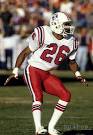
Fred Marion, my favourite Patriot defensive back
Roland James, part of that amazing secondary
The Patriots finished third in the AFC East, behind division champion Miami and the second-place New York Jets. That meant all their playoff games, if they kept winning, were on the road. They opened with the AFC Wild Card Game at the New Jersey Meadowlands against the Jets on Dec. 28. I was home for Christmas and recall watching that game, thinking no one was going to beat Miami in the AFC. After all, the Dolphins handed the unbeatable Chicago Bears their only loss of the season in a Monday Night thriller. It was conventional wisdom the Bears and Dolphins were destined to meet in the Super Bowl.
The Patriots had other ideas, and were led by their defence. That Patriot defence, especially the secondary, was possessed. They forced four turnovers and sacked the quarterback five times en route to a 26-14 victory in the AFC wildcard game. That set up a date with the AFC West champion and number-one seeded Los Angeles Raiders in the LA Memorial Coliseum on January 5, 1986. The defence forced six turnovers, converting them into 17 points, on their way to a 27-20 win. Awaiting them for the AFC Championship was arch-rival Miami in the Orange Bowl on January 12. The Dolphins, led by quarterback Dan Marino, looked beatable after barely escaping with a win against Cleveland the week before. Bernie Kosar was the Browns' rookie quarterback and one of my favourite players of all time. He almost engineered a huge upset, as the Dolphins had to score late to squeak out a 24-21 win.
Ronnie Lippett, he windmilled Jim McMahon in the Super Bowl
Raymond Clayborn, voted one of the Patriots' 50 gretest players.
However, the Patriots were ready for Marino and his vaunted passing attack. The Patriot secondary would riddle them, intercepting Marino, and forcing six turnovers in total. The game was never really close, as New England left the Orange Bowl with 31-14 win and a date with the Chicago Bears in the Super Bowl. The Patriots had become the first team in NFL history to win three straight playoff games on the road, and only the second wildcard team to go to the Super Bowl.
The clock struck midnight for the Cinderella Patriots in the Super Bowl as the Bears blew out New England 46-10. Yet that month of football was magical to watch. I loved defence, especially the secondary, and there was no group of defensive backs more captivating than the Patriots. Fred Marion, Ronnie Lippett, Roland James, and Raymond Clayborn. Household names, right? I still remember them. They were the four starters in the Patriot secondary, and the four legs that propped up that underdog.
What had me thinking about that 1985 Patriot team earlier in the day was probably my favourite Patriot of all time (I cannot even believe I am even typing these words given the current Patriots): Irving Fryar. First round pick, number one overall from the Nebraska Cornhuskers. He was electrifying in college, and became a great pro. Actually, to be honest, I liked their two quarterbacks – Steve Grogan and Tony Eason – and offensive lineman John Hannah, runningback Craig James, Fryar’s companion wide receiver the ageless Stanley Morgan, there were lots of cool players. Interestingly, that team was all about the run and ultraconservative on offence. Most Eason passes were long handoffs. They rarely stretched the field vertically, even with Fryar and Morgan. Not like now.
There were all kinds of interesting stories. Julius Adams, who wore number 85, announced he was retiring at the end of the 1985 season. It was a storybook finish to go to the Super Bowl. There were all kinds of high draft picks that finally matured, like Andre Tippett and Garin Varis.
The times are a changin'
How times have changed. Raymond Berry was a gentleman as a coach. The current coach won't even come out to talk to the media when his team loses in the playoffs. It makes him look like a poor loser and a poor sport. The Patriots were also sanctioned by the NFL for taping the practices of the Philadelphia Eagles in the lead up to their Super Bowl encounter. Their record is impeccable, and their current quarterback Tom Brady is a class act. Yet, the attitude of some make them all hard to cheer for.
Unlike the current edition of the Patriots, there was no hype, no arrogance, no swagger to the 1985 team. Instead you had a bunch of guys who worked hard, scratching for every yard, and just happy to be where they were.
The other day I heard that Reveen died. It was a name I had not heard in a long time. I didn't even know his name was actually Reveen – Peter Reveen. It brought back some fond memories, not just of a great show, but a particular time in my life that was changing.
A night on the town
It was the first time I ever got to go out with a friend. It was junior high and the call came around 7 p.m. on a school night. It was Mike Hartman, my old friend and basketball teammate. He got straight to the point
"Do you wanna go see Reveen?"
I jumped at the chance. I'd seen the commercials, like the one at the right here. I'm pretty sure Mike had seen Reveen before, and was quite impressed. I sure was when the night finally came.
If memory serves, Mike's dad Gary actually picked me up on the farm, and took us to the Sportsplex in Lethbridge, home of the Lethbridge Broncos of the Western Hockey League. I'd been there before with my parents for Bronco games, but never with a friend. Now, it's called the Enmax Centre, home of the Lethbridge Hurricanes of the WHL. It was cool. We found our seats, and Mr. Hartman stayed put while Mike and I wandered around the arena for awhile.
On with the show
Then the show started. Reveen took the stage, and looked to me like Wolfgang Jack, only with an Australian accent.
Reveen never used the word hypnosis. Instead, he used the description "a state of super consciousness". I read all about that in the program Mike bought. The other striking memory was that he never made fun of the people on stage who were "under his spell". It was a clean show, something Reveen prided himself on.
He asked for volunteers who had to be a certain age. They all made their way to the stage, and Reveen had a "try out". People were asked to close their eyes and concentrate. They had to lock their hands or arms together, and do some other stuff. Reveen wandered among them, eventually determining who could achieve "super consciousness" and who could not. He announced an intermission so those not chosen could return to their seats, while the chosen ones remained on stage.
Then it was show time.
There were a lot laughs. The one guy in particular that I remember was in love with a fictitious wife named Chloe. Reveen told him Chloe had run off, so the guy went all over the arena chasing after Chloe. There were other performances, and periodically this guy would appear somewhere around the arena yelling for Chloe. Even when the performance was over, and Reveen was bringing everyone around, the last thing this guy said was, "Look Chloe, I know you're around here somewhere."
We laughed all the way home.
It was a great night, and life changing. I began to go out with my friends more and more, but that was pretty much the first time. I hadn't thought about it in years, until I heard Reveen had died.
So there he was providing entertainment one last time, and a chance to reminisce. Rest in peace Peter Reveen – hopefully you've achieved your own state of super consciousness.
One of the things I regret just a little bit about getting involved in university life was losing track of the greater world outside me. I got so absorbed in campus life at the University of Alberta, I lost track of a lot of news, sports, and even music, which had been touchstones for me, especially growing up on the farm.
Probably the two things I regret missing most, but only after hearing how great they turned out afterwards, were the 1988 Notre Dame-Miami football game, and Game 1 of the 1988 World Series.
Then the Internet came along, and I have found both. The football game is in another post, and the entire bottom half of the ninth inning of the baseball game is above. I'm sure the entire game would be interesting to see, but the drama, one of the most dramatic moments in World Series history in fact, occurs in the bottom of the ninth inning. I'd seen highlights before, but never the entire bottom half of the inning. And it is amazing. See for yourself
Free agent
Kirk Gibson had made his name as a Detroit Tiger, breaking the hearts of my beloved Blue Jays many times. He was a double letterman at Michigan State, playing both football and baseball. He had a deadly combination of speed and power. He was also tenacious and tough.
That tenacity went beyond the baseball diamond. In 1988, the owners in Major League Baseball were found guilty of collusion, and Gibson was one of the players granted immediate free agency. He signed with the Los Angeles Dodgers, taking his show to the National League.
Just like a movie
The Dodgers won the National League West pennant and faced the New York Mets in the National League Championship Series. Gibson had home runs in Games 4 and 5, winning the game in one and breaking the game open in the other.
However, he was hobbled and unlikely to play in the World Series against the Oakland Athletics, who were appearing in their first of three consecutive World Series. With a bad left hamstring, and a swollen right knee, he was physically unable to play, according to announcer Vin Scully.
Then, with the Dodgers trailing 4-3 and two out in the bottom of the ninth inning, L.A. manager Tommy Lasorda chose to pinch hit for shortstop, and former Toronto Blue Jay, Alfredo Griffin. Mike Davis stepped in and worked a walk.
The entire stadium took a deep breath. What would Lasorda do? Then, out of the dugout came Kirk Gibson, slowly limping to the plate. The anticipation built.
"You talk about a roll of the dice, this it," Scully said as Gibson dug in.
"So the Dodgers, trying to catch lightning right now."
Facing Gibson was Dennis Eckersley, the best reliever in baseball, who had quickly recorded two outs before Davis' walk. He had not allowed a home run since August 24.
After Gibson fouled off the first pitch, Scully said the leg injuries prevented Gibson from pushing off, or landing.
"He's going to use all arms," colour man Joe Garagiola said.
After two more foul balls, Scully said Gibson was so banged up, he was not even introduced and did not come out onto the field at the start of the game.
He fouled a nubber down the line and you could see the pain on his face as he tried to run to first.
"You can really see the limp," Garagiola said.
"He almost has to talk to his legs and say hey, let's go, we gotta get outta here."
Gibson worked the count to 3-2 when Davis stole second, putting himself in scoring position. A base hit would now tie the game.
"Now the Dodgers don't need the muscle of Gibson as much as a base hit," Scully said.
Eckersley delivered. Gibson swung, and you could hear the crack of the bat. The right fielder could just watch as the ball sailed out of the park. Gibson had delivered. As Scully said, "In a year that has been improbable, the impossible has happened."
"And now the only question was could he make it around the base paths unassisted."
Bob Costas described it best in "Ken Burns' Baseball": It was like a scene from a movie.
When Hockey Canada was is in the process of selecting its under-18 World Junior team back in December of 2012, there was talk, with the NHL lockout making all the young talent available, that that year's group could be the best team ever.
Anytime there is talk of the best team, the one that gets lost is the very first team. To me, they will always be the best because they did what none of their predecessors did – bring gold back to Canadian soil. I guess it wasn’t really back, because the tournament was co-hosted by Winnipeg and Minnesota. Still, Canada won its last game in the United States, so in essence, they did bring the gold home.
No superstars
This team was remarkable for several reasons. It was the first team made up of players from different teams across Canada and the United States. No one knew how this new approach would work, but it could be no worse then sending actual complete junior teams, because they never won gold. More remarkable than the way the team gelled, was that there were no superstars. No Jonathan Toews, no Jordan Eberle, no John Tavares, no Sidney Crosby, no Eric Lindros, no Mario Lemieux, no Wayne Gretzky. Gretzky’s team came closest but still no gold. Instead, it took a team to achieve what had never been done.
Dwelling in obscurity
It was a magical run too, largely achieved in anonymity. The World Juniors has become so popular, families gather around the TV at Christmas to watch the games on TSN. The ups and downs of each team, each player, are chronicled daily by the mainstream media and on social media. Back then no one broadcast the games, like TSN handles them all now. In fact, TSN would not even go on the air for two more years. Only after Canada won its first few games, with the Soviet Union and Czechoslovakia still to play, did CBC pre-empt its regular holiday programming for the game against the Soviets. Many who watched that game, me included, thought it was exactly what we needed, not just for that tournament, but for our pride.
Canadian hockey was reeling
Back in 1981, Canadian hockey was not in a good place on the international stage, as the Soviets seemed to beat us at every turn.
1979 Challenge Cup
The National Hockey League decided in 1979 to forego an all-star game. Instead a team of NHL all-stars would play a three-game series against the Soviets' best. Nominally an NHL all-star team, it contained 23 Canadians and three Swedes, making it a de facto Canadian team. It featured some of the best players ever: Guy Lafleur, Darryl Sittler, Bryan Trottier, Mike Bossy, Gilbert Perreault, as well as three solid goaltenders in Gerry Cheevers, Ken Dryden, and Tony Esposito.
All three games were played at Madison Square Garden in New York. Ken Dryden got the start in net in Game 1 on Thursday, February 8, and backstopped the NHL all-stars to a 4-2 win. I recall the all-stars dominating that game, and scoring a fifth goal that was disallowed because the ref ruled Bill Barber kicked it in. Dryden was back in net for Game 2, which I missed most of because we were on our usual weekly Saturday shopping trip to the city. I did catch part of the third period, including a great skate save by Dryden, when we stopped to visit at my Uncle Ed's in Lethbridge. The Soviets won that game 5-4, setting the stage for a tie-breaking third game Sunday night. I was thrilled because Gerry Cheevers got the start, and he played for my favourite team, the Boston Bruins. He did not play well, and neither did the team in front of him. The Soviets attacked wave after wave and the all-stars seemed helpless. They poured in six goals while legendary goaltender Vladislav Tretiak had been replaced in net by rookie Vladimir Myshkin. He boarded up the net, as the Russians left with a 6-0 victory. Perhaps most telling was the sixth goal, where most of the all-stars were caught up ice, leaving Guy Lafleur helpless on a two-on-one break. I vividly remember Soviet captain Boris Mikhailov hoisting the Challenge Cup. It's probably still sitting somewhere in Moscow, probably in Vladimir Putin's office.
1980 Winter Olympics
Canada had refused to send hockey teams to the Olympics after our bronze medal finish at Grenoble, France in 1968. We were protesting the fact Canada could not send professional or semi-professional players to the world championships. An agreement was eventually reached to allow professionals in the world championships, although still not in the Olympics, so Canada iced its first Olympic team in 12 years at the games in Lake Placid, New York in 1980. The darling of that Olympics was the "Miracle on Ice" U.S. hockey team. Canada, who was coached by Tom Watt who eventually would coach the Toronto Maple Leafs, were not in the same pool as the Americans. Instead, Team Canada would have to beat the Soviets or Finns to make the medal round, as only the top two advanced. The Canadian roster was largely made up of university and college players, most notably Randy Gregg, who captained the team, Paul MacLean, current coach of the Ottawa Senators, and hall-of-famer Glenn Anderson. The goaltenders were Bob Dupuis and Paul Pageau.
Canada opened by beating the Netherlands 10-1, then Poland 5-1, before facing Finland. The winner of that game likely would go to the medal round, because the Soviets were pretty much a lock for the other spot. We were at a family thing in Calgary, so I had to listen to the game on the radio on the drive back to the farm. I recall, Finland leading, and Canada coming on. Then Dupuis let in a long, weak goal, and Canada could not recover. They lost 4-3, but still had the Soviets to play. Canada beat Japan 6-0, on my birthday, then faced the Soviets two days later. I recall riding the school bus and someone yelling they heard Canada was leading. It was true. The teams were tied 1-1 after the first period, then Canada took a 3-2 lead into the third period. The Soviets took control, but not without controversy. Canada suspected the Soviets of using illegal sticks. The first time Watt called for a measurement, the Soviet had disposed of his stick. The second time they got caught. The joke was the Russians had used all their good wood in the war in Afghanistan. Anyway, the Russians scored four times to skate away with a 6-4 victory. I remember cursing Dupuis as the final whistle went. Hey, I was immature at 10 years and two days of age.
Canada went on to finish sixth, which oddly, is still better than Canada's NHL all-star laden 2006 Olympic hockey team.
1981 Canada Cup
Canadians did not put much stock in the Olympics because Canada could not send its best, while the Soviets and Czechs could. We always held on to the belief that in a contest of our best against their best, we would win. We did in the 1972 Summit Series and the 1976 Canada Cup.
Now, five years after that last Canada Cup we could walk the walk. Tensions between the Soviet Union and the West had led to a boycott of the 1980 Summer Olympics in Moscow, and delayed the Canada Cup from its scheduled 1980 date to 1981. It was again full of the best players in the world, many who suited up in the Challenge Cup over two years earlier, with one notable addition: Wayne Gretzky. The goaltenders were Don Edwards, Mike Liut, and Stanley Cup champion Billy Smith. Something that stuck in my craw was that Tony Esposito, now an American citizen, started for the USA. This after representing Canada, most notably in the 1972 Summit Series.
Canada sailed through the round robin unbeaten with four wins, including a 7-3 win over the USSR, and a 4-4 tie with Czechoslovakia. That set up a semi-final match where Canada beat Esposito and his American teammates 4-1. Meanwhile, the Soviets beat the Czechs in the other semi-final by the same 4-1 score. The showdown everyone expected was set for the Montreal Forum for Sept. 13. After skating to a scoreless first period, the floodgates opened as the Russians scored three in the second and five in the third, for an embarrassing 8-1 loss on home ice (Keeping in mind, it was the only Canada Cup with a one-game, sudden-death final, instead of a best two-of-three series). Adding insult to injury, the Soviets tried to steal the trophy and take it back to Moscow. The tip of the maple-leaf-shaped trophy is still bent, when they dropped it while stuffing it into a hockey bag.
Three shots at the Russians, three crushing defeats. Canadian hockey was in a state of self-doubt. It was into this environment that the Canadians entered the World Junior Hockey Championships. It was a chance for redemption – on home ice.
Revenge is a dish best served cold, and it doesn't get colder than Winnipeg
There was no playoff round back then. Instead the team with the best record after the round robin was awarded the gold medal. Canada opened by beating Finland 5-1, then Sweden 3-2. That set up a showdown with the Soviets in Winnipeg on Boxing Day, 1981. I recall watching the game on CBC when I was out of school for the holidays. I was so nervous because I feared the Russians. I still had visions of the Challenge Cup, the Olympics, and especially the Canada Cup. I was also pretty stoked because the Moller brothers, Mike and Randy, were playing for Canada. I had watched them play junior in Lethbridge, so it was cool to see them on TV.
In the end there was no need to worry, because Canada was all over the Russians. They out-skated and out-hit them. Goaltender Mike Moffat made the saves when he had to, but his defence was strong, and the offence was relentless. The top line of Mike Moller, Scott Arniel, and Marc Habscheid created scoring chance after scoring chance. The Canadians skated away with a 7-0 victory. It was the worst loss ever inflicted on the Soviets in international play.
During the game, John Ferguson who was general manager of the Winnipeg Jets at the time, had gone done to the bench and encouraged the Canadians to keep pouring it on. He urged them to try for a seven-goal victory, the same margin Canada lost by in the Canada Cup. He was one of the broadcasters for the CBC and called it a good measure of revenge as the final seconds wound down. He was absolutely right.
Canada went on to beat the Americans 5-4, the West Germans 11-3, and Switzerland 11-1. The only thing standing between them and gold was Czechoslovakia, who had also beaten the Soviets. Canada was 6-0, so all they needed was a tie and gold, the country's first ever gold, was theirs. The teams faced off in Rochester, Minnesota on January 2, 1982. Canada fell behind, but rallied to take the lead, only to have the Czechs tie the game at 3-3. That was the way it ended, and Canada had their first-ever World Junior gold medal, and had signalled the country was back internationally. Moffat was named the top goalie, Gord Kluzak the top defencemen, and Moffat, Kluzak and Mike Moller made the tournament all-star team.
Once the final whistle blew, and Canada received their gold medals, they made a startling discovery. There was no recording of O Canada to be found anywhere in the arena. So, as Canadians do so well, they improvised and sang the national anthem themselves. It was a fitting way to end the tournament, and start a tradition of players singing the national anthem.
One of the best ever
Every member of that team played in the NHL, even if just for a handful of games. More than anything they could accomplish in the pros though, they set in motion a process that has led to a harvest of gold medals at the World Juniors. Their names are rarely mentioned among the best ever Canadian teams because too many people are enamoured by statistics and personalities, and quite frankly take the gold medals Canada has won as a given. These men didn't and couldn't. Instead, they restored our pride in our country. Dave King was their coach, and he and general managers Sherry Bassin and Bob Strum took a chance, with a system that Canada had never tried before. Has it ever paid dividends since then. Here are the 1982 World Junior Hockey champions:
Scott Arniel
Paul Boutillier
Garth Butcher
Frank Caprice
Paul Cyr
Bruce Akin
Marc Habscheid
Gord Kluzak
Moe Lemay
Mike Moffat
Mike Moller
Randy Moller
Dave Morrison
Mark Morrison
Troy Murray
Gary Nyland
Jim Patrick
Pierre Rioux
Todd Strueby
Carey Wilson
Thanks for everything boys. You began the dynasty, you left the legacy.
Phil Kessel played nine games for the Calgary Stampeders in 1982
It had been bugging me for a few months, but not enough to inspire even a Wikipedia search. Every time I heard the name Phil Kessel, I didn't think of the forward with the Toronto Maple Leafs. The player who the Leafs got from my Boston Bruins in exchange for the talent that helped them win the Stanley Cup two years ago.
Instead, I thought of this obscure quarterback who took a few snaps for the Calgary Stampeders in the 1980s. It must not be the same name, it couldn't be.
My curiosity was satisfied Tuesday night (April 9), when Amanda Kessel scored the game-winning goal for the U.S. women's hockey team against Canada in the Women's World Championship in Ottawa. During the broadcast, the announcers referred to her brother Phil, and their Dad who was also named Phil. That peaked my curiosity. Then they actually said he played quarterback in the CFL – for Calgary. All doubt had been removed.
Memories of a journeyman quarterback
Phil Kessel suited up for the Stampeders at a dark time in their history. They had been a solid team
under coach Jack Gotta in the late 1970s and early 1980s. However, they were in the same division as the Edmonton Eskimos who were a dynasty, winning five straight Grey Cups from 1978 to 1982.
After that success, the franchise went into decline, and had a parade of quarterbacks come through the turnstiles at McMahon Stadium. At the same time, CBC Calgary hosted a weekly show called "Catch 22" on Thursday nights which was about the Stampeders. The title referred to wide receiver Tom Forzani, who wore number 22. Incidentally, his son Johnny catches balls for the Stampeders now. Anyway, Gary Arthur hosted "Catch 22" and I recall one episode in 1982 where they talked about their quarterback situation and how this guy named Phil Kessel would get some playing time.
Phil Kessel plays for the Toronto Maple Leafs. He looks like his dad.
Kessel had a good career at the University of Northern Michigan. He was: 1980 Associated Press All-American second-team quarterback; 1980 Mid-Continent Conference Player of the Year; and 1979 and 1980 team most valuable player. He was taken in the 10th round of the 1981 draft by the Washington Redskins, but didn't catch on.
Kessel played one season in Calgary, largely backing up Canadian quarterback Gerry Dattilio. He played nine games, completing 30 of 56 passes for 399 yards, four touchdowns, and four interceptions, with his longest completion going for 74 yards. I seem to recall liking what I saw when I watched him. According to Steve Simmons of the Toronto Sun, Calgary was not satisfied with his play and it motivated them to go out and sign Bernard Quarles, who had a serviceable CFL career, and Danny Barrett, who was one of the best. I do recall Quarles and Barrett coming to the Stampeders' camp in 1983, along with Ron Reeves, a quarterback who was cut.
Kessel was inducted in 1992 into the Northern Michigan University hall of fame.
The Kessel Run
When I asked my buddy if he knew anything about Phil Kessel the quarterback, he said: "All I know is Han Solo said the Millennium Falcon can do the Kessel Run in less than 12 parsecs." Not the same thing.
Parting shot
Even if Amanda Kessel broke my heart on the ice, and her dad didn't really pan out for my Stamps, I can still thank the trade involving her brother Phil for helping return the Stanley Cup to my Bruins.