Linda Miller, Ralph Waite, and Stan Shaw, the main actors on "The Mississippi".
It was another case of “I recognize that face…and that voice”, but it seemed kind of hard to believe. I was home for lunch one day watching “Days Of Our Lives”, and this old priest came on screen. He looked so familiar, but I just could not place him.
Then it clicked. It had been a long time, a really long time ago. I was surprised he was still alive. Staring me in the face, through the magic of television, was Ralph Waite, the man best known for playing John Walton Sr. in “The Waltons” which ran from 1972 to 1981. Wikipedia revealed he is pushing 85 years of age, which is so impressive.
From Walton’s Mountain to the Mississippi River
As the ‘80s opened, "The Waltons" was running its course. It had become a victim of the same malady as all family-centred, long-running TV series. The children had grown up and moved on, so where do you go? Ultimately into cancellation and the world of follow-up TV movies.
Ralph Waite opened the 1980s in the role of John "Pa" Walton.
Still, through it all, there was Ralph Waite playing the patriarch of the Walton family – owner of a sawmill during the Depression, father of six, and wise giver of advice. It was an archetypical role, one that would define him as an actor.
Yet, what I remember most in the 1980s about Ralph Waite was another show he did. Simply titled, “The Mississippi” he played a southern lawyer who drove a boat along the fabled Mississippi River. I first read about the show as one of a package of mid-season replacement series CBS was unveiling. Of course, on peasant vision it did not air on Channel 13 for a few more months.
Again I recall Waite’s character being very similar to John Walton – wise, calm, and measured in his response to everything that came at him. I also remember his co-star, African-American actor Stan Shaw who played his sidekick Lafe Tate. However, like so much peasant vision, only a few episodes aired before “The Mississippi” disappeared into the ether. It was too bad, because the reason the show interested me was Ralph Waite.
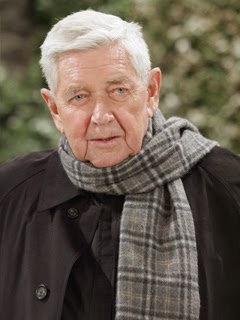
Ralph Waite in his final recurring role on television, Father Matt on "Days Of Our Lives"
The years after
The next time I saw Ralph Waite was playing Kevin Costner’s character Frank Farmer’s father in “The Bodyguard”. Again, he played the calm yet confident and stern father figure.
Parting thoughts
Playing a priest on “Days Of Our Lives” is the next logical step in a lifetime of roles as sage paternal figures. He truly has gone from “Pa” Walton to “Father” Matt. Some would call it typecasting, but Ralph Waite’s longevity proves it is more than that. It is a style that makes him an actor that directors want to hire, and viewers want to see. How many other actors are still working at 85?
Post script
After I first posted this entry, Ralph Waite died. Still, who can claim, especially actors, that they worked until their last day on Earth. Ralph Waite can.
Could you believe this cute face could end up on the body of Barney Stinson?
It’s not often an actor has a chance to successfully re-invent himself. There are some examples such as Buddy Ebsen going from Jed Clampett to Barnaby Jones, Raymond Burr from Perry Mason to Ironside, even Lee Majors from Steve Austin (The Six Million Dollar Man) to Colt Seavers (The Fall Guy), and even Tom Selleck from Thomas Magnum to Frank Reagan (Blue Bloods).
Perhaps the most striking example is Neil Patrick Harris. Once known exclusively as Doogie Howser, he will likely go down in history now as Barnie Stinson. That’s an amazing feat for an actor who could easily have been typecast the rest of his life as a genius, teenage doctor.
Worth the wait
Doogie Howser, M.D. debuted in 1989 with an unlikely premise: a boy genius becomes a doctor. On the surface, the premise seemed goofy bordering on ludicrous. However, it was created by Steven Bochco who was one of the best writers on television. He had already won critical acclaim for shows such as "Hillstreet Blues" and "L.A. Law", so his name lent credibility to the show.
Yet, I did not start watching until the summer of 1991. I was home from university for the summer and had no one really to hang out with. Consequently, I spent every night watching reruns of shows I had no time to watch during the school year. That’s when I decided to give "Doogie Howser, M.D." a shot – and I was not disappointed.
Classic Bochco
The show was classic Bochco in a couple ways. He had a stable of actors and drew from that for every one of his productions. In this case, James B. Sikking, who had played Howard Hunter in "Hillstreet Blues", played Doogie’s father David Howser (just as Dennis Franz had been in "Hillstreet Blues", "Bay City Blues" and "NYPD Blue", and Jimmy Smits was in "LA Law" and "NYPD Blue"). It also addressed social issues head on such as AIDS, ageism, teenage sexuality, racism, and homophobia.
What made the show compelling was Harris’ portrayal of a boy in an adult world who knew on paper exactly what to do, but struggled with the fact he was dealing with human beings. His best friend was his next door neighbour Vinnie Delpino, who was your average teenager. Vinnie kept Doogie grounded, usually by climbing through his bedroom window to visit him. His parents, David, and Katherine (played by Belinda Montgomery) also provided conventional wisdom to an exceptional teenager. And then there was Wanda, Doogie’s girlfriend who kept him grounded only the way a girlfriend can.
"Doogie Howser, M.D." ran its score and was cancelled in 1993 after four seasons. I never saw the final episode but heard Doogie left the hospital and headed to Europe.
The years after
Neil Patrick Harris disappeared from network television for a time. He returned in 1999, co-starring for a season with Tony Shalhoub in "Stark Raving Mad". Then, in 2005, he assumed the role of Barney Stinson in "How I Met Your Mother". It has been on the air twice as long as "Doogie Howser, M.D.", spanning more than 200 episodes, and garnered Harris four Emmy nominations, from 2007 to 2010, for outstanding supporting actor in a comedy series.
He will go down on history as Barney Stinson. Neil Patrick Harris has definitely left Doogie Howser behind.
It was one of the first movies I ever saw that focused on seniors issues – aging, elder abuse, independence . “Amos” used a brilliant cast, ultimately earning Kirk Douglas an Emmy nomination.
A minute that changes everything
Amos Lasher is a one-time baseball manager who loses his wife and home in an accident, confining home to a state-run nursing home. That’s when the fun really begins.
The home is a sterile place where everyone lives in fear of Daisy Daws, the nurse who runs the place with an iron fist. Elizabeth Montgomery turns in a brilliant performance as the wicked, ruthless, condescending nurse who does whatever she wants to keep the residents in line and, if memory serves, bilk them out of their estates. If they are really uncontrollable, somehow they always end up dead too. Her performance is a complete about face from her long-time role as Samantha Stevens, the kind, sweet, charming witch on Bewitched. Here, she’s more like the wicked step-sister.
The caption for the photo above.
Game, set, and match
Nurse Daisy, however, will meet her match in Amos Lasher, whose indomitable spirit will not be squashed. He is assigned to a room with Ray Walston, who gives Amos the name Chuck. It is the same name he gives all his roommates, after his very first one. Chuck died but his name lives on in all who come after him. No use getting to know them when they’ll be gone in no time. He also meets Tommy Tanaka, played by Noriyuki “Pat” Morita, fresh off his Academy Award nominated turn in “The Karate Kid”. Tommy has a love for gardening, but he has to hide his plants from the staff. When they discover one, they take it away. The home is very much a police state. Soon, Amos meets Hester Farrell, played by movie starlet Dorothy McGuire, who eventually falls in love with him.
Parting thoughts
Blockbuster calls this movie melodramatic, but I whole-heartedly disagree. The ending is anything but predictable or melodramatic, although I won’t spoil it for you because I have embedded the movie in its entirety in this post.
Beyond its dramatic quality, “Amos” shines a light on the plight of the elderly. We are all destined to get old, but not at the expense of our dignity, self-respect, or grace. “Amos” showed just how we, as society, abdicate our responsibility to care for those who once cared for us. It shows that instead of helping people age gracefully, we warehouse them, and treat them as a burden or an expense to the bottom line of life. But it also shows that, just because we age, we don’t die. We have the same desires, needs, and expectations we always did. And you try to take those away, we won’t go down without a fight. Long before concepts like “aging in place” became the vogue, we needed movies to show us what happens when we stop respecting our elders.
Not many people will remember “Amos”, but it did its part to change the world and, maybe just maybe, it opened a few eyes along the way.
An ad for "Murder Can Hurt You" showing exactly who starred in the movie. You can guess who they were spoofing.
The spoof has become a lost art on television. The idea of parodying television shows or movies seems to have been relegated to sketch comedies and late-night talk shows.
Back in 1980, ABC and by extension CTV Channel 13 on the peasant vision dial, aired one of the more all-encompassing spoofs. It was a send-up of television crime dramas and spoofed no less than eight different television series. It was more cheese than comedy, but certainly left a lasting impression.
It was called “Murder Can Hurt You”, and it featured a who’s who of television actors from the 1970s and 1980s. The plot was simple: someone is murdering all the great detectives and cops, and it is up to the surviving ones to find the murderer and stop him (or her).
The characters were:
• “Chief Ironbottom”, played by Victor Buono, spoofing “Ironside”;
• “Pony Lambretta”, played by Tony Danza, spoofing “Baretta”;
• “Studsky”, played by Jamie Farr, and “Len ‘Hatch’ Hatchington”, played by John Byner, spoofing “Starsky and Hutch”;
• “Lt. Nojack”, played by Gavin MacLeod, spoofing “Kojak”;
• “Sheriff Tim MacSkye”, played by Buck Owens, spoofing “McCloud”;
• “Sgt. Salty Sanderson”, played by Connie Stevens, spoofing “Police Woman” and the lead character Pepper Anderson;
• “Lt. Palumbo”, played by Burt Young, spoofing “Columbo”;
• “Mrs. Palumbo”, played by Liz Torres, spoofing “Mrs. Columbo”.
The narrator was Don Adams, who had played secret agent Maxwell Smart in “Get Smart”, itself a spoof of spy movies.
“Murder Can Hurt You” is a TV version of Neil Simon’s 1976 movie “Murder by Death”, which spoofed literary detectives and their theatrical equivalents.
Parting thoughts
I missed the first fifteen minutes or so of this movie, so I never did see the set up. What I found interesting, beyond the mystery of who was really behind all the murders, was trying to identify the characters being spoofed. Some of them did such a good job, it was like they actually were the characters they were parodying.
I cannot really think of another example of a parody this broad, and that’s too bad, because “Murder Can Hurt You” and even “Murder by Death”, offer a window to the pop culture of the time they come from.
This is the most recent Zellers location, which turned out to be the last, in Lethbridge. Back in the 1980s, it was located on Mayor Magrath Drive, the current home of The Movie Mill and Value Village.
This past Christmas was the first in more than 80 years without Zellers. Last year, a cloud of death hovered over the store, with a flurry of closing-out sales and announcements that everything must go. If you visited a store, it looked like a scene out of “Mutual of Omaha’s Wild Kingdom”, when angry hyenas pick clean the carcass of a zebra. But Zellers was still there.
Not so this Christmas. U.S.-based Target, which bought up the Zellers chain, began opening its own stores to replace Zellers in what it deemed to be profitable centres. Lethbridge wasn’t one of the lucky spots. Instead, there was ghostly silence where yet another retail fixture in the community went into that good night – following in the same path as Woodward’s, Woolco, Woolworth’s, and Eaton’s.
Those were all part of the route of stores we frequented when we made our weekly trek Saturday mornings to go shopping in the city. Zellers was not part of that route, located in a place off our very narrow beaten path. Yet, every so often we ventured down Mayor Magrath Drive and checked out what Zellers had to offer.
Even if we were not regulars, there was something comforting in knowing there was another store – a Canadian one – to visit if we needed something the other stores just may not have had.
Now, yet another option has disappeared, and without any fanfare. Just like those other stores.
The cast of "Our House". In back from left are Deidre Hall and Chad Allen, while in front from left are Shannen Doherty, Wilford Brimley, and Keri Houlihan. Unfortunately, Gerald S. O'Loughlin, my favourite character, is not in this picture..
If there was ever a TV show that left me feeling satisfied at the end of every episode, it was "Our House".
It aired Sunday nights on Channel 7, and was the story of Gus Witherspoon, a crusty old man whose daughter-in-law and her three children move in with him after his son dies. There is the predictable clash between generations as Gus tries to set down some rules, but they slowly grow into a family. In virtually every episode someone would get in trouble, and Gus would get them out of it, usually by telling off the bad guy in the end.
The cast was a mix of people who would go on to be quite prolific in television, or had already made their mark.
Let me tell you something
Gus Witherspoon was played by Wilford Brimley, and he was awesome. He was this wise man who really would not put up with any garbage. His best friend was Joe Kaplan, played by Gerald S. O'Loughlin, who would always seem to come along with Gus, whether he wanted to or not.
I loved the way Gus saved the day so much, the first column I ever had, on my friend Anders Svensson's website "Screaming Midget", was called "Let me tell you something", a tribute to Wilford Brimley. (In fact, Anders believed I would look like Brimley when I got to be that age, and used a cartoon drawing of Brimley to accompany my byline). Brimley often started his tirades with, "Let me tell you something", if memory serves.
In fact, I just looked up Wilford Brimley on Wikipedia. There is a part that talks about Brimley and his good friend Robert Duvall working on the movie "Tender Mercies". There is a quote from Brimley confronting director Bruce Beresford, and right in the middle is embedded the phrase, you guessed it: "…let me tell you something…"
Days goes nights
Gus' daughter-in-law Jessie Witherspoon was played by Deidre Hall, who played Marlena Evans on "Days Of Our Lives". She actually tried to do both the daytime drama and "Our House" at the same time. Marlena disappeared, and at first her body was never found. Then we discovered she had been kidnapped and held hostage by the evil "Orpheus". Eventually, she did leave "Days" in 1987, in the midst of the run of "Our House". But, as with so many other soap opera stars, she kept rising from the dead like Lazarus, even to this day. It was odd seeing her in something other than "Days Of Our Lives", but not surprising that she returned there once "Our House"ended.
Before "90210" and "Charmed" there was…
Looking back, it is hard to believe that Shannen Doherty pretty much got her start on "Our House". She played the role of the oldest daughter Kris, who was 15 and full of teen angst. She was so young, but this would be a stepping stone for all that success.
Chad Allen – you'd know him to see him
Up to that point, Chad Allen may have been best known as Tommy Westphall, the autistic son of Dr. Donald Westphal, the conscience of the show, "St. Elsewhere". The show actually ended up being a figment of Tommy's imagination. On "Our House", he played the lone son, David Witherspoon. He would go on to recurring roles in "My Two Dads" and "Dr. Quinn: Medicine Woman".
Gerald S. O'Loughlin – more than a sidekick
Every hero needs a good sidekick, and Joe Kaplan was perfect for Gus Witherspoon. But actor Gerald S. O'Loughlin was more than just a sidekick. He had quite a prolific career in the 1980s.
He appeared in three notable TV movies that were all excellent: "Brothers-in-Law"; "Child's Cry"; and "Under Siege". He also had a recurring role in the series "Automan".
However, the role that I remember most was a guest spot in an episode of "Quincy, M.E.". He played a coroner's investigator who was one of the best, and a friend of Quincy's. Then, one day he makes what appears to be a careless blunder and blows a case. It turns out he can't read. He loses his job, but Quincy helps convince him to learn how. The episode ends with him sounding out the word, "leg". I have been a bit critical of Quincy becoming much more heavy-handed and preachy in its final years, but this episode did bring light to an important issue – and Gerald S. O'Loughlin turned in a powerful performance.
Parting thoughts
"Our House" was only on the air for two season, from 1986 to 1988, and I only watched the first season. After that, I was off to university where I rarely watched any TV. Yet, for that one season, it was a show I never missed. I either watched it every Sunday night, or taped it.
The reason was simple: It always had a satisfying ending. No matter what had happened, whether a store had ripped someone off, one of the kids was bullied at school, or someone got hurt, Gus took matters into his own hands and made things right.
Looking back, it was probably pretty formula, but at a time in my life that was full of all kinds of emotions as with all teenagers, it was something that gave me comfort every Sunday night.
It’s amazing how time flies, and how small the world can be.
Recently the Notre Dame football team celebrated the 25th anniversary of their 1988
national championship. Dozens of former players and coaches returned to share
memories and celebrate the successes they achieved.
It was a special day for one person in particular – current
wide receiver T.J. Jones. His father Andre Jones played defensive end on that team 25 years ago, but
passed away a few years ago. T.J. is the first son of a player from the 1988 team to play for Notre Dame, and Andre was so proud of his son.
That championship season
It was the last time Notre Dame reigned supreme in college football, and what a season it was. The Irish were coming off an 8-4 season that culminated in a 35-10 loss to Texas A&M in the Cotton Bowl. The highlight was Tim Brown winning the Heisman Trophy. They entered the 1988 season ranked number 13 in the country, with expectations not that high.
The Irish opened at home against arch-rival Michigan, who were ranked ninth. Their dream season ended almost before it started as the Notre Dame offence could not generate any points. The sole touchdown came off an 81-yard Ricky Watters punt return. The remainder of the scoring came from field goals, including an 48-yarder by walk-on Reggie Ho to win the game 19-17.
The win moved the Irish up to number eight when they visited the Spartans at Michigan State. The Irish fell behind 3-0 early, but rallied for two field goals to lead 6-3 at halftime. The offence finally got rolling as quarterback Tony Rice scored the offence's first touchdown of the season, and the defence shut out the Spartans the rest of the way en route to a 20-3 victory.
They Irish stalled at number eight, but moved to number five after blowing Purdue out 52-7 to move to 3-0. Notre Dame moved to number five when they hosted Stanford, blowing them out 42-14, to up their record to 4-0, although they remained fifth in the nation. Next up were the Panthers in Pittsburgh. The Irish did not play well, and their hopes of a championship were in doubt again, but they found a way to win. Their record improved to 5-0, they moved up to number four in the rankings, and everything would likely come down to their next game.
Looming on the horizon were the number one, undefeated Miami Hurricanes, winners of 36 straight games. The game is actually on YouTube in its entirety, and I watched it a few months ago. In fact, it is embedded on this blog. Polls have voted it one of the greatest games of all time, and I have to agree. Beyond the drama leading up to the game, the fact it was dubbed "Catholics versus Convicts", and there was a pre-game fight, it was one of the most entertaining games I have ever seen. Given my absolute distaste for Miami, and that Notre Dame ended their 36-game winning streak, made it even sweeter.
Notre Dame took it to them early, but pretty much in the blink of an eye, that high-powered Hurricane offence led by quarterback Steve Walsh brought the team back with 21 points in the second quarter to go into halftime tied 21-21. Notre Dame would go up 31-21 before the Hurricanes again roared back. Leading 31-24, the Irish recovered a Cleveland Gary fumble on their one-yard line keeping Miami out of the endzone. Miami fans believe Gary was down before the fumble, and should have had the ball first and goal. It really did not factor into the final result, as Notre Dame fumbled three plays later giving the ball back to Miami, who would score the possible tying touchdown. However, trailing 31-30 Miami coach Jimmy Johnson went for the win with a two-point conversion attempt. Notre Dame defensive back Pat Terrell knocked away the Walsh pass, preserving Notre Dame's 31-30 victory. It was an incredible game.
Yet the result was not good enough to vault Notre Dame into the number one spot in the country. Instead, they were number two as they beat Air Force 41-13, then Navy 22-7. That win finally put them into the number one spot, where they would remain the rest of the season. They blew out Rice 54-11, then knocked off old rival Penn State by a score of 21-3, to move their record to 10-0.
Looming on the horizon now was another old rival: the undefeated and second-ranked USC Trojans. It was the first time in their history they entered their meeting both undefeated. The Irish were all over the Trojans, winning 27-10 in Los Angeles.
The only thing now standing between them and a national title was number three West Virginia, led by quarterback Major Harris, who were also undefeated. It was a de facto national championship game, and Notre Dame played like champions. Again they took control early and cruised to the 34-21 victory, giving them the school's 11th national championship.
I remember exactly where I was. The Fiesta Bowl was played on January 2 that year, and I returned to res that morning because I had a ton of stuff to do. My buddy Dave was there too, coming back early to watch the bowl games. So we watched that game in the lounge on Fifth Kelsey, and my love for the Notre Dame Fighting Irish was cemented.
The aftermath
The Irish had a lot of great players that I just loved: Tony Rice, Derek Brown, Mike Stonebreaker, Chris Zorich, Jeff Alm, even Rocket Ismail. A few, like Rice and Ismail, ended up in the CFl, and a lot made the NFL. My old friend and mentor Michel Ouellette read a book by Irish coach Lou Holtz, and said he thought every starter on that Notre Dame team played pro ball of some sort.
The drought
The Irish came close in both 1989 and 1993, but came up short for the championship. It was 24 years until they went on that magical run in 2012. Again they went undefeated and finished the season ranked number one. However, they faced a juggernaut in Alabama who was really more like a pro team, and humiliated the Irish so bad, they fell to fourth in the final rankings. Ouch.
Parting thoughts
What made that 2012 championship run so special was that T.J. Jones, the first son of a player from that 1988 team, was playing for the Irish. From the moment he started playing in his freshman year, he has worn the same number as his father.
The young man is so mature, his dad's teammates have said he got them through Andre Jones' death more than they helped T.J. through it.
They celebrated that 1988 championship a few weeks ago, and it was a special night for T.J. A few weeks later he played his final game at Notre Dame Stadium, the end of a storied career of his own.
He may not have won a championship like his dad did, but he brought honour in all he did to his father's memory, his family, and his school.
Samson Satele, current centre for the Indianapolis Colts.
Alvis Satele, linebacker for the Calgary Stampeders in 1986.
When I recently discovered that Indianapolis Colt offensive
lineman Samson Satele was the nephew of Alvis Satele, it reminded me of a time
long ago when the Calgary Stampeders were not only terrible,
but their very
existence was in jeopardy.
A bad season…
The 1985 season for the Calgary Stampeders would prove to be
a pivotal one in their history. The Stampeders had finished 6-10 in 1984, dead last in the West Division. Things really could not get much worse going in to 1985. There was optimism before the season began as Calgary had signed quarterback Joe Barnes, who just two seasons earlier had helped the Toronto Argonauts to the Grey Cup championship, and was an all-star the next season in 1984. The Stampeders acquired him in a trade to bolster their chances.
The optimism would not last. They started the season 0-5 and things really were not going that well, but there would be a moment of hope.
One bright light
It was in their sixth game of the season, It was a Saturday night, August 17, and they were playing the Lions at B.C. Place in Vancouver. It was a late start, 8:30 p.m. to be exact. The Lions had never lost to Calgary at B.C. Place, and they were one of the best teams in the league. The Stampeders had fired coach Steve Buratto and replaced him with Bud Riley (whose son Mike Riley would go on to coach Winnipeg to Grey Cup wins in 1988 and 1990).
What unfolded was one of the best football games I had ever seen. My mom had come out of the bath and settled on the couch to watch with him. I found myself explaining the rules to her, and she caught on quickly. She got deeper into the game as it went on, and the Stampeders were hanging around. Joe Barnes was finally beginning to play like the quarterback they had acquired.
Calgary led 6-3 after the first quarter and 16-11 at halftime. I was surprised at how well the Stamps were playing. They hung tough in the third quarter, leading 30-18 with just 15 minutes to go. I was hoping so hard they could hold on. The lions mounted a furious comeback with two touchdowns, but Calgary hung on for the 35-32 win.
I thought it may be a turning point, but it was the one big bright spot of the season.
…Becomes the worst season
The Lions would go on to finish 13-3, good enough for first place in the West, defeat Winnipeg in the West Final, and win the Grey Cup with a 37-24 win over Hamilton at Olympic Stadium in Montreal. Calgary would go on to win two more games, finishing 3-13 in the West, dead last and actually worse than the year before. No playoffs, no all-stars, not a lot to celebrate.
More foreboding was the fact their eight home games at McMahon Stadium averaged 14,988 spectators, with a high of 18,303 and a low of 11,185. The team had lost money and talk began to surface about the team folding altogether.
Save Our Stampeders
Things were desperate, so a group of community members, players and fans organized the "Save Our Stamps" campaign. The result was the sale of 22,400 season tickets and an injection of much-needed money.
What I will always remember was in the winter of 1986 listen to, I think it was 1140 AM radio, and they played a song called, "When the going gets tough, Calgary gets going". It was set to the same music as another popular song of the time: "When the Going Gets Tough, The Tough Get Going" by Billy Ocean. His song was actually part of the soundtrack for the movie "The Jewel of the Nile", which was the sequel to "Romancing the Stone".
After all the pleas to the community for support, the question now was: could they put a decent product on the field.
The 1986 would be very important – maybe the most crucial in the team's history.
Who is Alvis Satele?
The Stampeders hired Bob Vespaziani as their coach and general manager Earl Lunsford set about rebuilding the team. Once again, after a three-win season the previous year, there was no place to go but up.
They opened their regular season at home against their arch-rival, the Edmonton Eskimos. The team that took the field had been completely re-tooled. There were players who had been with other teams, like defensive back Ken Miller and offensive lineman Kari Yli-Renko, and some new faces, like Marshall Toner. He was a Canadian receiver who had written a letter to every team in the CFL looking for a break.
This is where linebacker Alvis Satele comes in. He was one of those players Lunsford brought on board to improve the Stampeders.
Alvis Satele was a graduate from the University of Hawaii who had spent some time with the Washington Redskins and San Diego Chargers before being released.
The first time I saw him play was in that 1986 season opener against Edmonton. I was amazed at all the new names, and surprised at some of the players from other teams they had brought in.
From the beginning, the Stampeders were a different team. Their defence dominated the Eskimos, and Satele even recovered a Milson Jones fumble in the third quarter. Calgary led throughout the game, but their old nemesis Matt Dunigan got them again, hitting Stephen Jones with a last-minute bomb to set up the game-winning score and pull out the 21-20 victory. To make matters worse, out of frustration over getting beaten deep by Jones, Miller punched him and got an unnecessary roughness penalty. Still, it signalled the Stampeders were for real.
The turnaround
They would go on to have a huge turnaround, finishing 11-7 (that year the league went from 16 to 18 regular season games) tied for third in the West with Winnipeg, but finishing fourth based on a tie-breaker.
That year the CFL changed the playoff format. If the fourth place team in one division had a better record than the third place team in the other division the team with better record made the playoffs. That year the West was much stronger so, the fourth-place Stampeders qualified. It mean first played fourth and second played third in the West, while the top two teams in the East played a two-game, total-point series.
That meant a date with the Edmonton Eskimos at Commonwealth Stadium, where Edmonton won 27-18. The Eskimos would go on to win the West final 41-5 over BC, before being blown out in the Grey Cup by Hamilton by a score of 31-15.
The Satele legacy
Alvis Satele with his son Brashton, in high school at the time, and wife Lee Ann.
Alvis played two seasons in Calgary and one in BC before his career ended. His statistics are not readily available. The only thing I could easily find was that in 1986 he had seven quarterback sacks and two fumble recoveries. He also shares the club record for most sacks in a game with four against Toronto on Oct. 13, 1986.
His son Brashton Satele followed his footsteps and played with the University of Hawaii, and has played in the pros with the New York Jets and Dallas Cowboys. He has three nephews who played pro too: Samson Satele plays with the Indianapolis Colts; Hercules Satele who played with the Arizona Cardinals; and Melila Purcell who played with the Cleveland Browns.
Parting thoughts
It's funny how some names just stick with me. I recall that 1986 season opener like it was yesterday, which made finding this piece of video that much more gratifying. I recall seeing Satele play, and
playing well.
More than anything, every time I hear the name Alvis Satele, I am reminded how close we all came to losing our Stampeders. Would that have made us Rider fans by default?
It was a great idea that just didn't work out as well as it could have: four high schools holding a dance in a central spot. Every time I hear "Tarzan Boy" by Baltimora, my mind takes me back to that night we piled in a van to Picture Butte and I danced for the first time with a girl I really liked.
The ultimate dance My good friend Dave was our Student Union president. One day he came back from a meeting with this great idea: a quad high dance. It would be at Picture Butte High School, which was kind of in the middle. Coalhurst High School and Noble Central High School from Nobleford would be the others, along with us, Kate Andrews High School of Coaldale. Dave and a couple of his friends, and me, piled into our friend Mike’s dad’s van in Coaldale and drove out to Picture Butte. It was kind of odd for me because I actually lived part way between Coaldale and Picture Butte. Mike was the same friend who a few months earlier had that birthday party featuring “Wildcats” and Chris DeBurgh. I was excited about the dance because this girl I liked told me she was going to be there. She was in Grade 11 and sat in front of me in biology. Her cousin was in my grade and she, her cousin, and her cousin’s best friend were all going to be there. Plus, I figured we might meet some people from other towns. When we arrived it was the opposite, and I could have guessed. You had the Coaldale kids in one corner, the Picture Butte kids in another corner, Coalhurst in another, and Nobleford in another. Never the four shall meet. We ended up sitting with the girls, and to my surprise she asked me to dance. I’m pretty sure "Sounds Unlimited" was doing the music and they had a big video monitor – our first video dance. The song was “Tarzan Boy” by Baltimora, and it was one of about half a dozen songs we danced to. But that would be it. I tried to kind of make conversation, but she was preoccupied at first. Some drama with a boy she actually liked. Later, she was just plain bored. She smoked, much to my chagrin, and had made the empty cigarette package into a piece of rudimentary origami. She just played with it, putting it to her face and looking at me through it, like some sort of telescope. She would ultimately be the girl I asked out, who said no. You remember, the sounds of Bruce Hornsby provided the soundtrack. Parting thoughts Whether anything came of that thing with that girl or not, that quad high, video dance remains etched in my memory. It was the first time I ever danced live to music videos, and it was a great time. Baltimora and “Tarzan Boy” may be a one-hit wonder, relegated to a shampoo commercial these days, but every time I hear it, I think of Picture Butte High School in 1987.
The cover of the game program commemorating the bond between father and son on the Oklahoma Sooners.
Long before “Grey’s Anatomy” and Derrick “McDreamy” Shephard, there was a real live person named Derrick Shepard who terrorized defences with the Oklahoma Sooners in college football.
A few weeks go, when Sterling Shepard, a wide receiver with
the Oklahoma Sooners, broke the hearts of thousands of Notre Dome fans with a long touchdown reception, all I
could think was, “Man he looks like his dad out there.”
It was back when I was still an Oklahoma Sooners fan, and they were a national championship contender. Barry Switzer was their coach and they employed that wishbone, option offence run by quarterback Jamelle Holieway. And Derrick Shepard was their best wide receiver.
Blazing speed
The first time I saw Derrick Shepard play, was in the 1985 Orange Bowl after the 1984 season. The Sooners were upset 28-17 by the Washington Huskies. I recall Shepard being from Odessa, Texas which, if memory serves, is the community on which the movie "Friday Night Lights" is based. The Huskies had jumped out to a 14-0 lead, but Oklahoma rallied and Shepard scored the tying touchdown just before the half when he caught a Danny Bradley pass at the 47-yard line and ran it in. The Huskies would go on to win though, and finish second in the nation. Incidentally, they were the first Pac-10 team invited to the Orange Bowl. Anyway, what I remember most was the blazing speed Shepard showed on that pass-and-run play. It was just a sign of things to come.
Derrick Shepard of the Oklahoma Sooners in full stride in he early 1980s.
National champion
The Sooners realized they had blown any shot at a national championship in 1984 with that loss to Washington. Brigham Young University was undefeated, and won the national championship with a weaker schedule, but the Sooners would have made it an interesting discussion had they beat the Huskies. Consequently, they came into the 1985 season on a mission to win the national championship.
They were ranked number two and reeled off three straight wins to start the season, against Minnesota, Kansas State, and Texas. That set up a showdown with the Miami Hurricanes, a perennial college powerhouse and national championship contender. But, Miami's national championship aspirations had dimmed with a loss to the Florida Gators in their season opener. However, in the world of college football, a loss early in the season is not as bad as a loss later in the season.
The Hurricanes always had Oklahoma's number. From 1985 to 1987 Oklahoma was 33-3, with their only losses coming to Miami. This game started that string of three consecutive losses to the Hurricanes, as they went down 27-14 at home in Norman. Bradley had graduated, and the keys to the offence had been turned over to quarterback Troy Aikman. However, the Hurricanes would knock him out of the game as Jerome Brown sacked him, breaking his ankle in the process, and ending his season. In stepped freshman quarterback Jamelle Holieway who would have to guide the team the rest of the way.
The Sooners would rebound, winning seven straight, including a 27-7 victory over number two Nebraska at home on Nov. 23. They finished the regular season 7-0 in conference play, wrapping up the Big 8 Conference title, ranked number two in the country and set to face undefeated Penn State in the Orange Bowl for the national championship.
It was an interesting scenario. If the Sooners beat number one Penn State and Miami beat Tennessee in the Sugar Bowl, the Sooners were giving the national championship to their arch-rival. Obviously, they were cheering for the Volunteers in New Orleans.
They still had to take care of business against the top-ranked Nittany Lions. Boy did they ever. After Penn State scored a touchdown on their first possession, the Sooners exploded for 16 second-quarter points including a 71-yard touchdown pass from Holieway to All-American tight end Keith Jackson. The tough Oklahoma defence led by All-Americans Tony Casillas, Brian Bosworth, and Kevin Murphy shut out the Nittany Lions in the second half, and cruised to the 25-10 win.
Meanwhile, the Tennessee secondary riddled Miami quarterback Vinny Testaverde, routing the Hurricanes in the Sugar Bowl by a score of 35-7. That gave the Sooners the national championship.
Derrick Shepard finished the 1985 season with 14 receptions for 273 yards and three touchdowns, and another reception for eight yards in the Orange Bowl. It was his third season with the Sooners. In his freshman season of 1983, he had 19 receptions for 314 yards and two touchdowns, then in 1984 he had his best season with 24 receptions for 305 yards and two touchdowns, plus three receptions for 87 yards and a touchdown in that orange Bowl loss to Washington.
His numbers had declined in his third season for two reasons. The run-oriented Oklahoma offence afforded few chances to catch the ball. All-American tight end Keith Jackson had also arrived, presenting a big target with surprising speed.
Shepard closed out his college career in 1986 with 13 receptions for 198 yards, and another reception for 36 yards in the Orange Bowl.
His career totals in four years at Oklahoma are in dispute according to the Internet. Some sources state Shepard finished with 76 receptions for 1,237 yards, and other sources say 75 receptions for 1,221 yards. In any event, regardless of the numbers he was considered by many to be Oklahoma's best receiver.
It turned into a serviceable pro career too, primarily as a punt and kick returner. He played 1987 and 1988 with Washington where he won the Super Bowl, split 1989 between Dallas and New Orleans, then returned to Dallas for 1990 and 1991.
Walk on to folk hero
There is much more to the Derrick Shepard story than the numbers and big plays.
In 1999, current Sooner coach Bob Stoops created the Derrick Shepard Most Inspirational Walk-on Player of the Year Award. I did not know that he had been a walk-on, earned a scholarship, then went on to achieve all these other things in his career.
Sadly, the reason the award was named after him was that Derrick Shepard died of a heart attack at the age of 35 while he was an assistant coach at Wyoming. His son Sterling was just six years old.
As a boy he presented the award named in his father's memory. Eventually, he joined the Sooners himself and was there to watch his own teammates receive.
From the minute Sterling Shepard joined the Oklahoma Sooners he dedicated his play to his father. He even wears his father's number three to honour him.