It was by far the best Christmas present ever – or at least the one I used the most out of all of them. It came the Christmas of 1984, and still sits in my apartment to this day. It was my first, and only, ghetto blaster.
Coveting another man’s ghetto blaster One of my closest friends was my friend Mat, who was also my neighbour and the one I sat with for years on the school bus, even when we went to different schools.
One day, I was over at his place and he was playing some music. At first I thought it was his parents’ stereo. But the music is too current, I thought. So I asked him where it was coming from. He took me to this machine, shiny and new, from Sears. He told me he just got it and how much it cost.
What struck me most was the songs he was playing. He had recorded all of them off the radio. Up to that point, I had this old recorder that had been part of my brother's first stereo system. It had a microphone I had to use to tape anything, which made it easier to tape off TV. Still, it was old and getting worn out.
Christmas time
The first tape I ever bought, "An Innocent Man" by Billy Joel.
I told my mom about it too. The next time we were in Lethbridge to go shopping, I found the exact same ghetto blaster Mat had and showed my mom. Low and behold, come Christmas time, which was just a few weeks after that, the ghetto blaster appeared under my tree.
Suddenly, the musical world opened up wide to me. First thing I got, with Mat's advice, were some blank audio tapes. He bought these chromium dioxide jobs from Radio Shack, so I followed suit. Eventually, my brother advised me to but tapes in a box of 12, because it was cheaper. That's when I discovered TDK, which still litters my tape collection. The ghetto also had synchro-dubbing, another piece of state-of-the art '80s technology. It allowed you to record music from one tape to another. It was synchronized so if you hit pause on the recording tape deck, they both stopped, hence the synchro moniker.
Let the music play Initially, I too taped songs off the radio. A week after Christmas, LA-107 FM spent all of New Year's Day counting down the top 100 albums of 1984, so I went crazy taping stuff. I had to juggle between watching the Orange Bowl and taping, so I did not get as much music as I wanted.
Shortly after, I bought "Sports" by Huey Lewis and the News, I tape I fell in love with the summer of 1984 listening to it while I cruised the streets of Brooks with my cousin Fred.
"No Jacket Required" by Phil Collins, the second tape I ever bought.
Not too much after, I started buying tapes. My first purchase was "An Innocent Man" by Billy Joel. My junior high buddy Shawn had bought it, but got into heavy metal and spurned the piano man. Consequently, he sold me that tape, virtually unplayed, for $9. Pretty soon, I started checking out the music sections of stores. As frugal as I have always been, I started with the bargain bin at Eaton's.
There was stuff that I really wanted to hear too though. That previous summer, I'd spent a couple weeks in Brooks with my cousins. One of them, Fred, turned me on to Huey Lewis and the News, and their hit album, "Sports". When I returned home, Phil Collins released his long-awaited third solo album, entitled, "No Jacket Required". In a spending spree unparallelled to that point, I bought both "No Jacket Required" and "Sports" straight off the rack.
And the final tape in my initial buying spree, a little known greatest hits collection by Chicago entitled, "If You Leave Me Now".
That was followed up not too much later by a purchase out of the Eaton's bargain bin. It was a Chicago greatest hits compilation entitled, "If You Leave Me Now".
Eventually, I joined Columbia House and my tape collection doubled and tripled over night.
Over the next couple years, I also continued to tape music off the radio, most notably album highlights on LA-107, like the one of the band Boston and their third album, "The Third Stage".
On the road Eventually, it was time to leave home, so I took that ghetto blaster to Kelsey Hall, and the University of Alberta. That machine followed me everywhere thereafter. I would use it as a student. I got a summer job painting res rooms, and the ghetto blaster was there to supply the music that helped pass the time. It came with me when I left res, moved into Garneau walk-ups, then my one-bedroom apartment in Colorado Plaza, off to Vermilion and Lakeland College, back to my bachelor's apartment in Elmtree Manor in Edmonton, then back to Lethbridge when I moved home. I went to college, and even used that now 15-year-old machine for a simulated radio commercial for a class project. I took it to Fort Macleod then up to Claresholm. Ultimately, one of the speakers failed, so I had to retire it to my closet. Nevertheless, without that ghetto blaster, I am not sure I would have had the amazing musical experience I had throughout the '80s and beyond. It was so durable, it should have been made by Timex, because that ghetto blaster took a licking, and just kept on ticking.
Time does fade memory, and often people can’t see the big picture. Specifically, some people just can't see how things are the same, only different.
So much is made about cell phones and how teenagers are different now. It is true that more and more teenagers would rather text than talk, e-mail rather than phone. Yet, was it so different for 1980s teenagers? I have a whole box full of notes written to me by friends who were girls. Note passing was as prevalent in the 1980s among teenage girls as texting is now.
The only difference is that potential third man is cut out. By that I mean, there is no chance a teacher can intercept a note and read it in front of the whole class. No chance a boy can grab it in the hall and use it against you later in the theatre of high school drama.
Even in the 1980s, teenagers already monopolized the phone for hours. I can recall at least two, no three girls in my class who had their own phones, with their own private lines in their rooms. Again, the only difference now is that most phones aren’t shared by a household like they used to be. In my case, shared with two other families as well on a party line. That means more privacy, which can be good and bad. The same goes for bullying. Back then, teenagers were mean to each other too. Notes were passed that were mocking and hurtful, and there were mean and sometimes obscene phone calls. Obviously, the biggest difference is the immediacy of communication. Today, it is instantaneous, and much more pervasive. Something posted in Facebook can go to hundreds of people in less than a second. The 1980s equivalent would have been to photocopy a note and pass it around – which never happened obviously. Social media also desensitizes people. They can be as mean as they want, hiding behind the comfort of their keyboard or phone. They can also be anonymous by creating whatever pseudonym or alias they like. However, I still believe the behaviours we see today are not new. They occurred when I was in high school in the 1980s, the medium was just different. One of the things I regret most in my life as a teenager was sending a mean, spiteful note to a girl. It hurt her and diminished me. I did apologize as well, and it was via another note. Had that happened today, the whole thing would have happened via texting or messaging.
(Just out of interest, check out this news story from 1986, when I was in Grade 12, when the cell phone first made its appearance. Check out the price: $3,300, although it was set to come down to around $2,000.)
It's funny how music, movies, TV, and pictures can conjure up memories.
Growing up, I had friends, but you could never say I was popular or cool. When I entered high school, I wasn't at the top of anyone's list for parties. That was fine by me because I had a lot of other stuff to occupy my time.
Things did change in Grade 12, as we got to know each other, and I got invited to my first birthday party in a loooong time.
It was my friend Mike’s birthday party on Saturday, Nov. 15, 1986. I remember the day clearly because it was also my brother’s birthday, and he was home visiting for the weekend from Calgary with his wife and eight-month-old daughter. We were actually in Lethbridge earlier in the day. It was the beginnings of winter and I had earned my driver’s licence not too much earlier. I fretted about driving to that party in Coaldale, afraid the roads might be bad.
On the drive home, my brother assured me they were fine – and he was right.
The party was hosted by Mike’s girlfriend and sister, at his house in downtown Coaldale. It was an intimate gathering in the living room, but I knew everyone, and it was a lot of fun.
Conversation
A couple of friends, had just come back from the first ever provincial high school football championship. All season LCI, the biggest high school in Lethbridge, had terrorized high school football, winning all their games and allowing exactly zero points. They were not were not well liked, but everyone thought they were a lock for the provincial championship. Up to that point, there were regional leagues, but no overall championship. That year was the first, although Calgary was still pouting and did not participate. That meant it was north versus south for the title, until Calgary joined a few years later. Salisbury Composite High School from Sherwood Park was the opponent and they dominated LCI on a windy day at the Sportsplex in Lethbridge. I laughed out loud when I heard the news. That was awesome.
Entertainment
The conversation was awesome. So was the food. It was pretty low key, and we did what you did in those days. We watched a movie. The conversation about football was the perfect set-up, because the
movie we watched was "Wildcats", starring Goldie Hawn, and three young, up-and-coming actors: Woody Harrelson, Wesley Snipes, and Mykel T. Williamson. This was before "Cheers" for Harrelson, "Forrest Gump" for Williamson, and "Blade", "Demolition Man", and "Passenger 57" for Snipes. Hawn played a female high school football coach, trying to balance family and football, and battle sexism. It was a good football movie.
The Chris DeBurgh album that brought the world "Lady in Red", "Say Goodbye to it All", and "Fire on the Water".
The present
The reason I’d gone to Lethbridge earlier that day with my brother was to buy a birthday present for Mike. I had Chem 30 with Mike, and one day he mentioned really liking a Chris DeBurgh song, so I bought him DeBurgh’s latest album, “Into the Light”. It had “Lady in Red”, “Fire on the Water”, and "Say Goodbye to it All" on it. The next week at school, after class he told me he really liked the tape, pointing out all the liner notes that were folded up inside.
Parting thoughts
This was my first birthday party since junior high, and I will remember it fondly for the friends and the movie. But more than all that, I felt like I belonged, that new and different people wanted to hang out with me. And that feeling is absolutely priceless. Every time I hear Chris DeBurgh, or see a rerun of "Wildcats", I think of that mild November winter night in 1986.
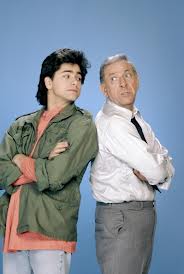
Jack Klugman with Tony Randall in "The Odd Couple".
The death of Jack Klugman over Christmas reminded me of just how versatile an actor he was. Beyond being Quincy, the M.E., he played a wide range of characters from the comedic to dramatic and even tragic.
My favourite sportswriter
It was reruns where I first saw Jack Klugman playing the sloppy sportswriter Oscar Madison, who roomed with neat freak Felix Unger (played by Tony Randall). The show, which ran from 1970 to 1975, was based on the Neil Simon play and movie of the same name. The chemistry that Klugman and Randal had, made the show. It was off the air by the time the '80s dawned, but I saw it in reruns. I even bought the first season DVD and it holds up pretty well.
Still, it was in comedy where I first saw Jack Klugman in action, making it a little jarring when he appeared in the dramatic, and at times intense "Quincy, M.E."
Jack Klugman in "12 Angry Men".
One of the angry ones
Christmas 1985 was when I received my first VCR, and I wore it out taping shows I could not stay up late enough to watch.
It was a few months into 1986 when I was browsing "TV Guide", as I did every week, when I saw Channel 7 was airing "12 Angry Men" after midnight, on a school night.
Faithfully, I set the timer, and when I had some time, watched one of the best movies I have ever seen.
The premise is well known. It is a hot, sweltering day in the city, and no one wants to be cooped up inside, especially a jury of 12 men deliberating over a murder case. A guilty verdict means the death penalty, and seemingly everyone believes, beyond a shadow of a doubt, the defendant is guilty. The foreman takes a vote and the result is: 11-1. Juror number eight, played by Henry Fonda, is not completely convinced either way, but he wants to talk about it given the life-or-death stakes of the situation. It concerns him that everyone seems to want to vote guilty just to be done with jury duty. Slowly, he points out inconsistencies, convincing juror after juror there really is reasonable doubt.
Jack Klugman plays juror number five, who is dressed in a suit and seems to be a young professional. He is one of the first to change his vote to not guilty. It turns out he grew up in a tough neighbourhood and, when discussion turns to the mechanics of a knife fight, he shares his personal observations. He points out that in a knife fight, someone experienced would thrust up, not down, as one of the witnesses had testified.
Klugman's performance, although as dramatic as any episode of Quincy, is even more intense. However, instead of the brash and opinionated coroner, here he plays the opposite, a quiet, understated man with a more difficult past than he lets on. He was part of an amazing ensemble that included Martin Balsam, Lee J. Cobb, Jack Warden, E.G.Marshall, John Fiedler, Ed Begley, Robert Webber, and others.
Return to comedy
Jack Klugman with John Stamos in "You Again".
In 1986, a new comedy debuted starring Klugman and teen heart throb John Stamos. It followed another new comedy "Valerie", starring Valerie Harper, on NBC, and was based on a British comedy. In fact, the actress who played housekeeper Enid Tompkins on "You Again" simultaneously played the same role on the British comedy, frequently commuting from England to the U.S.
Klugman was a grocery store manager, divorced for a decade, who had a son he never paid much attention to. One day the son appears to live with him. Subsequently, the sparks begin to fly.
I really liked the show, although it took some getting used to seeing Klugman doing comedy once again. However, not many other people did as it only lasted parts of two seasons, for a total of 26 episodes.
"You Again" must ave made an impression though, because when Klugman died, Stamos was one of the people close to the deceased actor, who was interviewed about his time with Klugman.
Given the current state of network television, we likely will never see an actor as versatile as Jack Klugman again. He truly was a master of his craft, just as convincing doing comedy as heart-stopping drama. He was as durable in life as he was on the screen. Throat cancer would take part of his voice, but it did not dampen his enthusiasm or drive. Instead, the aftermath of his throat cancer was worked into the story of the "Odd Couple: Together Again" reunion movie in 1993.
Comedy, drama, Jack Klugman could do it all, and anyone who saw him in action was richer for the experience. Just ask John Stamos.
The cover of the paper back version of "The Devil and Max Devlin".
There is something to be said about self-confidence. It can make all the difference in the world. So much so that some people would go so far as to sell their very souls to the devil to get it.
The same goes for redemption. It is never too late to do the right thing for the right reasons.
Such is the premise of the 1981 Disney movie "The Devil and Max Devlin". It stars Elliott Gould as Max Devlin and Bill Cosby as the devil "Barney Satin" (read "Satan"). Max is a pretty despicable character, a slumlord who is hit by a car and killed.
He meets Barney who offers him a bargain. If he can deliver three uncorrupted souls to the devil, Max can have is life back. He has three months to complete the job too.
We see the first hint of conscience in Max when he exclaims the three souls all belong to children. Yet, Max knows what is at stake when he returns to earth.
The movie is then broken into three story lines whereby Max goes about masquerading as various men to ingratiate himself into the lives of his three victims. One is Toby Hart, a boy, played by Adam Rich of "Eight is Enough" fame, who really just wants a dad. Another is a teenage nerd "Nerve" Nordlinger, who wants to be popular, and figures being a motocross racer will do it. The final one is a young lady, Stella Summers, played by Julie Budd, who wants to be a famous singer, but can't seem to carry the slightest hint of a tune.
Max is endowed with some supernatural abilities which allow him to fulfill these dreams. He proposes to the Toby's mother, turns "Nerve" into a motocross racer, and Stella into a singing sensation.
As the deadline approaches, and they all sign "contracts" with Max, their personalities change and become, as he describes them, monsters. Barney responds that they all belong to him now.
Max has second thoughts about what he has done, and when he discovers the three youth will be taken instantly and not after they naturally die, he wants out of the deal. Barney warns it will be a living nightmare for Max, but he burns their contracts anyway. The movie ends with Stella about to go on stage. Max tells her she can't because she will bomb, although he can't reveal he was propping her up all along. She tells him she won't. You see Max believed in her and now she believes in herself. She goes on stage, and is sensational, singing "Roses and Rainbows". As the time approaches that he will be whisked off to hell, he stays. He saved his own soul by saving the others. The movie ends with him looking heavenward and mouthing a silent, "Thank you".
All it took was the power of belief to instill the self-confidence she needed to succeed.
In search of a sound track
There doesn't seem to be a movie today where you can't purchase the soundtrack, or individual songs you hear in it.
That wasn't always the case. The best example is "The Devil and Max Devlin". After I saw that final scene, I could not get that song out of my head. The following Saturday, my family went to Lethbridge for our weekly shopping trip. We stopped at Anglo's Stereo and Photo, which was the best music store in the city. Some movie sound tracks had already made it, so I was not completely off base to expect one for "The Devil and Max Devlin". Yet, no one had even heard of the movie, much less seen a sound track.
The best I could settle for, as I did with other movies, was buy the paper back.
Now, through the power of YouTube, "Roses and Rainbows" appears before you.
I'm glad I re-discovered the movie, and found the song, because it really struck a chord with me. So did the movie. If you do the right thing, for the right reason, redemption is always possible. Just ask Max Devlin.
"What did Steve Smith say to Mark Messier when he asked him to go out for a drink?
“I don’t know. I’ll have to bounce it off Grant Fuhr first.”
~a joke heard the day after Game 7 of the 1986 Smythe Division Final
It will never be given the credit it is due. Worse, it will always be remembered for an unfortunate bounce that led to the game-winning goal. But Game 7 of the 1986 Smythe Division final was not only one of the biggest upsets in NHL history, it was when the Calgary Flames signalled they finally had arrived. They showed they could get over that hump and beat the Edmonton Oilers. In 1986, they finally slayed the dragon.
One-sided Battle of Alberta
Back in the 1980s, the top four teams in each of four divisions automatically qualified for the playoffs. In each division first played fourth and second played third in the first round. The winners played in the second round. The winner of that played the other division winner in their conference for the conference trophy. The two conference winners played for the Stanley Cup.
This format meant the Flames faced the Oilers virtually ever year, and always in the second round. The Oilers had won in 1983 and 1984, the only two previous match-ups. The Flames had mounted a stirring comeback in 1984, down 3-1 in the series, to force a seventh game but could not beat Edmonton.
Meanwhile the Oilers had gone to the Stanley Cup final in 1983, 1984, and 1985, winning the championship in 1984 and 1985. During the 1986 regular season, the Oilers finished first in the NHL with 119 points, a full 30 points ahead of Calgary, who finished second in the division and conference, but sixth in the league, with 89 points. When the Oilers hosted the Flames in the 1986 Smythe Final, not only were they the two-time defending Stanley Cup champions, but the best team in the league by far.
It was a severe mis-match – on paper.
The series no one expected
But hockey is not played on paper. Anything can happen in the playoffs. That's why they play the games. Regular season records no longer mattered, beyond determining home ice advantage and playoff positions.
The Flames certainly didn't play like they finished 30 points behind the Oilers. They jumped all over the Stanley Cup champions in Game 1 in Edmonton on April 18, skating away with a 4-1 victory.
Game 2 was two nights later, again at Northlands Coliseum, and it was a back-and-forth affair all night, probably the most entertaining game of the series. Regulation time settled nothing as the teams headed to overtime 5-5. The Oilers prevailed, tying the series 1-1, heading to the Calgary Saddledome for the next two games.
Calgary won Game 3 by a 3-2 score, before Edmonton again tied the series with a convincing 7-4 win. The fire power the Oilers showed in Game 4 gave everyone cheering for the Flames cause for concern. Edmonton had finally shook out the cob webs and played like the best team in hockey, and they were going home for Game 5 on April 26.
Again, the Flames took it to the Oilers, winning by the same 4-1 score as in Game 1 of the series. Shockingly, the Flames were one game away from ousting the Oilers and, had it not been for an overtime winner by Glenn Anderson in Game 2, the series would already be over. And the Flames were going back to the friendly confines of the Saddledome to try and close out the series.
Game 6 showed how talented the Oilers were. With their season on the line, they overcame a 2-0 Flames' lead, skating out of Calgary with a 5-2 win, and a chance to save their season in front of their home crowd.
Game 7 was set for April 30 at the Northlands Coliseum.
The Flames celebrate and Steve Smith mourns as he inadvertently bounced the puck off his own goalie and into the net. It was one of several miscues by the Oilers that led to one of the biggest upsets in Stanley Cup playoff history.
More than one bad bounce
Everything came down to this one deciding game, but let's be clear here. The Oilers had lost three games already, two at home. They had played poorly and were lucky to even be in Game 7.
Once more, the Flames took it to the Oilers. That was a trademark of the series. Calgary consistently put Edmonton in a position where they had to play catch up. Game 7 would be no different.
About 15 minutes into the first period, Hakan Loob score a short-handed goal to give Calgary a 1-0 lead. This came with the vaunted Edmonton power play on the ice.
Two minutes into the second period Jim Peplinski made it 2-0. This goal was as soft as they get, but is never, ever mentioned. Oiler goalie Grant Fuhr came out to poke check the puck. It spun end over end over top of him, landed behind him and bounced into the net.
Now down 2-0, the Oilers re-grouped, as Anderson and Mark Messier scored unanswered goals to make the score 2-2 after two periods.
It should be noted that the entire game, Oiler defencemen, and all-star Paul Coffey in particular, were making dangerous cross-ice passes from behind their own net. And, Fuhr aimlessly wandered in his crease while the play was going on behind him throughout the game. At one point, one of the announcers observed one of Coffey's passes came dangerously close to hitting the goalie.
Sadly, it was not Paul Coffey who would be etched into history. Instead, Steve Smith, a young defenceman celebrating his 23rd birthday the night of Game 7, went behind his own net to retrieve a shoot-in from Flame Perry Berezan. With 5:14 gone in the third period, his attempted cross-ice pass hit Fuhr and went into their own net. It gave the Flames a 3-2 lead they would not relinquish.
The Flames had finally slayed the dragon.
Everyone to blame
After that game, Oiler fans were outraged and blinded. They were looking for someone to blame, so they focused their fury on Steve Smith. Because Oiler fans were never very good at losing, they never knew how.
Well, there was plenty of blame to go around. First, the Oilers should never have been in that position in the first place. They had had one of the best regular seasons in NHL history, yet let a team of grinders continually get up on them.
Then, during Game 7, they made a myriad of mistakes. Surrendering a short-handed goal when you have one of the best power plays in the league? Inexcusable. Botching a poke check that ends up pinballing into the back of the net? Unacceptable. Allowing all your defencemen to make dangerous cross-ice passes from behind their own net, while the goalie is wandering into the passing lane? A horrible coaching mistake. Finally, having the most potent offence in the league and having more than 14 minutes to score one goal with your season on the line and coming up empty? Shameful.
Everyone was to blame.
High school memories Can't believe it
As the series wore on, I recall the topic coming up virtually every day in social studies class. Our social teacher was Gid Vuch. I recall Mr. Vuch saying the Flames should not be winning the series.
My response was simple: “From what I understand, the team with the most goals at the end of the game – wins”.
He did admit the Flames were out-working the Oilers.
Hockey pool
Two guys in school, Troy and his cousin Jared, had a hockey pool. It was the first one I entered and it was pretty straightforward. They passed out the playoff draw, and we had to choose which team would win every series until we got to a champion.
In the end, Corinna and Shelly, two girls in Grade 10, won the pool by getting every series winner right.
I worked with Corinna and, at work one day, asked her how they did it.
"It's pretty simple," she said. "We looked at every pair and asked, 'Where is the best shopping?'"
Just that simple.
Only shirt
When the Flames first moved to Calgary in 1980, my mom bought me a Flames t-shirt with the flaming "C" on it. I was 10 years old at the time.
I dug out that old Flames t-shirt from junior high the next day to wear to school to show my support. I had grown quite a bit since the last time I'd worn that shirt. It was not just pride that was bursting that day.
The legacy
The Flames moved on to the Campbell Conference Final against the St. Louis Blues. They took a commanding 3-1 series lead, before allowing the Blues to come back. The low point was Game 6, where the Flames blew two three-goal leads to force Game 7. The Flames won that, but had nothing left for the Montreal Canadiens in the Stanley Cup Final. The Flames did win Game 1, but dropped the next four games in a row. It would be three more years before they won the Cup, becoming the only team in NHL history to win the Cup in Montreal.
Meanwhile, the Oilers won the Stanley Cup the next year, and the year after that. Steve Smith had a 16-year NHL career and, ironically, finished it with the Flames.
The 1986 Smythe Division Final also still remains the only time the Flames have ever beat the Oilers in Stanley Cup playoff history.
Greg Peterson set a CFL playoff record by intercepting a Matt Dunigan pass and returning it 106 yards for a touchdown. It was the highlight of the 1987 West Division Semi-final.
The feeling in my feet did not return for hours, the victim of my first Edmonton winter. The lesson I learned from that day in November of 1987 was how to dress right for the cold.
But the memories I have of that day are etched in my mind forever. Cold yes, but what made it memorable was on that day, I witnessed my first ever Canadian Football League game, and it was a doozie: the 1987 Western Division Semi-final.
Dream into action
Watching a pro football game live was like a dream, as corny as that sounds. I’d seen dozens of games on TV but that seemed like another world, like it wasn’t even real. When I headed off to university in Edmonton in September of 1987, that was not on the top of my list.
So, a couple months later when my next door neighbour Daryl invited me and my roommate Chris Vining to go to the Western Semi-final, I jumped at the chance. Not only was it a pro game at Commonwealth Stadium, but my favourite team, the Calgary Stampeders, was Edmonton’s competition.
It was just two short years earlier the Stampeders almost went under, if not for the SOS (Save Our Stampeders) campaign at the end of 1985, and the beginning of 1986. The Stamps managed to rebuild and make the playoffs in 1986 losing to the Eskimos, and were back again in 1987 looking for redemption.
The Eskimos were the defending Western Division champions, but were humiliated in the 1986 Grey Cup by the Hamilton Tiger-Cats (which included Jim Rockford, who had played with J.C. Watts' Oklahoma Sooner team that mounted that amazing comeback in the 1981 Orange Bowl). They too were looking for their own redemption.
Road trip, no free parking
Daryl and his best friend Mike were from Whitecourt, and another friend of theirs drove us to the game. It really was surreal. We snaked through the traffic into what seemed like a residential area when suddenly, looming in the distance, was Commonwealth Stadium. It is hard to describe the size and grandeur of seeing that stadium for the first time. Television never did it justice.
Finding a parking spot was the first great adventure. Suddenly, people holding up signs with prices appeared, offering their yards and alleys for us to park. Our driver selected one and followed his directions into a yard where we were packed in like sardines. All I could think was, we better not leave early because we couldn't. How could this be legal?
Game time Our seats were in the bleachers in the west side of the north end zone, I think. The sun shone on that bright Sunday, November 15 afternoon, but it was deceptive. I thought I had dressed for the cold, and was bundled up with several layers – except for my feet. One pair of white athletic socks would prove not to be nearly enough.
The whole first quarter I just kept thinking, "I can't believe I'm here." The Eskimos scored the only points of the quarter and led 7-0 after 15 minutes. The second quarter was pretty much the same, as they upped their lead to 10-6 by halftime. As became the norm at all games in Edmonton, no matter what the sport, we were surrounded by Edmonton fans. They never let us forget the score, or the fact the Eskimos were winning. It did not help that Calgary's offence could not move the ball. Their only points came off a couple J.T. Hay field goals.
Faint hope Then things changed on a dime, as they often can in the CFL. After Edmonton kicker Jerry Kauric made the score 13-6, Calgary's offence sputtered again and they had to punt. On the ensuing drive, Calgary free safety Greg Peterson intercepted a Matt Dunigan pass in his own end zone. Me and Vining cheered loudly, our first hope. But Peterson broke a tackle, got into the open and took the ball all the way to the end zone. Our cheering got louder and louder as he approached us, climaxing in an explosion of high fives as Peterson crossed the goal line. We looked over in the direction of those obnoxious Eskimo fans and just smirked. When the smoke cleared, it was a 106-yard return, which was a CFL playoff record at that time, lasting 10 years. All of a sudden, miraculously, the Stampeders had tied the game at 13-13. It was a new ball game.
Not for long. The Eskimo defence smothered Calgary's offence, not allowing a touchdown the entire game. Calgary's defence kept Edmonton out of the end zone too, but the field goals began to mount. Kauric tacked on two more before the end of the quarter, making the score 19-13 with just 15 minutes to play. There was still hope, but Edmonton never let Calgary get close. They traded field goals, and Edmonton added a single to make it 23-13. Calgary had one more hope, but turned the ball over deep in their own territory with very little time left on the clock. All Edmonton had to do was run out the clock to end a game they had already won. Instead, of going down on one knee, Dunigan plunged straight ahead on the goal line for another touchdown, making the final score 30-16. I never liked Dunigan as a player to that point, and revelled in his humiliation in the Grey Cup the year before. Now, he showed how little class he had, running up the score like he did. The Eskimos went to Vancouver the following week, upset the first-place B.C. Lions in the Western Final, then won the Grey Cup, also in Vancouver's B.C. Place, the following week on a last-play field goal by Kauric. The third option Daryl and Mike were sporting the colours of their favourite team: the Saskatchewan Roughriders. It was my first exposure to that uniquely Canadian phenomenon: Rider Pride. Part way through the second quarter, we we were jeering Dunigan. Mike and Daryl joined in. "Matthew, you weenie!" Mike yelled. "You suck," Daryl added. Our newfound friends, the Eskimo fans, told them to sit down. Then the Stampeders got possession. "Boo," Mike yelled. "Calgary sucks!' "Ya," Daryl chimed in. The Eskimo fans were perplexed now.
“Who ARE you cheering for?” one of them asked.
“The Riders.”
Post-game show
As the temperature dropped, and our hopes faded, my toes got more and more numb. I could not believe I had not worn more than one pair of socks when I double and triple-layered all my other clothing. Still, it did not hamper my enjoyment of the experience.
After the game, Daryl took off and told us to join him. We ran onto the field, and just walked around for maybe 20 minutes. It was like standing on plush carpet, it was so soft and full of body. It was the last natural turf in the CFL, and had won all kinds of awards. I could understand why. When we got back to our room in res, I immediately ducked under the covers to warm up, and stayed there for over an hour. I had been so cold – but it was so worth it. Every time after that, and I have now seen close to 60 football games, I wore at least two pairs of socks, and sometimes three.
The Glenbow Museum has this photo of Kate Andrews High School the way I still remember it.
It took a little while to warm to the idea. I’m not sure why I finally decided to, but part way through Grade 11, I bought a high school jacket. White leather arms, dark baby blue melton, and “KA” in black lettering. It took me a minute to figure out my grad year because it seemed so far away. I recall counting it out a few times to make sure it was 1987. So that’s what was on one shoulder “Grad ‘87”, while on the other shoulder was my name, “Rob”. That was it.
And that’s what made me hesitate. I always thought you had to earn a jacket, like if you played football or basketball. But really, it was the letters you earned. Everyone was a student at Kate Andrews so they had just as much a right to wear their school colours as the jocks.
What kind of put me over the top was something my best friend Chris Vining said.
“We can wear our high school jackets when we’re on campus.”
I had not even thought that far ahead.
A couple years later, that’s in fact what we were doing.
One of the drawbacks about growing up on the farm was that I did not get to spend a lot of time in town or with my friends.
That all changed when I entered junior high and we started taking shop classes over at the high school once a week. Every Thursday, we had regular classes at St. Joe’s then over lunch hour walked over to Kate Andrews High School.
It was a new freedom for me. A chance to check out Mac’s and Red Rooster and – the arcade. It was called McLennan’s and you could hear the video games even before you entered the building. It was in downtown Coaldale, right beside a butcher shop.
McLennan’s was where I first encountered Pac Man, and Ms. Pac Man, Q*bert, Centipede, its son Millipede, Missile Command, Berzerk and its cousin Frenzy, and my all-time favourite Space Invaders. It’s also where I first feared for my life and my safety.
There is nothing I have seen like the arcade atmosphere of the 1980s. There were players, and people who just crowded around the consoles to watch them.
The currency was the quarter, the goal was to stay alive as long as you could in whatever electronic environment you chose, earning as many points as possible along the way. You could become a man, a gun, a ship, even just a pair of crosshairs. Players lived vicariously through all of this video incarnations and much more.
Because I never really had a lot of money, I didn’t play a lot of video games. Not like some guys I knew who played a lot. That was the only way to get any good though was by practising. Unfortunately, some guys got addicted. They ended up stealing from friends and parents to play just one more game or another.
I can understand that compulsion to play. You kind of go through stages. At first you learn the rules, usually by watching other guys play. Then you get better by developing some sort of pattern. There is a high in going farther and farther, your score continuing to climb. The rush ends just as quickly when you run out of lives or men. Sometimes it is an irresistible urge to play again. Especially a little bit later when, if you plugged in more money before a certain time, you could continue from where you left off as opposed to starting all the way back at the beginning.
There was something different about arcade video games. I had an Intellivision and later a Commodore 64. It may have been the graphics, or the playability, or the atmosphere, but there was just something better about playing a video game in the arcade. Maybe it was standing up, as opposed to sitting or lying down. Or being surrounded by a dozen backseat players.
Glen Wesley was another favourite, although his time in Boston was too brief.
Cam Neely, my favourite Bruin.
It could not have been a better present for my 18th birthday. Not only did I get to see my favourite hockey team in the whole world win, but they beat the best team in the world to do it.
I was in my first year university in Edmonton, not even away from home an entire year, when the Boston Bruins came to town. I had been a fan since I was five years old and, living on that farm, never thought I would ever get to see them.
Back then, the National Hockey League played an unbalanced schedule so the Bruins, who played in a different division and conference, came to Edmonton once a year. It was the same time of year, and it happened to be the second week of February, coming very close to my birthday.
In 1988, the date was February 12. The Engineering Students Society periodically sponsored a party and a bus to go to Oiler games. We had a friend on our floor, Mak, who always let us know and could get us tickets. The price included the game and a bus ride to and from the Northlands Coliseum. My roommate Chris Vining had already taken advantage once, going to see the Chicago Blackhawks.
As luck would have it, the engineers were going to the Boston game, and Mak made sure there were spots for me and Vining.
What followed was the most memorable game I have ever seen. Not just because it was my first ever NHL game either.
The setting The Northlands Coliseum was just a picture on TV when I was a kid. We saw it often, because by the dawn of the 1987-1988 season, the Oilers had been to four of the previous five Stanley Cup finals, and won three of them. They were always on TV.
Nothing prepared me for the Coliseum. When we entered, it was surreal. Everything I had seen on TV the past seven-plus years was right in front of me. "That was the ice surface", I thought. When I turned to start climbing the stairs to our seats, I was amazed. I’d gone to a fair number of Lethbridge Bronco games at the Sportsplex, and that had been the biggest arena I’d ever been in for a hockey game. Looming in front of me was the Sportsplex with two bowls of seats added on top. It was huge.
As we climbed the stairs (Vining led the way), my nose didn’t bleed, but I was winded. And back then, I was in the best shape of my life. We were so high up, we could look down into the press box and see the replays on their monitors.
We settled in. Pretty soon, it was time for the national anthem, then the opening face off. I was pumped.
Gord Kluzak first caught my attention as part of the 1981 Canadian World Junior team.
Goaltender Rejean Lemelin, another all-time favourite, back to his days with the Calgary Flames.
The teams The leader of the Boston Bruins was defenceman Raymond Bourque, one of the greatest ever to play the game. My favourite Bruin was rugged winger Cam Neely. They also added goalie Rejean Lemelin, who I’d grown up watching play for the Calgary Flames. They had four other great defencemen too: Glen Wesley, Don Sweeney, Michael Thelven, and Gord Kluzak (who had made his mark on that 1981 Canadian world junior gold medal team). Their coach was Terry O’Reilly, who was a tough guy with the Bruins when I was growing up. He was still relatively young, especially as far as NHL coaches went.
They were not a high-scoring team, but didn’t need to be playing in the low-scoring, defence-minded Adams Division. They were a tough, gritty team.
Conversely, the Oilers were one of the highest scoring teams in NHL history, boasting captain Wayne Gretzky, the best player on earth, and a cast of future hall-of-famers, including Mark Messier, Glenn Anderson, Jari Kurri, and Grant Fuhr. They were the defending Stanley Cup champions and were one of the favourites to win it again.
This was what my favourite team faced.
The game: Inauspicious beginning It did not look good early on. Before the game was too old, I almost began to regret the abuse I was sure I would take by buying a Bruins pennant at one of the souvenir stands. The Oilers scored early, and pretty often. Before I knew it, they had surged to a 4-1 lead. "It only gets worse," one nearby Oiler supporter said when he noticed my Bruins pennant. And he said that after every goal they scored.
Given the Bruins didn't have a lot of offensive fire power, things looked bleak.
The game: It only gets worse
Ray Bourque, one of the best Bruins ever.
I wish I knew what O'Reilly said to his team in the first intermission. When the second period started, the Bruins were a different team. They scored, and scored again, and again.
Vining looked over at our newfound friend.
"It only gets worse!' he yelled – after every goal.
What was the Oiler supporter's response?
"Who's got more cups?"
That was the standard response of Oiler supporters back then, usually in response to the fans of their arch-rivals the Calgary Flames who had never won the Stanley Cup to that point.
I looked at this guy kind of puzzled.
"Um," I said. "The Bruins do."
The game: Bring on Warren
When we were growing up, there was a goalie who played for the Calgary Wranglers we came to like named Warren Skorodenski. On that day, he was backing up Grant Fuhr, who was one of the best goalies in the world, and had just beat the Soviets in the 1987 Canada Cup.
After the Bruins got a couple quick ones past Fuhr, me and Vining started another chant:
"We want Warren!"
The Oiler supporters around us had no idea what we were talking about, and told us so.
"See, they don't even know their own team," I muttered to Vining.
Oiler back-up Warren Skorodenski, who replaced starter Grant Fuhr after the Bruins chased him. Skorodenski was an old favourite from his junior days with the Calgary Wranglers.
Suddenly everyone knew. It came over the loud speaker.
"Now playing goal for the Edmonton Oilers, number 30, Warren Skorodenski."
We screamed our approval. Everyone else frowned.
By the time the dust had cleared, the Bruins had scored six unanswered goals and cruised to a 7-4 victory.
Ten different Bruins hit the score sheet: Ray Bourque had a goal and an assist; Randy Burridge had a goal and three assists; Lyndon Byers had a goal; Geoff Courtnall, who would be traded to the Oilers not too much later, had two goals; Steve Kasper had a goal and two assists; Reed Larson had an assist; Tom Lehman had an assist; Ken Linseman, a former Oiler, had two assists; Bob Sweeney had a goal and two assists; and Glen Wesley had an assist.
The defence rests
About half way through the third period, the Oilers were crossing centre ice with the puck, when Vining said:
"Look at that. Five Bruins across the blue line."
Boston had boarded up the net.
Once the final buzzer sounded, we let out one last cheer. Otherwise, the place was a morgue. It was awesome.
I could never have asked for a better 18th birthday present.