Tuesday, 20 August 2013

First concert: Boston, Fall 1988, Northlands Coliseum

The cover for Boston's self-titled debut album,
featuring "More Than a Feeling", and "Peace of Mind".
It was a dream come true, something I never dreamed possible when I was sitting in my bedroom with the headphones on late at night listening to Boston on tape. In the fall of 1988, just a couple months into my second year of university, I saw Boston live in concert at the Northlands Coliseum in Edmonton.

The seed
My love for Boston came pretty quickly. At the end of Grade 11, I started hanging out with a classmate named Randy. He was a year older than me, as was everyone in my class, and he had a car – and a stereo. And, his mom loved music. One day, he came to school with a tape he made from his mom’s collection. We listened to it while we cruised the streets of Coaldale after class. Two songs I distinctly remember being on that tape were “Dream Weaver” by Gary Wright, and “More than a Feeling” by Boston. That summer, we went to visit my brother in Calgary. He always said I could record any of his music, and the man had tons of vinyl. One of the albums was Boston’s debut album, which contained “More than a Feeling”. He recorded that album on tape for me, and I never tired of listening to it. Little did I know, there was more to come.

The Third Stage
Grade 12 was maybe a month old, when I was listening to LA-107 FM, and they advertised their next album highlight. Every week night, the album-oriented radio station played a few songs and provided a bit of history on a new record that had just come out. That night’s album highlight was “The Third Stage” by Boston. I had something else going at 7 p.m., so I actually set my ghetto blaster to record the album highlight. It was the best decision I ever made.

I didn’t listen to the tape until it was time for bed that night. I put on my headphones and got my first real introduction to Boston.

Since then, I have listened to that tape so often, I can pretty much recite the intro to that album highlight: "They were a pretty hot band in the 70's then kind of faded away. Now Boston's back with 'Third Stages'". I distinctly recall the deejay getting the name of the album wrong.


Then the slow intro to "Can'tcha Say" began and I was hooked. "Holly Ann" followed, then "Amanda", which was the first single they had released.

The deejay came back on and gave some history on the band, especially guitar player and band leader Tom Scholz. He was an engineer who experimented with sound. He invented a machine called a "Rockman" which was described as a pocket amplifier that a guitar plugged into, and its sound was evident throughout the album. Other artists, such as Berlin, would use the "Rockman" as well. A broken tone bender was also used in one song to create a distinctive sound.

After their debut album, which sat on the charts almost two years, they put out "Don't Look Back", a follow-up album that also charted well. Then, Scholz got into some legal problems, and did not fulfill his contract for another album. Consequently, some of the songs were more than a decade in the making, as the deejay referred to the notes to the album.

The version of Boston that produced the "Third Stage" album was completely different from the 1970s version of the band. The only holdovers were Scholz, and lead singer Brad Delp. His voice gave Boston the same vocal sound as we all heard on their first two albums. Gone were Barry Goudreau, Sib Hashian, and Fran Sheehan, although the last two were credited on the album.

The original lineup for Boston, which was long gone by 1986.
From left are Barry Goudreau, Tom Scholz, Sib Hashian,
Brad Delp, and Fran Sheehan.
That album highlight concluded with another song, "I Think I Like it". When the deejay introduced it, he said it was "To Be a Man". I guess he probably never checked the script against he songs.

I must have played that recording more than a hundred times. Eventually I bought the "Third Stage" record through Columbia House and my sister dubbed it onto a blank tape for me.

In Social 30, my teacher Mr. Vuch used to talk about music. One day he mentioned an article he read in Time magazine on Tom Scholz. I told him I had become a big fan, so he made me a photocopy. It was only a one-page article, but recounted how Scholz was an engineer who never let stardom affect him. He still lived in the same small, old brick house in Boston, and drove the same old Volvo.

By the late fall of 1986, "Amanda" caught fire and shot up to the top of charts where it stayed for two weeks. The album climbed the charts too, reaching and staying at number one on the Billboard Hot 100 for four weeks.


The second single, "We're Ready" also charted, peaking at number nine, but there was no more top 10 success. They released "Can'tcha Say" and it peaked at number 20. I was surprised because I loved that song.

In concert
Boston remained in my listening rotation when I headed off to university in Edmonton in the fall of 1987, but they there was no follow-up singles or album, so they fell off my radar.

Then, in the fall of 1988, my second year of university, I heard they were coming to Edmonton. They would be making their first tour ever into Western Canada, and the Northlands Coliseum was one of the stops.

The problem was that I had no credit card, therefore little chance of getting a ticket. Besides I wasn't sure I had anyone to go with. And I didn't know what to do. I had never been to a concert – ever.

Enter a girl on my floor, Peg from Peterborough. She loved Boston and did all the work, getting tickets for me, her, and her boyfriend, which actually changed between the time she bought the tickets and we were riding the LRT to the concert.

When we got there, I experienced another first. I bought a concert shirt. It was black and had the same drawing as appeared on their first album cover.

The concert was awesome. Scholz came out, sporting a huge knee brace, limiting his mobility. He basically just stood there and played. That was fine by me, but critics panned his performance the next day. The Edmonton Sun headline was "Less than a feeling". I was enraged.

Anyway, Boston did just what I wanted: they played all the songs I liked – except "Holly Ann".

They left the stage for the obligatory encore. I hooped and hollered. Peg and Greg ran down to the concert floor (we were in the first row of seats behind one of the players' benches). All of a sudden the band returned – and they played "Holly Ann".

Then, I found myself alone. All the people who had been sitting around us disappeared. Scholz went into the solo at the end of the song, and played right along on my air guitar. He looked in my direction and I pointed at him. I swear he pointed right back at me. I swear.

Parting thoughts
You always remember your first. Considering Boston had never come to Western Canada, and I never thought they would, they were the best band to be the first I saw in concert.

In high school I was profoundly affected by Tom Scholz. He seemed like a nerd who had made good, and I had always felt like a nerd. Here was an engineer who was not only rocking out, but sitting on the top of the charts. He never sold out, or played by the rules set out by heartless recording companies. Instead, he seemed to stay true to his vision and I always admired that.

And Brad Delp's vocals are amazing. "Amanda" remains one of my top ten favourite songs, and it is his voice as much as everything else in that song. Sadly, Brad Delp committed suicide in 2007, and it was a waste, a sad ending to a life that entertained, and even inspired, a generation.

Monday, 19 August 2013

Walking the runway with Wang Chung


It came like a shock from the unknown. It was a simple question, really, but I had to ask myself, “Who me?”

It was Grade 12 and one of the members of the grad committee, confronted me in the lunch room right near the front doors. It was Kate Andrews High School, second semester, 1987. She looked serious. I worried.

“Do you want to be in the grad fashion show?” she asked.

Never, in a million years, had I thought that would ever happen.

It took close to one nanosecond for me to answer: “Ya.”

Stuff like that was always for the cool kids in school. Was I actually cool now? It really didn’t matter because I was working, going to school, having my heart broken by a girl, and beginning to see the end of high school, and university in a far off place looming on the horizon.

Clothes make the man
All us models were told to head downtown to Herb Fletcher’s Men’s Wear to choose a few outfits: one tuxedo, one semi-formal, and one casual.

It was an amazing experience. Herb, at least I thought it was Herb, knew just what to do. He gave us a catalogue of tuxedos to leaf through. Tuxedos! It was so cool. I chose a black one with a longer jacket.

I remember when one f the other guys, Tony I think, came out of the change room, fully decked out in his tuxedo. He walked about five feet, spun, looked me in the eye and said, “Bond – James Bond.” We both giggled, you know like two 17-year-olds should.

When I emerged from the change room in my black tuxedo, I was still in disbelief. It was so cool. Herb conveniently told us we could rent those tuxes for grad, and marked in the catalogue which ones we had modelled. I went home and told my mom I would love to wear a tuxedo for grad. She said she’d planned on buying me a suit, but this was just as good. In retrospect, to this day, I think it was better.

That day, I also chose a steel gray jacket with a tie for my semi-formal, and pair of black pants and a yellow shirt with a black boxed pattern for my casual wear.

My mom always said “clothes make the man” (or at least the German equivalent) . I felt like a man now.

Show time
We had no rehearsal, and no preparation. It was a week night, a Wednesday I think, and I drove to the school early. We got dressed, formal wear first, and that tux felt so nice. I ended up walking around the lunch room which was next to the gym. One of the girls had some modelling experience and demonstrated how to walk. Well, there was no way I could move like that. I thought I would just follow the lead of my partner.

It was show time, and the emcees were Ed Ryan, our guidance counsellor, and Angie Credico, our sewing/home economics teacher. Mr. Ryan, who was like a second father to me, was a radio announcer in his previous life, and he was a great host.

Suddenly, “Let’s Go” by Wang Chung was playing, and I accompanied my escort down the runway. It was so awesome! Once we left the stage, we quickly changed and repeated the runway walk.

There was a change of plans for whatever reason, for the casual wear. I went out with Jason and Rachel. We walked down the centre together, then each of them went in a different direction, leaving me facing the crowd. I didn’t know what to do, so I did what came naturally – nothing. I stood, and kind of walked in place. I felt like a soldier marching. They completed their turns, we joined up and walked off together. We were laughing so hard when we got off the runway.

It was the beginning – and end – of my modelling career. But every time I hear “Let’s Go” I think of that special night I got to feel, or at least dress, like I was important.

Sunday, 18 August 2013

Cruisin’: The night of the "Easter Epic"

Where were you when the the "Easter Epic" ended?

What is the "Easter Epic" you ask? Well, back in 1987, it was not called that, but as the legend grew, one of the most famous first round series' and the longest Game 7 in Stanley Cup history, acquired this name.

Incidentally, I was in my parents’ 1974 Oldsmobile Omega cruising the streets of Lethbridge.

Nice night for a drive…and an overtime marathon
It was the spring of 1987, April 18 to be exact, and I had had my licence about six months. A normal Friday night for me was going to the Lethbridge YMCA with my friends, dropping down a $1 bill for “Teen Night”, and playing some racquetball, and later basketball. The place closed at 10 p.m., so we got something to eat, then went cruisin’.

We always took turns driving. This particular night, I picked up my best friend Chris Vining. Before I left the farm, I had watched a couple minutes of the Capitals-Islanders game. It was the Patrick Division semi-final, tied three games apiece with the deciding Game 7 in Washington. When I pulled up to Vining’s place in Coaldale, he told me it was 1-1.

That was the last we thought of the game.

Instead, we played some ball, had something to eat and cruised. It was the same route over and over, but we never got bored. Why? Because there was always the promise, or so we thought, of finding some girls to hang out with – no matter how remote the possibility was.

When I dropped Vining off, I joked: “I wonder if the game is still on.” It was about 12:30 a.m.
The New York Islanders celebrate Pat LaFontaine's goal in the fourth overtime period of Game 7 of the 1987
Patrick Division Semi-final. It remains the longest Game 7 in Stanley Cup playoff history.
LaFontaine's heroics
The next day, Vining phoned me.

“You know what?” he said. “When I walked in the house, mom said the game had just ended a few minutes earlier.”

It had turned out to be an epic battle. Washington came out flying, but could not beat Islander goaltender Kelly Hrudey. Finally, with 48 seconds left in the opening period, Mike Gartner scored for the Capitals, with assists from Greg Adams and Scott Stevens, to give them a 1-0 lead after 20 minutes.

Pat Flatley tied it for New York with 8:25 to go in the second period, but Washington responded. With 1:15 left in the period, Grant Martin put the Capitals ahead with help from Adams and Larry Murphy.

That 2-1 score held up until Bryan Trottier tied the game 2-2 with with just over five minutes remaining in the third.

There was no more scoring in regulation time, or the first, second, or third overtime periods. Finally, with eight minutes gone in the fourth overtime period, New York's Pat LaFontaine took a turnaround snap shot from near the top of the face-off circle. It looked harmless, but beat goaltender Bob Mason to end the game after 68 minutes and 47 seconds of overtime. The assists went to Ken Leiter and Gord Dineen.

Everyone was exhausted, but they had cemented their place in history. Hrudey stopped a record 73 shots, including 50 straight after Martin's goal had made it 2-1 for Washington.

The situation
Washington had finished second and New York third in the Patrick Division that year, setting up a semi-final series that was the fifth straight year the two teams met in the playoffs. The year before, the Capitals eliminated the Islanders the earliest time in their history, although New York had won the other three series.

Washington jumped out to a 3-1 series lead, before the Islanders won two straight to set up the decisive Game 7. Their victory was just the second time in 12 years a team had come back from that kind of deficit.

There was no rest for the wicked as the Islanders had to re-group to face the well-rested Philadelphia Flyers. Again, the Islanders fell behind in the series 3-1, and again they battled back to force a decisive Game 7. The clock struck midnight for this Cinderella, as the Flyers won 5-1 to take the series. They would go on to the Stanley Cup final, losing in seven games to the Edmonton Oilers.

Saturday, 17 August 2013

Remembering August Schellenberg

Canadian actor August Schellenberg, who appeared
in virtually every TV series shot in Canada, died on
August 15. He was 77. He also played the
patriarch in the Canadian TV movie "Striker's Mountain".
Yesterday I heard Canadian actor August Schellenberg died. Most people I think would recognize him, even if they didn't recognize the name.

According to all the tributes, he is praised as being one of the best Native-Canadian actors ever. That description certainly fits, given such roles as Sitting Bull in "Crazy Horse" and "Bury My Heart at Wouned Knee" (for which he was nominated for an Emmy); Cochise in "Geronimo"; Randolph Johnson, Haida keeper of Willy the Orca in "Free Willy"; and the Algonquin Chief Chomina in "Black Robe".

He guest starred in virtually every TV series filmed in Canada from "The New Avengers", "ENG", "Street Legal", "Seeing Things", "Night Heat", and "Adderley", to "Hangin' In", "The Edison Twins", "The Littlest Hobo", "Road to Avonlea", "Friday the 13th", "The Hitchhiker", "Due South", "Lonesome Dove", "Counterstrike", and "North of 60".

He also guest starred in some American primetime series' such as "Grey's Anatomy", "The Equalizer", "Airwolf", and "Walker, Texas Ranger".


Striker's Mountain
However, for me, August Schellenberg's most memorable role is as "Jake Striker" in the Canadian TV movie "Striker's Mountain", for which I devoted a blog post in July.

He plays the patriarch of a family that owns a ski hill that has fallen on hard times, and is under threat from a developer. He is struggling between preserving the only way of life he has known, and trying new things to keep the operation viable, such as heli-skiing.

Schellenberg plays the consummate patriarch, navigating the difficult waters of a parent with grown children who have their own ideas.

Legacy
August Schellenberg was a prolific actor. I was surprised at the depth and breadth of his work. Quite frankly, I was surprised he was a Native-Canadian actor, because the role of Jake Striker was a non-Native role, and that was the first role I saw him in. Still, it was a powerful and passionate performance, and gave just a hint of the talent he possessed. That talent was evident by the Emmy nomination he received in 2007

The fact he kept on working, right up until his death at age 77, is a testament to that talent and versatility.

Friday, 16 August 2013

Human League at the house party


Now I was not one of the most popular kids in high school. It wasn’t until Grade 12 that I got invited to my first house party, but a memorable one it was.
Every time I hear "Human" by the Human League, I think of that party in October of 1986.

Invitation only
This girl named Monica, who I had known since early in elementary school, was throwing a birthday party for one of her friends, Michelle I think. By then, in Grade 12, the social circles were evolving, and we all kind of began to become friends with each other. So I was surprised, and thrilled, that she invited me over to watch movies, with a bunch of other mutual friends.

There was Chris Vining, my best friend at the time. We were pretty much inseparable. My friend Randy, who I'd been bench partners the semester before in Biology 20, was also going so I was stoked. There was another very important reason to go.

For the better part of a year, I had this crush on a classmate that I had no guts to act on. By then, we were kind of on the outs, although that would change, and another girl, Mal, caught my eye. She had even shown some interest, by passing me a note in social class.

She was one of Monica's closest friends – and she was going to be there.

I picked up Vining, and we arrived at the appointed time, after the actual birthday portion of the evening was over. I had just got my driver's licence over the summer, and this was one of the first times I had the car on my own out at night. It was awesome, although I was nervous, as me and Vining pulled up to the party.

When we got to Monica’s, they were watching some videos Mal had taped. At that moment “Human” by Human League was playing. All the videos were kind of new wave-ish, like General Public and Human League. Bands with lead singers that were somewhat feminine and even a tad androgynous.

Vining scoffed, especially at General Public. Mal scoffed back because she really dug that stuff. I wasn't a fan either, but I did sure like that Human League song.

I cannot recall what movies we watched, which is odd, but I do recall sitting around and talking afterwards. I could not take my eyes off Mal. She sat on the floor, her legs crossed, looking all beautiful, just taking in everything that was being said. Randy left, and took Vining with him. Another friend of the time, Dave, kind of took over the conversation, along with Monica, and they were talking about ghosts and ghost stories. I kept looking over at Mal, making the occasional comment, trying to make her laugh or at least get her attention. I wasn't that successful though.

The evening was beginning to wind down. Mal needed a lift home, and it would have been the perfect time to talk to her.

Instead, I hesitated. Another buddy, Mike, who actually had a girlfriend, did the gentlemanly thing and offered her a ride home. I stood there, frozen in time. I recall, pulling out of the driveway and following them all the way to the four-way stop at the junction to Highway 3 in Coaldale. Mike was turning left, into town. I was going right to head back to the farm. As I pulled into the right turning lane, I saw Mal, a few feet away in the passenger side of Mike's car. She might as well have been a thousand miles away.

She looked over as I was staring at her. She smiled and waved.

Then she was gone. So was my chance.

Not much after that, she found a boyfriend.

Whenever I hear "Human", I wonder what could have been. What would have happened, had I taken her home, and had just a few minutes alone with her in the car? How my life would have been different, if I had just taken a chance. Or would it? We will never know.

After all:

"I'm only human
Of flesh and blood I'm made
Human
Born to make mistakes"

Thursday, 15 August 2013

Ted Wass: Moving behind the camera

Ted Wass as Danny Dallas in the sitcom "Soap".
Recently I was watching a rerun of “2 Broke Girls” and it wasn’t the actors who rang a bell. That night it was the director – Ted Wass.

At various times he has been the father to “Blossom”, and the heir apparent to Inspector Clouseau in the “Pink Panther” movies. However, I remember him as part of a cast of one of the ground-breaking sitcoms of the late 1970s and early 1980s.

Ted Wass played Danny Dallas in “Soap”, which broke taboos and addressed subjects rarely mentioned to that point on television. It was pioneering, and able to do that through a clever plot device. It spoofed soap operas, which were already renowned for outlandish plots. It provided the perfect cover to attack dozens of social issues, and Ted Wass played a big role.

Another Dallas in a soap opera
The show was created by Susan Harris, Paul Junger Witt, and Tony Thomas. It centred around two sisters: Jessica Tate (Katherine Helmond) and Mary Campbell (Cathryn Damon), who had more secrets than anyone could count.

Wass played Danny Dallas, Mary's eldest son, and protective older brother to Jodie Dallas (Billy Crystal). In the first season, Danny was told by the mob his late father had been murdered, and he was to avenge that death by killing his father's murderer. There was just one problem though: the supposed murderer was Danny's step-father Burt Campbell (Richard Mulliagan). He spends the first season first trying to kill Burt but unable to do so, when he discovers Burt acted in self-defence. Consequently, Danny has to take it on the run, ultimately cutting a deal where he has to marry Elaine (Dinah Manoff), the daughter of a mobster (Sorrell Booke, who later played Boss Hogg in "The Dukes of Hazzard") in exchange for his freedom. In the midst of all this, he actually goes from loathing to loving Elaine, only to see her kidnapped and murdered.

Commentary – social and otherwise
"Soap" tackled a lot of controversial issues, and brought a lot of taboo subjects to television at a time where they had rarely or ever been discussed. One of the characters was openly gay, another suffered post-traumatic stress disorder. There was a suicide attempt, the struggles of a priest who fell in love and tried to reconcile that with his sacred vows, and a boy abducted by a cult. "Soap" also mocked racial and gender stereotyping.

There was a lot of talk about sex, whether it was extra-marital affairs, promiscuity, impotence, or the power of the orgasm.

And there was of course, the perpetual spoofing of soap operas and their outlandish story lines. There was the demonic possession of a baby, an alien abduction, and a character suffering amnesia and getting lost.

Dimwitted Danny Dallas was in the thick of a lot of it.

My own take
I still cannot believe I was allowed to stay up to watch "Soap". On peasant vision, it was on Thursday nights at 9:30 p.m. on Channel 13. It followed a CTV-made show called "Live it Up", which was kind of a consumer/current affairs show hosted by Jack McGaw, Allan Edmonds, and Mary-Lou Finlay. I have vivid memories of all the plots, but never even came close to getting any of the sexual references or innuendo. It was only when the show aired every day after school in Grade 9, on Channel 7, that I began to understand what some of those deeper meanings were. Good thing too.

Aftermath
After four seasons, "Soap" went off the air in 1981. Ted Wass would go on to appear in some TV movies such as "I was A Mail Order Bride" with Valerie Bertinelli, and some theatrical movies such as "Curse of the Pink Panther" and "Oh God, You Devil".

There had even been talk of making Wass' character in "Curse of the Pink Panther" into a recurring character to keep the "Pink Panther" franchise going, but that never materialized after the movie bombed.

Instead, Wass landed another landmark role in 1991, as Nick Russo, Blossom's dad, in the sitcom of the same name. This show was actually produced in association with Witt and Thomas. "Blossom" also dealt with some social issues, often announced with the phrase "a very special episode".

After five seasons, "Blossom" went off the air in 1995, and Ted Wass retired from acting to focus on his directing career.

Ever since then, he has directed a episodes of "Spin City", "Everybody Hates Chris", "'Til Death", "Rules of Engagement", "Two and a Half Men", "The Big Bang Theory", and of course, "2 Broke Girls".

It is always interesting to see how many actors move behind the camera to become directors. It is just interesting for me to see how the work, and the people who directed them, influence their own direction.

Ted Wass played two distinct characters in television shows that did not shy away from tackling tough issues. Hopefully, that informs his current work, so he can bring that same depth and layering to sitcoms in the 21st Century.

Jack Klugman: Grandfather of medical examiners

Jack Klugman in his role as Quincy, medical examiner.
TV is full of medical examiners now – whether it is the crew of CSI, Maura Isles on "Rizzolli and Isles", Megan Hunt on "Body of Proof", or others. They are the next generation who owe it all to one man, someone we only knew by a single name: Quincy.

Watching some of these shows and the death of Jack Klugman over Christmas reminded me just how versatile an actor he was.

What is an autopsy?
Jack Klugman is perhaps best known in the 1980s for his role as the medical examiner with one name: Quincy. Fans never discovered what his first name was, even late in the series when he got married. The show debuted in 1976, and it is just on the outer edge of memory. I recall it being part of the rotation of the "NBC Mystery Movie" with "McCloud", "McMillan and Wife", and "Columbo". "Quincy" soon spun into its own show, that settled into a Sunday night time slot on peasant vision on CFCN-TV Channel 13. The first episode I recall seeing involved the discovery of a bone with a bullet hole in it at a construction site, and how Quincy and company re-constructed that and solved the case.

It also had a great opening. Quincy is doing a demonstration with a body on his table for police officers. As he proceeds, they begin to pass out and fall over one by one, until none are standing around his table any longer. Somewhat taken aback, Quincy just peers over his table.

The show introduced terms foreign to television before that: coroner, forensic medicine, autopsy, pathology. Apparently, the origin of the series lies in several sources. According to Wikipedia, Quincy is based on the novel "Where Death Delights" by Marshall Houts; as well as on Thomas Noguchi, known in Los Angeles at the time as "Coroner to the stars".

When I was a kid I also recall seeing a Canadian talk show with actor John Vernon as a guest. They talked about this show Vernon once starred on CBC called "Wojeck", and said it was the inspiration for "Quincy" which was then on the air. Steve Wojeck was the fictional coroner in Toronto in the 1960s.

The show had a strong ensemble cast, led by Canadian actor Robert Ito who played Quincy's assistant Sam Fujiama. There was also John S. Ragin, who played Quincy's supervisor Dr. Robert Asten; Garry Walberg who played LA homicide detective Frank Monahan; and Sal Bisoglio, who played Danny, the owner of the waterfront bar and restaurant they all frequented.

The relationships with Sam and Asten were particularly interesting. Sam started out as a trusty assistant, but his character evolved. I recall one episode where he was drawn into a web of intrigue that involved his family and the Yakuza, the Japanese version of the mob. As for Asten, there was always a healthy tension between Quincy and Asten who was his boss. Asten vacillated between being a bureaucrat and bean counter, and a pathologist himself who wanted to seek the truth as passionately and unhindered as Quincy did.

Unfortunately, as the series wore on, it became much more preachy, and less about mystery. It began to take on issues of social justice, with mixed results. At times it shone a light on issues such as the glorification of drugs in music; eating disorders; the condition of foster homes; and the definition of criminal insanity. However, Quincy became more prone to lecturing rather than examining, and there more and more soliloquies.

The last season, the show's eighth, ended in 1983. By then Quincy had met Dr. Emily Hanover, played by Anita Gillette, fallen in love and married her.

Dr. Megan Hunt, played by Dana Delaney, is a medical
examiner in Philadelphia on "Body of Proof".
Dr. Maura Isles, played by Sasha
Alexander, is a medical examiner
in Boston on "Rizzoli and Isles".
Legacy
No matter how preachy and over the top the show became, the impact of Quincy on pop culture is cemented into history. The show introduced television to a part of crime investigation not before seen. Obviously, it was a rich mine for material given the explosion of medical examiners and crime scene investigators, such as Megan Hunt and Maura Isles. The technology may be more sophisticated, and the television production more slick, but there was no one better at solving a mystery than Quincy.

Tuesday, 13 August 2013

Tom Selleck: The Distinguished Gentleman

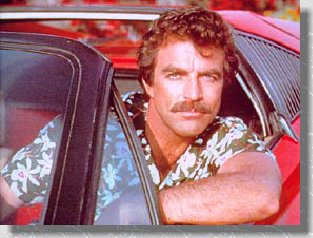
Tom Selleck as Thomas Magnum in his
patented Hawaiian shirt and Ferrari.
He currently plays Frank Reagan, police commissioner of New York City, in the police procedural “Blue Bloods”, but to people of a certain age, Tom Selleck will always be that venerable private investigator Thomas Sullivan Magnum.

It was never about the Ferrari, or the beautiful tropical setting, or the pretty girls. What struck me about Magnum was the moral centre, the good heart, the desire to help people.


Magnum P.I.
Thomas Magnum was a private investigator based in Hawaii. Somehow he managed to finagle a job as director of security for Robin Masters, a reclusive millionaire who furnished Magnum a place to stay and all the toys that went with his estate – including that trademark Ferrari. It also furnished him with his foil throughout the show, Robin Masters' major domo Jonathan Quayle Higgins.

Magnum operated his private investigation business from his home on the estate with the help, albeit not always willing, of his friends Rick and T.C. Rick was partners with Robin Masters in an establishment called the King Kamehameha Club. T.C. operated a helicopter service. What bound the three of them was their service in Vietnam together.

Tom Selleck guest starred in "The Rockford
Files" as private investigator Lance White,
who was nothing like Thomas Magnum,
but one of Selleck's first acting roles.
The heir apparent
“Magnum P.I.” debuted in 1980, a few months after the end of “The Rockford Files”. I have always believed that just as Jim Rockford was a private eye for the 1970s, Thomas Magnum was the consummate private eye for the ‘80s. Thomas Magnum was the logical successor to Jim Rockford. It made sense, partly because many of the people who created Rockford also created Magnum. (Besides, one of Tom Selleck's first acting roles was a guest starring spot in "The Rockford Files" as private eye Lance White).

I also believe Magnum was the last great TV private eye. We now live in a world of police procedurals, medical dramas, reality TV, and the drama fashioned on specialty channels. There are no more private investigators, and there have not been for a long time.

Evolution of a private eye
I call it the "Miami Vice effect". "Miami Vice" was not very popular when it debuted on NBC in 1984. Part way through that first season, it changed its style and tone, becoming much darker and brooding. Many shows followed suit, including "Magnum P.I.", where the story lines were not as clear cut, and we saw the darker side of Magnum, Rick, T.C., and even Higgins.

Back from the dead: the character and the show
"Magnum P.I." chugged along for years in its Thursday night time slot, a ratings juggernaut, confining its competition to the dust bin of time, and clips on YouTube.

Then along came a new force: "The Cosby Show". It was a formidable opponent and, eventually overtook "Magnum P.I." in the ratings. Contributing to Magnum's problems was the fact it was aging as a series.

Finally, CBS decided to put "Magnum P.I." out of its misery by moving it to Wednesday nights to compete against another long-time ratings force: "Dynasty". It was the seventh season of "Magnum P.I." and sure to be its last.

The creators even wrote a series finale where Magnum is shot in an ambush. He appears as an angel, guided through life by the ghost of his old friend Mac. This John Denver song keeps playing, and the show ends with Magnum and Mac walking off into the sunset.

But a funny thing happened on the way to cancellation. "Magnum P.I." held its own in its new Wednesday night time slot opposite "Dynasty". So much so that an eighth and final season was commissioned. Although it was a short season, it tied up a lot of loose ends, and gave Magnum a fate no one really expected. But I won't spoil that for anyone who missed it. You can still check it out on DVD or Netflix.

End of an era
When Thomas Magnum wrapped up his last case, it was the end of an era. Private investigators were a rare breed on TV. Unlike police, they don't have to follow the law, or always play by the rules. Often they are at odds with the law. They can gain access to places the law can't, or won't go, and find out things the law never could, in ways the law never would.

The distinguished gentleman:
Thomas Magnum meet Frank Reagan.
They have the ability to bring justice, or even just closure, to people who have nowhere else to turn. Sometimes they even break the law to do what's right, or what they think is right. At other times they take on unsavory clients just to pay the bills. They face dilemmas where they have to make extremely difficult choices.

Right now, there is no equivalent to the private investigator on television. It's too bad.

If Tom Selleck had to play one of the last ones, you couldn't find anyone better.

My sister always said Tom Selleck would age gracefully. He would be a distinguished gentleman. When I look at police commissioner Frank Reagan, I realize that she was right.

Remembering Jack Gotta

Jack Gotta was coach of the Calgary Stampeders from
1977 to 1979, and again for 1982 and 1983.
He died on June 29. He was 83.
You always remember your first. He was dynamic, outgoing, charming, and an excellent football coach.

Recently, I heard that Jack Gotta died. He coached the Calgary Stampeders when I started watching football, and he will also hold a special place in my heart.

In any other time, or even the Eastern Division, he would have been to a bunch of Grey Cups. He coached the second best team in the CFL. The problem was the team in front of him may have been the greatest in history – and they never let him forget it.

The resumé
Jack Gotta took over a team that had finished dead last in the Western Conference in 1976 with a record of 2-12-2. They fired coach Bob Baker part way through the season, replacing him with interim coach Joe Tiller.

However, Calgary chose to go in a different direction, hiring Gotta who had a solid resumé. He had played tight end and defensive back with the Stampeders from 1956 to 1959, and was a western all-star end and defensive back in 1957, and a western all-star defensive back in 1958. From 1960 to 1964 he played for the Saskatchewan Roughriders, where he was a western all-star end in 1961. He finished his playing career with the Montreal Alouettes in 1964.

He quickly moved into the coaching ranks, joining Saskatchewan as an assistant in 1965, then after the 1967 season he joined the Ottawa Rough Riders as an assistant under CFL legend Frank Clair. Gotta replaced Clair who retired in 1970. That first season of 1970 the Rough Riders went from first to last place, finishing with a record of 4-10. In 1971, Ottawa improved to 6-8, good enough for third place and a playoff berth, which they lost to Hamilton.

The turn around came in 1972, when Ottawa finished tied for first with Hamilton in the East, with a record of 11-3, but Hamilton took first on a tie breaker. The Rough Riders beat Montreal in the Eastern Semi-final, setting up a showdown with the Tiger-Cats in a two-game total-point Eastern Final. Ottawa won the first game 19-7, but lost the second game 23-8, giving Hamilton the Eastern championship by a combined score of 30-27. Gotta was awarded the Annis Stukus Trophy as CFL coach of the year for 1972.

The 1973 season would be Gotta's last in Ottawa, and the CFL for awhile, and it could not have been better. Ottawa finished first in the East with a 9-5 record, then beat Montreal in the sudden-death Eastern Final by a score of 23-14, advancing to the Grey Cup against the Western Champion Edmonton Eskimos. Ottawa won the game, and the Grey Cup, in Toronto by a score of 22-18.

It was the last time Jack Gotta would ever beat the Edmonton Eskimos in the playoffs.

At season's end, Gotta once again was awarded the Annis Stukus Trophy as CFL coach of the year in 1973.

Jack Gotta in his playing days.
He would jump to the upstart World Football League, staying with the Birmingham franchise until the league's demise, and did not return to the CFL until 1977, when he became Calgary's coach/general manager.

Deja Vu: Gotta's first go around with Calgary
Gotta's first season with Calgary was 1977, and it was a repeat of his first year in Ottawa – a trip to the bottom of the standings. The Stampeders finished last in the West with a 4-12 record, including three losses to the arch-rival Edmonton Eskimos by scores of 32-19, 22-8, and 23-21. One of the highlights was wide receiver Tom Forzani's selection as a CFL all-star.

History repeated itself in 1978, when the Stampeders qualified for the playoffs in Gotta's second season. They finished with a record of 9-4-3, good enough for second place in the West, one point behind the Edmonton Eskimos, who they lost their season opener to 33-17, before tying them twice during the season by scores of 28-28 and 20-20. Calgary beat Winnipeg in the Western Semi-final at McMahon Stadium by a score of 38-4, setting up a showdown in Edmonton. The Eskimos won, 26-13, and went on to their first of five straight Grey Cup championships. The Stampeders had four CFL all-stars: runningback James Sykes; offensive guard Harold Holton; defensive tackle John Helton; and defensive end Reggie Lewis. History repeated itself again as Gotta won his third Annis Stukus Trophy as CFL coach of the year in 1978.

The 1979 season would be Gotta's last as coach, or so we thought. The Stampeders finished 12-4, good enough for second place in the West, two points behind the Eskimos. The Eskimos beat Calgary 44-9 in the third game of the season, then Calgary finally won one 26-19, before Edmonton won the final meeting 27-1 on Labour Day. Calgary beat the B.C. Lions in the West Semi-final by a score of 37-2, before dropping their second straight West Final to the Eskimos 19-7. The Eskimos went on to their second of five straight Grey Cups.

Calgary would not win another playoff game until 1991.

The Stampeders had four CFL all-stars in 1979: wide receiver Willie Armstead; offensive lineman Lloyd Fairbanks; defensive end Reggie Lewis; and defensive back Al Burleson.

Gotta retired after that 1979 season, and I recall being so sad. Gotta was always upbeat, and positive, charming and sincere. He always looked like he was having fun, because he was. His enthusiasm was infectious, and that probably more than anything else, made the Stampeders into a winner.

Jack Gotta during practice.
The dark times
Ardell Wiegandt replaced Gotta, and was perhaps the worst thing to ever happen to the Stampeders. Not only did the team falter, but he systematically dismantled it, trading or releasing the core of one of the best teams in the CFL. It was virtually a weekly occurrence watching my favourites leave – Reggie Lewis, Lyall Woznesensky, Al Burleson, Ed McAleney, Merv Walker. In 1980, they plummeted to 9-7, third in the West, and lost the West Semi-final to the Winnipeg Blue Bombers. The 1981 season was worse, Wiegandt was fired in October and Gerry Williams took over. The Stampeders finished last in the West with a 6-10 record, and the call for Jack Gotta's return could be heard across Southern Alberta.

Gotta's return…and departure
The cupboard had been left pretty bare for Gotta's return to the sidelines in 1982. They returned to the playoffs with a 9-6-1 record, good enough for third in the West, but lost to the Blue Bombers in the West Semi-final. They did manage to beat the Eskimos in McMahon Stadium on Labour Day. The Stampeders also had three CFL all-stars in offensive guard Lloyd Fairbanks; linebacker Danny Bass; and defensive back Ray Odums. Those three were joined on the Western all-star team by runningback James Sykes and wide receiver Willie Armstead.

The 1983 season was not much different than 1982, but the outcome was dramatically different. The Stampeders finished with an 8-8 record, tied with the Eskimos for third place. However, a tie-breaker gave Edmonton third, and the Stampeders were left on the outside looking in. Two bright spots were linebacker Danny Bass and defensive back Ritchie Hall named CFL all-stars.

Even though the Stampeders were just one game worse than the year before, they missed he playoffs, and that was too much for the club.

Jack Gotta was fired. His final record with the Stampeders was 44-46-6 record. It was the end of an era in Calgary.

He would join the CFL on CTV as a broadcaster in 1984, a job he was born to do. In 1985, he took over coaching duties for the Saskatchewan Roughriders and stayed there through the 1986 season, before leaving the coaching ranks for good.

John Hufnagel, current coach and general
manager of the Calgary Stampeders. Jack
Gotta was the coach's coach for three seasons.
Gotta's legacy
Jack Gotta may have finished two games under .500 as coach, but he brought a new attitude to the Stampeders. They learned how to win, and more importantly, how to compete. They never gave up, and it showed in the way they always gave the Eskimos the fight of their lives. They rarely beat the Eskimos under Gotta, but the five-time Grey Cup champions always knew they'd been in a fight when they played Calgary.

His greatest legacy may be in the fact he coached John Hufnagel, the current coach and general manager of the Stampeders. Gotta was the coach's coach for three seasons. And you can see the same look in Hufnagel's eye you used to see in Gotta's.

Yet, they differ in one important area. Hufnagel is all business, all the time. Gotta was serious, but not afraid to have some fun too. That's what so endeared him to the fans.

The story I recall best occurred when he was in the broadcast booth for CTV in 1984. They were covering a Saskatchewan game and Joe Paopao was playing quarterback for the Riders.

“I always wanted to get Joe Paopao for the Stampeders," Gotta said. "because I would have loved to have a quarterback who went pow! Pow!”

Rest in peace coach, and thanks for all you taught me as a fan about the game.


* Jack Gotta died in Okotoks on June 29, 2013. He was 83, and you can read his obituary by visiting: www.yourlifemoments.ca/sitepages/obituary.asp?oId=719841

Sunday, 11 August 2013

Old enough to vote

Progressive Conservative Leader Joe Clark celebrating his
victory over Pierre Trudeau in the 1979 Canadian federal election.
It was the fall of 1988, my second year of university, and I had a job that consumed my life. Yet I still
found the time to realize an important milestone in my life. Finally, after 18 years, I was eligible to vote in my first election.

What is a minority government?
My interest in politics began at age nine, when I stayed up late watching the federal election results that would see Joe Clark and his Progressive Conservative party upset the governing Liberals led by Pierre Trudeau. The results would end in a minority government, so when I went to bed, I had two questions: who was going to win? And what exactly is a minority government.

Politics was always a topic of conversation in our home. My parents are immigrants. They had to actually pass a test, demonstrating their knowledge of Canada and its government, so they knew how the system worked, and they explained it to me.

The non-confidence vote
A few months later I learned another important concept: the non-confidence vote. As quickly as they had been elected, the Conservative government had fallen. Finance Minister John Crosbie, sporting new shoes as was the tradition on budget day, presented a budget with a tax on gasoline. The opposition parties got together and voted it down, triggering another election. At the time I was nine, and did not realize how significant it was. It had to be, because it was televised. This in the days before C-SPAN or 24-hour news channels. I remember distinctly thinking, "The government is out? Really?". It was not very dramatic.

Birthday election
Sure enough, Canadians were going back to the polls, on February 18, 1980 – my 10th birthday. It was the first election campaign I ever followed, and it was full of intrigue. Trudeau had quit politics after the election. Suddenly, with another chance at power he was back. I recall thinking that just wasn’t right. He couldn’t just “un-quit”, but he did.

The night of that election, I had a terrible feeling, and it was confirmed. The Liberals had won a majority. Worse, the outcome was already assured before they even started counting votes where I lived, in Alberta. That didn’t seem quite right to me either.

The other thought I recall having was of sadness and dread. We had four more years of Trudeau and the Liberals. The situation just gave me a bad feeling, and I can’t explain why. It was like we were trapped, and it would be forever until the next election.

The three main party leaders in the 1984 and 1988 Canadian federal
elections. From left are Liberal Leader John Turner, NDP Leader Ed
Broadbent, and Progressive Conservative Leader Brian Mulroney.
The next election
Year after year passed, and my life got busier. Then one day in Grade 9, on the bus ride home from school I heard the impossible. Trudeau had taken a walk in the snow and decided to retire. I couldn’t believe it.

Since the 1980 election, Brian Mulroney had replaced Clark, and the Liberals would choose John Turner to replace Trudeau, making him prime minister automatically. That was another thing that did not quite seem right to me. Soon after, a federal election was called. Mulroney would go on to record the largest landslide in Canadian history and become prime minister. That election occurred in 1984, when I was just in the first few months of Grade 10.

Then came free trade
One of Mulroney’s big ideas was a free trade agreement with the United States. Eventually, the Senate blocked passage of the agreement until a federal election could be held. It would be a quasi-referendum on free trade, because both the Liberals and New Democrats opposed the agreement.

On February 18, 1988, I had turned 18, legal voting age in Canada. After watching for years, and thinking how so many parts of our system of government just did not seem right, I finally got to be an active participant.

I felt a sense of pride that day I voted. I still recall the candidates: Doug Main for the upstart Reform Party; Halyna Freedland, the New Democratic Party; Una MacLean-Evans, Liberal Party; and Scott Thorkelson of the governing Conservatives.

Thorkelson actually came to Lister Hall where I lived, circulating through our dining hall as we ate. My good friend Chris Jesswein asked him some tough questions on free trade. I asked him a question about voting with his party as opposed to his constituents. He stumbled and stammered, and never really gave me an answer. When he left our table, he went around the circle and shook everyone’s hand – but mine.

He won that election because of free trade and the vote splitting that resulted. If you add up the NDP, Reform, and Liberal votes they are almost double Thorkelson's.

Five years later he was out, a victim of the Mulroney backlash and unable to stand on his own two feet.

That’s okay, I didn’t vote for him anyway.

(But I won’t tell you who I did vote for)