Wednesday, 19 March 2014

Michael Weiss: Memories of Dr. Mike on “Days”

Michael Weiss before the "T" when he played
Dr. Mike Horton in the '80s on "Days Of Our Lives".
Not too long ago I finished watching the first season of “Blue Bloods” on DVD and what caught my eye was a recurring guest star, one of the suspected bad guys. He was played by Michael T Weiss.

That name may not ring any bells for some, but I recall a time in the mid-80s when he was still just Michael Weiss, no “T” yet. He played another Michael – Michael Horton on the daytime drama (AKA soap opera), “Days of our Lives”. 

Watching Days
It really started when I was in Grade 11. At Christmas time that year, 1985, my biggest present was a brand new VCR. That summer, when I got out of school I started watching “Days Of Our Lives” regularly. I really liked the characters. So, after I figured out how to use that VCR, I started taping “Days”. I started watching it every night after school, but life got busier and busier, so I ended up watching a week’s worth on Sunday afternoons.

Pretty soon my mom was in on it with me, which was good and bad. I loved watching it with her on Sundays, but often she actually watched it during the day. Every so often she would let something she saw slip. This was long before the phrase “spoiler alert” was coined.

The show got more interesting as we watched over the next few months, as a bunch of new characters made their debut, including a mystery, bearded man with a collection of long-sleeved Hawaiian shirts.

Mike Horton with his love interest Robin Jacobs.
Mike Horton comes home
I clearly remember his first appearance. This man I know I had never seen, walks into the Horton household which is empty. He is scruffy, and a bit shady looking, as he helps himself to something to eat. This cannot be good, I thought.

Well, people return home and we quickly discover he is no stranger to Salem, but is in fact Mike Horton, a character that had been on the show since birth.

He is now a doctor, who assumes his new role at Salem General. He spends a lot of time with his sister Jennifer Rose Horton, who is still played by Melissa Brennan to this day. Soon, he takes an interest in Robin Jacobs, another doctor at the hospital. She rebuffs his advances because he can never truly be together: she is Jewish and he is a Gentile. It is an interesting story line that goes on for months and years (as they all do on a soap opera). Eventually, he does convert and I believe they do get together, but it doesn’t last.

The days after
Pretty soon, I was off to university and lost track of the plot lines of “Days”. Periodically, I did watch it, but by then another actor was playing Mike. Weiss actually played Mike Horton for almost four years, from 1986 to 1990, but I totally lost track in 1988 or so.

I would see Michael Weiss play other roles. He would go on to play a role in a short-lived summer replacement called “2000 Malibu Road”, then in the mid-90s played Jarod, who was “The Pretender”.

When I saw him on “Blue Bloods” it again showed me how soap operas can be such a great training ground for actors.

Monday, 17 March 2014

Barry Goheen: The adventures of Crazy Whitey


As March Madness approaches, I was thinking about the first tournament I ever watched at length, and a guard from Vanderbilt who captured our imagination with his last-minute heroics. His name was Barry Goheen, but a friend who watched along with us dubbed him, “Crazy Whitey”.


Buzzer beater
It was the 1988 NCAA men’s national championship tournament, which was best known for the heroics of Danny Manning and the Kansas Jayhawks who upset the Oklahoma Sooners to win it all. That team was dubbed “Danny and the Miracles”, and for good reason.

By the time Danny and the Miracles were cutting the nets down, another hero had already begun to fade into memory. It was a few weeks earlier, when the tournament was just getting going when Barry Goheen captured our imaginations.

It was in the round of 32, and the underdog Vanderbilt Commodores played the heavily-favoured Pitt Panthers. Pittsburgh led by three with time running out. Me and my roommate Chris Vining were watching the game with a buddy named Doug. He said there was no way Pitt could lose this game. Pitt hit a foul shot to extend their lead to four points – a two possession game.

Well, Vandy’s guard dribbling hard, his head bobbing as he moved, went straight down the court and put up a three. It went in to cut the Pitt lead to one. It was actually two guys, the dribbler and the shooter. The shooter was Barry Goheen, and he was a junior.

“Look at Crazy Whitey go there,” Doug said.

We were now into this game.

Pitt had to foul to stop the clock. They did. Pitt made both foul shots to go up by three.

Goheen went straight down the court and dropped another three at the buzzer.

“Look at Crazy Whitey,” Doug, said mimicking his head bobbing.

We were heading to overtime.

The fact was, Vanderbilt was not a chump team. They had Wil Perdue, who would go on to play for the Chicago Bulls where he was part of their first three-peat. Perdue, Goheen and company, took control of overtime and beat the Panthers by six. They were off to the Sweet 16.

Their magic ran out there, but Barry Goheen made an impression that still lasts.

More magical moments
Wikipedia actually calls Barry Goheen, “one of the most clutch college basketball players in NCAA history…He won a total of nine games during his career on last-second shots, often in some of the most important games of each season…ESPN once created and aired a half-hour special documentary summarizing Goheen's last-second basketball game-winning heroics.”

As it turns out, Goheen had a lot of clutch performances left in him. The next year, he hit a half court shot at the buzzer to beat Louisville, and hit a buzzer beater to beat Georgia by two. That caps off a career that included an amazing performance in his freshman year. The Commodores were playing Tennessee, a major rival and, according to Wikipedia they trailed 58-50 with only 48 seconds left in the game. Goheen individually scored seven points in the last 30 seconds of the game, including the game-tying shot and go-ahead free throw in the waning seconds, to beat Tennessee 60-59. Goheen was carried off the court by elated fans.

Parting thoughts
Barry Goheen is a lawyer now, and by all accounts a successful one. Perhaps that is what makes his accomplishments so amazing. He nevr became an NBA star. Instead, he was a lot like the rest of us – an ordinary guy who did some extraordinary things when he had the chance. Those are my favourite stories.

Sunday, 16 March 2014

Andy Taylor: Take it easy in Duchess


Every time I hear a song called “Take it Easy” by Andy Taylor, I am transported back to a time and a place when I first learned what live music was really all about. It wasn’t a concert or a documentary. It was a basement in Duchess, Alberta, with a couple cousins of mine, and their upstart band.

Back in the summer of ‘86
Music has always been something I listened to, but never played. I have always been impressed by those who can, but never more so than when I was 16. It was a long time ago in a village far, far away (well at least a couple hours).

Every summer I spent a couple weeks in Brooks visiting my family and hanging out with my cousins. In particular, my cousin Fred. He was a couple years older than me and always seemed to be doing cool things. He had his own car, so we used to cruise the streets of Brooks and go out to Kinbrook Island and sit near the lake. He was a fantastic artist, and we had visions of doing our own animated cartoon – I’d write and he’d draw. And, by the summer of 1986, he was in a band. That was probably the coolest thing he did. Not only did he play bass and sing, but he drew his own album covers, concert tour posters, and concert shirt art.

His band went through a variety of incarnations. At that point, he played with our cousin Vince, who was a guitar player, and a fellow named Trevor, who lived out in Duchess.

Drag race to Duchess
Fred always seemed to be the centre of the action. One day, he had some guys over, including a guy named Carl who was sporting a new, souped-up truck. They were going out to Duchess to see Trevor, because there was a new song they wanted to try out. Fred and Vince took Fred’s car, and I hopped in with Carl.

They had talked about how much speed Carl’s truck had. We followed behind Fred until we got out on the open highway. It was raining, and a little bit of lightning flashed. Fred sped up. Suddenly, Carl hit the gas and I could feel the engine take off. Carl passed him in what seemed like a second, then stopped just as quickly. We were at Duchess.

Take it easy
Trevor had taped a music video off TV that he really liked. While he cued that up, Vince began warming up on his guitar, and Fred grabbed his bass. They had been working on a song called “Snow White”, by Streetheart. Fred sang a verse of that. I distinctly remember the phrase, “…People think you're peaches and cream…”.

They were all ready to go, so Trevor played the video. It was “Take it Easy” by Andy Taylor, who was a member of Duran Duran. Back in that period various members of Duran Duran were doing their own projects, whether it was John Taylor and company in Power Station or Simon LeBon and others in Arcadia.

“Take it Easy” was a catchy tune that was actually from the movie “American Anthem”. It would be pretty forgettable, confined to the dust bin of the ‘80s except for one thing: it starred Janet Jones, who not too long after that would end up stealing hockey legend Wayne Gretzky’s heart, and marry in a ceremony broadcast on national television across Canada.

Fred, Vince, and Trevor played the video a few times. Then Vince got wound up and started playing the song, pretty much the way he heard it on TV. Pretty soon, Fred began to sing along. At one point they had to stop because there were some words they could not understand. So they replayed that portion of the video over and over.

That went on for more than an hour, and I was just enthralled. I was watching these guys teach themselves a song. They were literally playing by ear, and it was fascinating to watch. If memory serves, none of them could read music, so this was what they had to do with any new song they wanted to learn. I was so impressed.

Gary Busey as "Uncle Red" in the 1985 werewolf movie "Silver Bullet". I had the pants scared off me when I saw it.
Watch a movie – take your chances
Eventually, they got tired. One of them had brought a movie, “Silver Bullet”. It was a horror movie starring Gary Busey, about werewolves.

Fred warned me that Carl was a prankster. He had a twin sister named Carla (who was also dating Trevor), who loved horror movies, but got so into them that she scared easily. One time, she was watching “Texas Chainsaw Massacre” and he snuck behind her with a chainsaw and started it up. Another time, she was watching this werewolf movie. Carl had a werewolf mask. He snuck out and crouched down beneath a window right behind the TV. He waited a couple minutes then jumped up behind it. Both times, his sister let out a blood-curdling scream.

So I waited for something scary to happen. It did, but it really wasn’t that elaborate this time round. Things went dark in a particular part of the movie, and suddenly there was a bang on the window. It still scared the crap out of me, because I was so wrapped up in the TV.

(In this small world we live in, Carl and Carla had a cousin who ended up, just over a year later, becoming one of my best friends in university.)

Parting thoughts
That was the last summer I went out to Brooks. My cousins were moving on and so was I. The following summer was my last at home before I went off to university. We visited Brooks, and I even brought up the idea of staying a week. But everyone had moved on. By then we are all “too busy”.

Whenever, I hear “Take it Easy”, I think back to a simpler time, when life was all about music, movies, and hanging out with your friends. I was really lucky because my friends were also my family.

Thursday, 13 March 2014

1989 Grey Cup: Best ever


To this day it still aggravates me that I missed most of the greatest Grey Cup ever played. I had a meeting, and it ended just as the fourth quarter was starting. I went back to my floor in res and saw my friend Kevan (we pronounced it Key-van), freaking out, pacing back and forth sporting a Saskatchewan Roughriders shirt.

Still, I was able to see live the wild way the game finished. I heard people say it was the best game they had ever seen.

Eight years later, CBC replayed the 1989 Grey Cup, and everyone was right. It is the greatest game I have ever seen. So much so, I have actually watched it twice since.

It came to mind recently because this year’s Grey Cup was the first time the Saskatchewan Roughriders played the Hamilton Tiger Cats in the Grey Cup since they waged war in that epic struggle 24 years ago.

Just like this year, the Riders had not finished first in their division and were not expected to make the championship game.

How the West Was Won
The class of the entire league that season was the Edmonton Eskimos. They were the first team in league history to win 16 regular-season games and were virtually unbeatable. They had appeared in the 1986 and 1987 Grey Cups, and in 1988 bolstered their team, plugging all weaknesses, in a blockbuster trade with the B.C. Lions.

They awaited the winner of the West Division semi-final. For the first time in three years, the Calgary Stampeders had made the playoffs. Saskatchewan had had a much longer drought that ended in 1988. Now they looked to do more than just make the playoffs.

The Riders won that game, earning a trip to Commonwealth to play the first-place Eskimos. No one gave the Riders any sort of chance, even though they had handed Edmonton one of their two losses that season.

It did not look good early, as Edmonton quarterback Tracy Ham marched the Eskimos straight down the field for a touchdown, making it look easy, and they led 10-3 after a quarter. Slowly the Rider defence took over, and the offence got rolling as Saskatchewan rolled up 14 points in the second quarter, to go into the dressing room at halftime leading 17-13. They added another 14 points in the third quarter and stifled the vaunted Eskimo offence, leading 31-20 after three quarters. The teams exchanged singles in the final 15 minutes to give the Riders the 32-21 win, and their first berth in the Grey Cup since 1976, and the chance to win their first league championship since 1966.

Awaiting them were the Hamilton Tiger-Cats, owners of a 12-6 regular season record, which was good enough for first in the east. They hosted the Eastern Conference Final, defeating the Winnipeg Blue Bombers 14-10 to become champions in the east. They were just three years removed from their last Grey Cup championship in 1986, and had seven all-stars going into the 1989 championship.

Where was I?
I actually was at Costco with my buddy Bruce Freadrich when the game was going on. We listened to a bit of it on the radio on the drive home, but Dana Dueck told me who won when we got back to res. It was absolutely shocking. But, as I have said all along, the arrogance of some of the Eskimos led to their undoing – and over confidence. Eskimos defender John Mandarich in particular talked a good game, so it was great to hear the Riders shut him up – and good.


The setting
The 1989 Grey Cup was held in a brand new facility, Toronto’s SkyDome, which had opened just a few moths earlier, in time for baseball’s Toronto Blue Jays to win their division and bring playoff baseball indoors to Toronto. Now the cutting-edge facility with the state-of-the-art retractable roof was hosting the biggest football game in the country.

SkyDome shootout
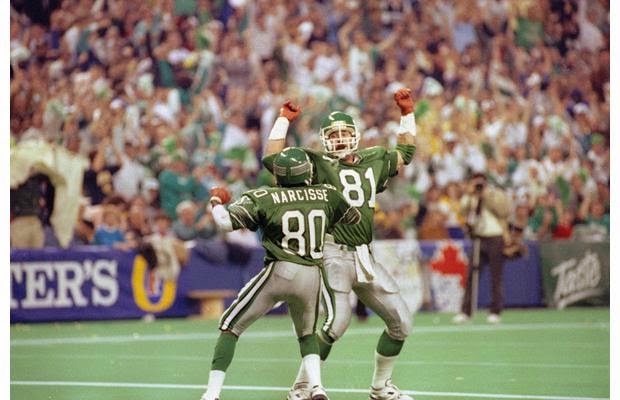
Donald Narcisser (#80) and Ray Elgaard (#81)
celebrate Narcisses's touchdown.
 
The teams would combine for 83 points and one of the most thrilling finales ever.

Hamilton had the early advantage moving into position for two Paul Osbaldiston field goals. All the Riders could muster was a punt single from Terry Baker, while the Tiger-Cats ended the quarter with a touchdown pass from quarterback Mike Kerrigan to Tony Champion, to lead 13-1 after one quarter. That connection between Kerrigan and Champion would be a harbinger of things to come.

Saskatchewan’s offence woke up in the second quarter, as quarterback Kent Austin connected with the dependable Ray Elgaard for the Riders’ first touchdown of the game, closing the gap to 13-8. Hamilton responded as Kerrigan hit running back Derek McAdoo for a touchdown and a 20-8 lead.

Jeff Fairholm (#18) celebrates his touchdown, which
remains one of the greatest catches I have ever seen.
Then came, for me, the turning point and one of the best plays I have ever seen. At least it’s my favourite play of all time. Austin went deep down the left side to receiver Jeff Fairholm. Hamilton defender Lance Shields was all over him. There were flags all over the field. Yet, with Shields pulling back on Fairholm, he caught the ball and took it in for a touchdown. Penalty declined, score 20-15. To me, that symbolized the resiliency and determination of the Riders during that playoff run.

Hamilton again responded as McAdoo plunged in for another major to restore their 12-point lead to 27-15. Before the half ended, Austin put together another drive culminating in a pass to receiver Donald Narcisse at the front of the end zone to cut Hamilton’s lead to 27-22 at halftime.

It was obvious halftime adjustments favoured the defences. The teams traded field goals before Rider Mark Urness forced Osbaldiston to concede a safety in the end zone to make the score 30-27 Hamilton. The Riders closed out the quarter by taking the lead, 34-30, on a one-yard run by Tim McCray, after a pass interference call in the end zone.

That set up a wild, and unexpected fourth quarter.

Again the teams traded field goals to make the score 37-33 when Saskatchewan kicker Dave Ridgeway added another three points to make the score 40-33 with just minutes remaining.

Kerrigan responded again, driving the Tiger-Cats, deep into Rider territory. This is about when I came in to watch. He spotted Champion in the end zone but seemed to overthrow him. Champion jumped high and hauled the ball in, which was over his head and behind him. He landed hard on his side but held on to tie the game at 40-40. It was later revealed he was playing with broken ribs. It was absolutely incredible.

Overtime loomed now.

Austin took the ball and again moved his team down the field. I cannot understand how Hamilton let him do that. Suddenly, with just seconds to go, Ridgway was trotting onto the field to try a field goal to win the game. The man known as “robo-kicker” was automatic from inside 40 yards, and made no mistake. His kick split the uprights with just a few seconds left to give the Riders the inexplicable 43-40 lead.
The Saskatchewan Riders celebrate winning the 1989 Grey Cup.

Saskatchewan still had to kick off though, and announcers Don Wittman and Ron Lancaster cautioned that if anyone had a kick return trick up his sleeve, it was wily Hamilton coach Al Bruno. He was out of magic though, and the game ended.

In a game for the ages, the under dog Saskatchewan Roughriders had won their second Grey Cup in franchise history.

Parting thoughts
You have to understand the mindset of the time to appreciate this game. The Edmonton Eskimos were absolutely dominant, and easily could have gone 18-0. Still, they were the first team to win 16 regular season games. Observers did note one of those losses was to Saskatchewan, so maybe the Riders had found a chink in their armour. After the Riders beat the Eskimos in the Western Final, it would have been easy to predict they would have nothing left for the Grey Cup. But they did.

The other dominant thought was that, since the retirement of legendary quarterback turned broadcaster Ron Lancaster, the Riders had been lovable losers for more than a decade. My ex-girlfriend, a Regina native, demonstrated it best when we watched a replay of the 1989 Grey Cup at her place in 1997.

It was the third quarter and I looked over to see her in the fetal position.

“I’m tense,” she lamented. “If anyone can blow it in the replay, it’s the Riders.”

Everyone in the country celebrated with the Riders in 1989. They were literally the Bad News Bears of Canadian football.

All of this, and the sheer entertainment value of the game, makes it the best Grey Cup ever. It really does.

Wednesday, 12 March 2014

Do you remember Carling Bassett?


Carling Bassett gets ready to serve.

Back in January I watched Canadian tennis player Genie Bouchard wage a heroic battle with China’s Li Na in the semi-final of the Australian Open. It was the first time in 30 years, and only the second time in history, a Canadian women’s tennis player had advanced as far as the semi-final in a Grand Slam tennis tournament.

Few people could name the last Canadian, but I remember her well. It was Carling Bassett, and she brought a unique story of her own to the court.

An American game, a well-known family name
Back in the 1980s all the best women’s players were Americans, such as Christ Evert-Lloyd, Tracy Austin, and Pam Shriver, or moved to the United States and became American like, perhaps the greatest of them all, Martina Navratilova.

Into this breach stepped a young, unknown Canadian. Many knew her last name, “Bassett”, because her grandfather had been a broadcasting titan, founding Baton Broadcasting which made up a good chunk of the Canadian Television (CTV) network, and her father who dabbled in professional sports ownership. He tried to bring a World Football League team to Toronto, and call it the Northmen, but he faced enough opposition that he instead located the team in Memphis and called it the Southmen. That enterprise failed, but Bassett was back in 1983 with the Tampa Bay Bandits, a team in the upstart United States Football League (USFL). Needless to say, the Bassett family cast a long shadow for the young Carling.

Carling Bassett returns a serve back in the 1980s.
Success on the court
Bassett turned pro when she was 15, and rose through the ranks through the decade. In 1981, she won the Canadian indoor title, and was ranked the number two junior player in the world. By the age of 16, she was Canada’s top tennis player.

In 1983, Bassett made the quarter-finals of the Australian Open. She reached her greatest heights of success in 1984, when she reached the quarter-finals of the French Open, then hit the height of her career, advancing all the way to the semi-finals of the U.S. Open. She would reach the quarter-finals of the French Open in 1986, and that would be the last noise she made in the Grand Slam. She climbed as high as number eight in the world rankings.

She was named the World Tennis Association’s Newcomer of the Year in 1983, exactly 30 years before Bouchard won the same honour in 2013, and Canada’s Female Athlete of the Year in 1983 and 1985. She retired in 1990.

In 1998, she was inducted into the Canadian Tennis Hall of Fame.

Teen sensation
It’s funny how much play Bouchard got when she answered “Justin Bieber” to the question, which celebrity would she most like to date?

Yet, in her day, Carling Bassett was on the verge of becoming a teen sensation of her own. That was fuelled in part by the fact her dad was a movie producer, and her grandfather owned CTV. Still, she was a cute blonde with personality and charisma. She modelled for the Ford Modelling Agency, starred in her dad’s 1982 movie “Spring Fever”, and in 1984 appeared in an episode of “The Littlest Hobo”.

That would be like Bouchard appearing in an episode of “Saving Hope”, “Heartland”, or “Arctic Air”. I just can’t see it.

Parting thoughts
It was ironic that Christ Evert was in the broadcast booth calling the Bouchard-Li match, because she was the one who beat Carling Bassett in the semi-final of the 1984 U.S. Open.

But it is likely no one would make that connection because here in Canada we so quickly forget. Carling Bassett may have been the greatest female singles’ tennis player this country produced, but no one knows it. But more than that, she was a celebrity. I have read her described as the Anna Kournikova of her day.

We have to do a better job of celebrating – and remembering – our success.

Kevin Dineen: Unfinished Olympic business


Kevin Dineen, centre, when he was named head coach
of the Canadian Olympic women's hockey team.

When Kevin Dineen was announced as the head coach for the Canadian Women’s Olympic hockey team,
he said he had some unfinished business at the Olympics. Well a few weeks ago in Sochi, Russia, Dineen completed his Olympic journey as the Canadian women mounted a stirring comeback to win the gold medal in overtime.

A long time ago, in an arena far, far away (even before the Saddledome was built)
It took me back 30 years, to the 1984 Winter Olympics in Sarajevo, Yugoslavia. There was no women’s hockey, and the men’s game was vastly different. Professionals were barred from playing, effectively keeping out Canada’s biggest and brightest players. Meanwhile, the Soviet Union dominated, skirting around this rule by saying their players were not paid to play, even though they played together virtually year-round and hockey was their full-time job.

Canada had reacted in various ways to this situation. At one point, we even refused to send teams, ending that boycott in 1980 at the Winter Olympics in Lake Placid, New York, best known for the American hockey team’s “Miracle on Ice” gold medal victory.

The 1984 Canadian Olympic hockey team.
Things changed for Canadian Olympic hockey with the arrival of coach Dave King. He had been successful at the junior and university level, and guided Canada to its first-ever World Junior hockey gold medal in 1982. After he joined the Olympic program, a renaissance dawned.

Back then, the team was based in Calgary and played virtually year round. However, the players had to maintain their amateur status, which meant they could not get paid, so a lot came and went, as the pros came calling – especially when they were making playoff runs.

The 1984 team saw a shift begin, as a number of high draft choices joined Team Canada, and a few NHL teams let their prospects play for their country. That meant expectations were higher when the boys travelled to Sarajevo then they had been in a long time.

Hockey in the former Yugoslavia
Kevin Dineen in 1984 playing for Team Canada.
Team Canada had some firepower entering the 1984 Olympic tournament. Their top line was made up of Pat Flatley, Kirk Muller, and Carey Wilson, while their defence was anchored by Jim Patrick (who played for King on that 1982 World Junior championship team), Doug Lidster, Bruce Driver, and Jean Jacques Daigneault. Their top goaltender was, and still is, one of my all-time favourite players: Mario Gosselin, and he stood on his head for Canada.

Kevin Dineen was also part of that renewal. He played two seasons with the University of Denver Pioneers, where he had been captain as a sophomore, before joining Team Canada in 1983. Back then, the Olympic team drew many of their players from college hockey.

The 1984 tournament was a marathon. Canada played in Group “B”, opening with a 4-1 win against the Americans, followed by an 8-1 beating of Austria, a 4-2 win over Finland, and an 8-1 win over Norway. The only team standing in the way of finishing first in the pool was the vaunted team from Czechoslovakia, considered the second best team in the world after the Soviet Union. The Czechs proved it, dominating from the opening face-off, and skating to a 4-0 win.

The top two teams from each pool advanced to the medal round, where they played the top two teams from the other pool. The results from the round robin also carried over. That meant Canada already started 0-1, with that loss to the Czechs.

A bronze controversy
Team Canada opened the medal round against the Soviets, who won 4-0. They could still win a bronze medal with a win over Sweden.

I was in Grade 9, and anxiously awaited the results. I kept asking my teacher, because they had the game on in the staff room. He broke the bad news to me – Canada had lost 2-0. We finished fourth and out of the medals.

When I got home, I discovered the game was marred by a controversial incident involving Flatley and the referee. The first thing I heard was Flatley had been ejected in the second period, the only player kicked out in the entire tournament. He claimed the referee took a dive. When I saw the highlights, I had to agree with Flatley. It seemed he brushed the ref as he turned to go back to the bench.

We’ll never know what Flatley’s presence would have done in the last half of that game. However, he was Canada’s second-leading scorer and one of their emotional leaders.

It was hard not to believe Flatley’s story because international hockey, especially back then, was officiated by the Keystone Kops. The referees could not keep up with the play, and bought every dive out there. Worse, they seemed to dislike the physical style Canada played and penalized them for “penalties” that would never be called in North America.

The incident would have marred the Olympics in any event, but happening in the de facto bronze medal game just sullied the whole tournament. Hey, I still vividly remember it 30 years later.

Coach Kevin Dineen with Genevieve Lacasse, Shannon
Szabados, and Charline Labonte after they beat the
United States for the gold medal at the Sochi Olympics.
Finishing Olympic business
So this, along with the fact Dineen was held pointless in those 1984 Olympics, was the backdrop to his appointment to coach Team Canada’s women, mere months before they had to travel to Russia.

He did not make an auspicious debut. The Canadians dropped every game to their top rival, the Americans, in an Olympic tune-up. He stripped the captaincy from Hayley Wickenheiser who many consider the greatest women’s hockey player ever, and gave it to a relative unknown. He changed the culture on the team.

When the Olympics arrived, Canada mowed through everyone in the round robin, and beat the Americans to finish first. Still, everyone on Earth knew they would face Team USA in the gold medal final – which they did. The round-robin game was a classic, but that gold medal championship was even better.

The game was a close, tight-checking affair. Finally the Americans broke through and scored just over halfway through the second period, then went up 2-0 in the third. Hope was lost as time ticked down. Five minutes, four minutes…

Then with 3:26 remaining Brianne Jenner ploughed through the American defence and made it 2-1. Canada pulled their goalie for an extra attacker. The Canadians tried to keep the puck in the American zone, but the linesman got in the way, and the US shot it down the office.

Commentator Cassie Campbell called it a travesty if the puck went into the empty net. It hit the post.

Canada would gain control and Dineen called time. He knew exactly what he wanted – three centres on the ice. It worked as Marie-Philip Poulin scored with 55 seconds left.  Canada had improbably erased a two-goal deficit to send the game into overtime.

They had gotten inside the heads of the Americans. Early in overtime, both teams had their chances, but again it was Poulin who won Canada gold for the fourth straight Olympics, with a goal 11:50 into overtime.

The women all poured on the ice, while Coach Dineen stood behind the bench. It was their moment to celebrate, not his.

When the camera focused on him, all I could think of was how he had waited 30 years for his gold medal.

Some day I would like to ask him if the wait was worth it. I would like to think it was.

Thursday, 6 March 2014

Brian Kerwin: "Misadventures" of an actor


The main cast of "The Misadventures of Sheriff Lobo".
From  left are  Mills Watson, Claude Akins, and Brian Kerwin.
It is rare when the bad guy in one show can become the good guy in another. Usually bad is bad and good is good, and never the two shall meet. Except, way back at the end of the 1970s and the start of the new decade with a show called “B.J. and the Bear”, and an unlikely spinoff that co-starred a familiar face.

I watched the sheriff
“B.J. and the Bear” featured a truck driver, B.J. McKay, and his best friend Bear, who was a monkey named after legendary football coach “Bear” Bryant. They would travel the countryside finding adventures.

One of the spots B.J. visits is Orly County, patrolled by the conniving, weaselly Sheriff Lobo, played by Claude Akins. He had two deputies: Perkins, played by Mills Watson, who was inept and bumbling, and  Birdie Hawkins, played by Brian Kerwin, who was honest, naïve, and referred to Lobo as his hero.

Sheriff Lobo proved popular enough he made more appearances on “B.J. and the Bear” then he was spun off to his own show: “The Misadventures of Sheriff Lobo”.

Now, Lobo was the protagonist with his two deputies.

After the first season, the show was restructured, likely to prop up ratings. It was re-named “Lobo” and the boys all moved to Atlanta, where they sailed on into that good night.

Sheriff Lobo did make a return to “B.J. and the Bear” but that would be it for our bad guy turned good.

Brian Kerwin as Birdie Hawkins.
Brian Kerwin in his guest
starring role on "Blue Bloods".
Misadventures of an actor
Birdie Hawkins was actor Brian Kerwin’s first recurring role, but he would find success as an actor to this day. In the 1980s he guest-starred in TV shows such as “The Love Boat”, “Simon and Simon”, “Highway to Heaven”, ”Murder, She Wrote”, and “St. Elsewhere”; theatrical movies such as “Murphy’s Romance”; and various TV movies and the mini-series “The Blue and the Gray”.

He continued that success on into the 21st Century with movies such as “The Help” and “27 Dresses”; and a lot of guest roles on TV including: “Law and Order”, “The West Wing”, “Grey’s Anatomy”, “Nip/Tuck”, “Desperate Housewives:, “Without a Trace”, “Big Love”, and much more. I recently saw Kerwin on an episode of “Blue Bloods” on DVD, which inspired this entry.

Parting thoughts
Brian Kerwin is another one of those durable actors we all know when we see him, because he seemed to be in everything, back in the 1980s and now.

But he really got his start worshipping a corrupt sheriff who, despite himself and his best efforts to do the wrong thing, always seemed to get the bad guy, and doing the right thing in the end.


Wednesday, 5 March 2014

2010: The year we make contact turns sad

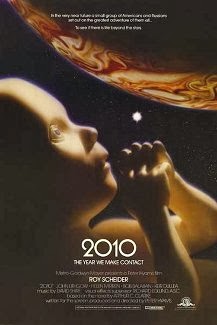
Movie poster for "2010: The Year We Make Contact".

It was a day I will always remember: December 23, 1984. The previous few months had been hard. My grandmother on my mom’s side had initially been hospitalized for stomach pain. Emergency surgery was done, and they kept her in the hospital. Eventually cancer was found, and the slow decline began.

I was in Grade 10, getting used to a new school, new classmates, trying out for the high school basketball team, and the teen angst all that brings. Every week or two, I would go see my grandmother in the hospital. It seemed almost to become part of the routine of high school.

However, by the time December came, we could see an end in sight  – a sad one. We went to see my grandmother on Dec. 23. I was done school, on Christmas break. After our visit, my sister and I decided to go see a movie. We hadn’t been for a while and, looking back, it was probably a good distraction from what was happening.

Lethbridge is so small, it doesn’t take long to get anywhere in the city. We headed over to the Paramount Theatre downtown, and there were three movies I wanted to see: “Beverly Hills Cop”, “Dune”, and “2010: The Year We Make Contact”.

The first choice was “Beverly Hills Cop”, but it was Rated “R” and I was just 14. So, “Dune” would be good too. My buddy Shawn had read the book by Frank Herbert and raved about it. That was rated “R” too.

That left pretty much our only choice: “2010: The Year We Make Contact”. There didn’t seem to be any ratings issues, so we went in.

A strange sequel
I have to admit, I loved going to the movies – no matter what was playing. I also loved science fiction, so “2010” was just perfect. Besides, it had Roy Scheider, who was one of my favourite actors.

The problem was, “2010” was a sequel to “2001: A Space Odyssey” and I never really understood it. The first time I saw “2001”, I was really young and just assumed that’s why I didn’t really get it. But then we watched it in Grade 9 science, probably a year before we went to see “2010”, and I still really didn’t understand it.

Apparently that was not uncommon, because in the first part of “2010” they talked a lot about not really understanding what happened with HAL, the super computer, and the astronauts. And what was with that “Star child”?

The movie was kind of a reflection and commentary of the Cold War period in which it was made. In the movie, diplomatic tensions increased between the United States and the Soviet Union. Ultimately, the two agree to a joint mission to discover what actually happened out there, led by Heywood Floyd (Roy Scheider). In the end, after all sorts of turmoil and drama, essentially a new world is created and everyone seeks peace on Earth.

It would be interesting to see it now, some 30 years later. Maybe all the symbolism and nuance would make sense to me.

Roy Scheider played astronaut Heywood Floyd
in the movie "2010: The Year We Make Contact".
A sad conclusion
After the movie ended, I hooked up with my dad and we went back to the farm. My mom stayed at the hospital to say goodbye to her mother. My dad and I had a real heart to heart in the kitchen before we went to bed.

A few hours later, I heard the phone ring. My dad never answered the phone, and I really did not want to get out of bed to do so myself. I knew what awaited us on the other end.

Just a few minutes earlier my grandmother had died. It was my mom phoning – and I knew it.

The next morning, I awoke, and my mom phoned. She recounted her mother’s last few minutes. It all seemed surreal. Shortly after, my brother and his wife showed up to visit our grandmother. Too young and dumb to be diplomatic, I just told him straight up our grandmother died. I have since learned diplomacy.

The time of death was past midnight – so my grandmother died on Christmas Eve. We buried her four days later – on my cousin’s birthday.

Parting thoughts
It seems strange that a movie set so far in the future when it was made, is now four years beyond “the year we make contact”.

I have not seen “2010: The Year We Make Contact” since that day in the theatre. I have not avoided it, but it never seems to be on. That’s probably for the better.

A movie that ends with so much hope, will always be tinged with sadness for me.

Monday, 3 March 2014

Deciphering "The Satanic Verses"


Cover art for the "Satanic Verses"
It takes a special person to write something so offensive it motivates the leader of a country to issue a death sentence. Back in 1988, Salman Rushdie did just that, penning the “Satanic Verses”, which incited so much anger in the Islamic world that in 1989, Ayatollah Khomeini, the head of Iran, issued a fatwa. That meant it was open season on the writer.

Now, freedom of expression is something I believe in deeply. It is part of the fibre of my life, and the under pinning of my profession. It sickens me that, essentially, he suffered fear and death threats for a novel he wrote.

I never read the “Satanic Verses”, but it came out in my second year of university, while I was taking my one and only English class. Our professor started one class by advising us there was a public reading of the “Satanic Verses” that afternoon. Me and my friend Chris Vining, who were also in English together, made the trip down there to a classroom. I thought as we approached, given the publicity of the “Satanic Verses”, the reading would be in a lecture hall or theatre. As it turned out, the classroom was packed and we had to sit on the floor.

The author and his book. Salman Rushdie holds up a copy
of his controversial book "The Satanic Verses", published in 1988.
What followed is very difficult to recount. I understood the words being read out, and the metaphors being drawn, yet it seemed nonsensical. Phrases melted into successive phrases that meandered all over without seeming to make a point. The next time I had this same impression of a book was when I read “Tropic of Cancer” by Henry Miller (only he used the “c” word – a lot).

I left that room with a couple impressions. One was that I was not sure what I just heard. The other was that our good friend in Tehran really had nothing to worry about. If the “Satanic Verses” was blasphemy, a lot of readers would never even know it. Would the Ayatollah even have a clue?